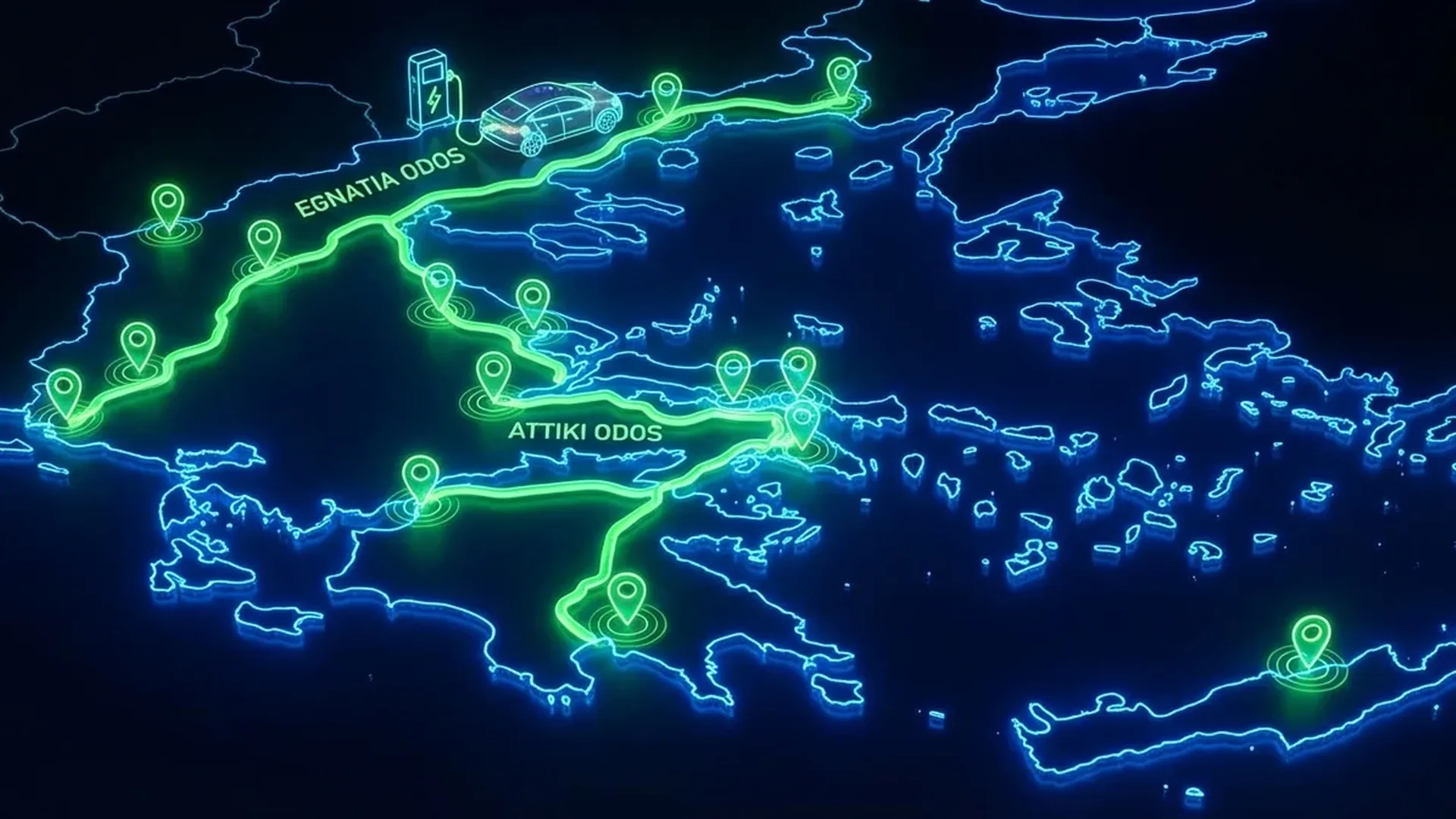
Highway charging used to be the biggest fear of every prospective EV buyer. Today, with over 1,700 public charging stations in Greece and fast-charging networks across all major highways, the situation has changed dramatically. This guide covers every highway, every provider, and every practical tip you need for a stress-free road trip.
The Current State: 2026
According to EAFO and Wikipedia data, Greece had approximately 1,700 public charging stations by mid-2022, a number that continues to grow. However, the ratio remained at 1 station per 250 kilometres of road network — significantly lower than leading countries like the Netherlands (1.18/km²). The government, however, has set ambitious targets: mandatory charging stations in every municipality, and massive expansion along highways.
The Major Highways
Attiki Odos (65 km)
Greece's busiest highway. Charging stations are located at Motorist Service Areas (MSAs) along the route, with DC fast chargers rated at 50–150 kW. Attiki Odos connects Elefsina to the Airport and is fully covered.
Tip: Airport charging is ideal if you're leaving your car in the parking lot — slow charge while you travel.
Athens – Thessaloniki National Road (500 km)
The backbone of the Greek road network. In recent years, DC fast chargers rated at 50–150 kW have been installed at MSAs every ~60–80 km: Thebes, Lamia, Larissa, Katerini. Providers like Protergia (elpefuture), PPC Blue, and Blink cover the route. A typical EV with 400 km range needs 1 stop of ~25–30 minutes.
Trip planner: Start Athens at 100% → Stop at Lamia (50% → 80%, 20 min) → Arrive Thessaloniki with ~30% battery.
Egnatia Odos (670 km)
Ioannina – Thessaloniki – Alexandroupoli. Greece's longest highway. Coverage here has traditionally been more sparse, particularly on the Thessaloniki–Alexandroupoli section. New stations are gradually being installed at MSAs, with priority given to gaps in Thrace. Full coverage every 80 km is expected by the end of 2026.
Warning: On the Xanthi–Alexandroupoli section, keep a reserve — gaps may exceed 100 km.
Olympia Odos (201 km)
Athens (Elefsina) – Patras via Corinth. With MSAs at Corinth, Aigio, and intermediate points, coverage is satisfactory. The 201 km of Olympia Odos can be covered with one stop or none by most modern EVs.
Tip: If heading to the Peloponnese, charge in Patras before entering the local road network — coverage off the highway is notably sparser.
Kentriki Odos & Moreas Motorway
Kentriki Odos (E65): Lamia – Trikala – Egnatia. A newer highway with DC stations at MSAs. Moreas: Corinth – Tripoli – Kalamata. Stations in Tripoli and intermediate points, but southern Peloponnese remains quite sparse.
Charging Providers
| Provider | Type | DC kW | DC Price | App/RFID |
|---|---|---|---|---|
| Protergia (elpefuture) | AC + DC | 50–150 kW | ~€0.45–0.55/kWh | App + RFID |
| PPC Blue | AC + DC | 50–180 kW | ~€0.40–0.50/kWh | App + RFID |
| Blink Charging | AC + DC | 50–120 kW | ~€0.50–0.60/kWh | App + Credit Card |
| Shell Recharge | DC | 150–350 kW | ~€0.55–0.65/kWh | App + Credit Card |
| Tesla Supercharger | DC | 150–250 kW | ~€0.40–0.50/kWh | Tesla App |
| NRG | AC + DC | 50–100 kW | ~€0.48–0.55/kWh | App + RFID |
Important note: DC fast charging prices are significantly higher than home charging (~€0.12–0.18/kWh). On a 500 km road trip, DC charging will cost ~€25–35. For comparison, petrol for the same trip: ~€55–70. It's still 40–50% cheaper.
Practical Guide: Athens → Thessaloniki
Start with 100% battery. Range ~400–450 km for a modern EV. You won't need an intermediate stop if Thessaloniki is your only destination.
DC charging at 50–150 kW. From ~45% → 80% in 20–25 minutes. Coffee + restroom + stretch — perfect timing.
If your EV has 400+ km range, you can skip Lamia and charge at Larissa. Risk: you'll arrive with ~15–20%.
Arrive with 30–50%. Charge at your hotel (if they have an AC wallbox) or at a public DC charger in the city centre.
Essential Apps
Real-time charger status, filter by kW, CCS/CHAdeMO. 1,691 stations listed in Greece.
The most accurate trip planner. Input your model, temperature, and speed — it tells you exactly where to stop.
Large community, user reviews, station photos. Ideal for unfamiliar areas.
Download apps for PPC Blue, elpefuture, Blink. You need an account before the trip — don't wait until you reach the charger.
Connector Types in Greece
| Type | AC/DC | Power | Vehicles |
|---|---|---|---|
| Type 2 (Mennekes) | AC | 7–22 kW | All European EVs |
| CCS Combo 2 | DC | 50–350 kW | European standard (VW, BMW, Hyundai, etc.) |
| CHAdeMO | DC | 50 kW | Nissan Leaf, older Mitsubishi models |
| Tesla (NACS→CCS) | DC | 150–250 kW | Tesla + others (via adapter, open network) |
10 Practical Road Trip Tips
Plan with ABRP. Enter your route, temperature, and speed. It'll tell you where, how long, and what percentage.
Download apps before you leave. PPC Blue, elpefuture, Blink — registration + payment ready.
Charge 20→80%. Above 80% the speed drops dramatically. Don't waste time aiming for 100%.
Keep a 20% buffer. Don't plan to arrive at 5%. Traffic, elevation changes, and climate control drain the battery.
AC ≠ Highway. On AC 22 kW you'd need hours. For road trips, use only DC fast charging.
Greek summer = −10% range. At 40°C, the A/C consumes a lot. Plan accordingly.
Precondition the battery. Many EVs (Tesla, BMW, Hyundai) pre-heat the battery if you set a charger destination in the GPS.
Have a Plan B. If a charger is broken, you need to know the next one. Check 2 stations in advance.
120 km/h → 130 km/h = −15% range. Aerodynamic drag increases exponentially. 10 km/h can mean an extra stop.
Charge at your hotel. If your destination has an AC wallbox, you'll leave every morning at 100%.
Trip Cost: EV vs Petrol
| Trip | EV (DC) | Petrol | Savings |
|---|---|---|---|
| Athens → Thessaloniki (500 km) | ~€28 | ~€58 | 52% |
| Athens → Patras (215 km) | ~€12 | ~€25 | 52% |
| Thessaloniki → Alexandroupoli (340 km) | ~€19 | ~€39 | 51% |
| Athens → Kalamata (260 km) | ~€15 | ~€30 | 50% |
* Calculations: EV ~17 kWh/100km, DC ~€0.50/kWh | Petrol ~7 L/100km, ~€1.65/L. Home charging (~€0.15/kWh) would reduce EV costs by ~70%.
What's Coming: 2026–2030
Greece is in a phase of explosive growth in charging infrastructure. The government has set a target of 1 in 3 new cars being electric by 2030, which means massive expansion of charging networks:
✅ AFIR (EU Regulation): DC ≥150 kW every 60 km on every TEN-T highway by end of 2025.
✅ Ultra-fast 350 kW: Shell Recharge, Ionity, and new providers are bringing 350 kW stations to Greece.
✅ Municipal mandate: Since 2021, every municipality is required to install charging stations.
✅ Greek islands: The “Green Islands” programme offers an additional €4,000/vehicle subsidy and charging networks on every island.
Conclusion: Charging on a Greek highway is no longer an adventure. With proper planning, the right apps, and a 20–30 minute stop, you can drive Athens to Thessaloniki at half the cost of petrol with zero emissions. And year after year, the infrastructure only gets better.