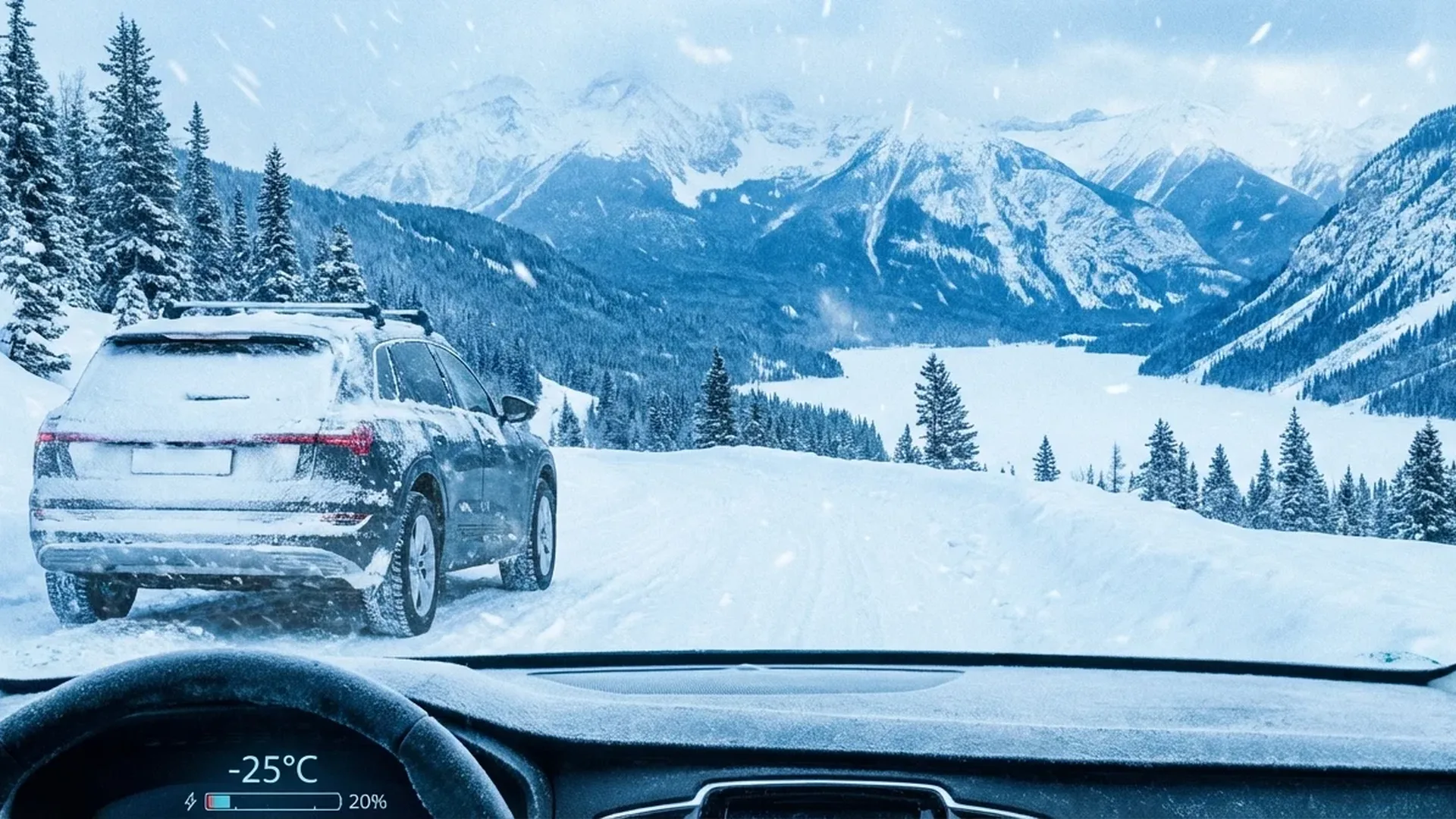
Cold weather is the biggest enemy of EV range. According to data from Recurrent Auto (30,000+ EVs, winter 2025/26), the 34 most popular models average 78% of their range at 32°F (0°C) and just 70% at 20°F (-7°C). However, this doesn't mean you should fear winter — just that you need to plan for it.
Why EVs Lose Range in the Cold
Range loss isn't a defect — it's physics. Two main reasons:
Battery Chemistry
Chemical reactions in lithium cells slow down at low temperatures. This increases internal resistance, reducing available power and energy. The same battery delivers fewer kWh in the cold.
Cabin Heating
A gas car produces massive waste heat — perfect for heating. An EV, far more efficient, must create heat using energy from the battery. This is the dominant reason for range loss.
The good news
Cold weather range loss is 100% temporary. It doesn't permanently damage the battery. When temperatures rise, range fully returns to normal levels.
Which Models Handle Cold Best
According to Recurrent data (30,000+ vehicles, real-world driving data):
| Rank | Model | Range at 32°F | Range at 20°F |
|---|---|---|---|
| 1 | Tesla Cybertruck | 88% | ~80% |
| 2 | Tesla Model X (heat pump) | ~86% | ~78% |
| 3 | Tesla Model S (heat pump) | ~85% | ~77% |
| 4-5 | Rivian R1S / Tesla Model Y | ~83% | ~75% |
| 8-9 | Kia Niro / Hyundai Ioniq 6 | ~80% | ~72% |
| 28-30 | VW ID.4 / Chevy Bolt EV | ~71% | ~62% |
| 32 | Chevrolet Blazer EV | 69% | ~60% |
Source: Recurrent Auto, winter 2025/26, data from 30,000+ vehicles
Heat Pump: The “Secret Ally”
The heat pump is the most important technology for winter range. It works like a reverse air conditioner: extracting heat from the outside air (even in cold weather) and transferring it to the cabin.
With Heat Pump
- +10% range at 32°F
- 3-4 units of heat / 1 unit of electricity
- Massive savings on regular commutes
Without (Resistive Heater)
- 1 unit of heat / 1 unit of electricity
- High consumption directly from battery
- Worse performance below 14°F (-10°C)
Tesla Octovalve (from 2021): Tesla dominates winter rankings thanks to the Octovalve system — a multi-channel controller that routes coolant between the cabin, battery, and drivetrain. It recycles waste heat from the electronics instead of losing it to the environment.
10 Practical Tips for Maximum Cold Weather Range
Precondition While Plugged In
Start heating your car while it's still connected to the charger. Energy will come from the wall, not the battery. Use the app or departure time scheduler.
Heated Seats & Steering Wheel Over Cabin Heat
Heated seats consume ~75W, while cabin heating uses ~3,000-5,000W. Lower the cabin temperature by 3-5°F and turn seats/steering wheel up to max.
Keep It Plugged In
The battery will draw power from the wall for thermal management instead of depleting its own charge. Set maximum charge to 70-80%.
Winter Tires: Non-Negotiable
Winter tires (or all-season M+S) don't just improve grip — they reduce rolling resistance in cold as they remain pliable at low temperatures.
Use Navigation for Charging Stops
In many newer EVs, navigating to a charging station causes the car to precondition the battery automatically, significantly reducing charge times.
Reduce Highway Speed
Aerodynamic drag increases exponentially. 75 mph instead of 65 mph can cost 20%+ range, even more pronounced in cold weather.
Watch the Regenerative Braking
On icy roads, reduce regen braking. Sudden deceleration can cause skidding. Also, a cold battery automatically limits regen since it can't charge as fast.
Park in a Garage
An enclosed garage can keep temperatures 10-18°F higher than outside, significantly reducing range loss and preconditioning time.
Plan Routes with Extra Buffer
On winter road trips, plan charging stops with a 30% buffer instead of the 10% you'd plan in summer. Account for 20-30% reduced range.
Be Patient at Chargers
Cold batteries charge slower — especially the first few minutes at a DC fast charger. Speed increases once it warms up. Don't worry if it starts at 30 kW instead of 150.
5 Cold Weather EV Myths Debunked
MYTH
"Cold weather damages the battery"
Truth: Range loss in cold is temporary. There's no permanent damage to the battery.
MYTH
"You can't drive an EV in snow"
Truth: Norway (93% EV sales) drives in snow 6 months a year. Electric drivetrains provide smoother, more controllable power on ice.
MYTH
"Charging doesn't work in the cold"
Truth: Charging works normally, but may be slower until the battery warms up. Navigation preconditioning nearly eliminates this issue.
MYTH
"You lose 50% range in the cold"
Truth: The average is 78% at 32°F (22% loss). Only the worst models at the coldest temps hit ~60%. The best retain 88%.
MYTH
"Gas cars don't have cold weather problems"
Truth: Gas cars also lose efficiency in cold (10-15% per DOE), have starting problems, and need engine warm-up time.
Conclusion
EVs work perfectly fine in cold weather — they just need a bit more planning. Norway proves it every day. With preconditioning, a heat pump, heated seats, and some patience at chargers, you can enjoy even ski trips without range anxiety. The key: charge in a garage, precondition before departure, and don't rely on the rated range number.