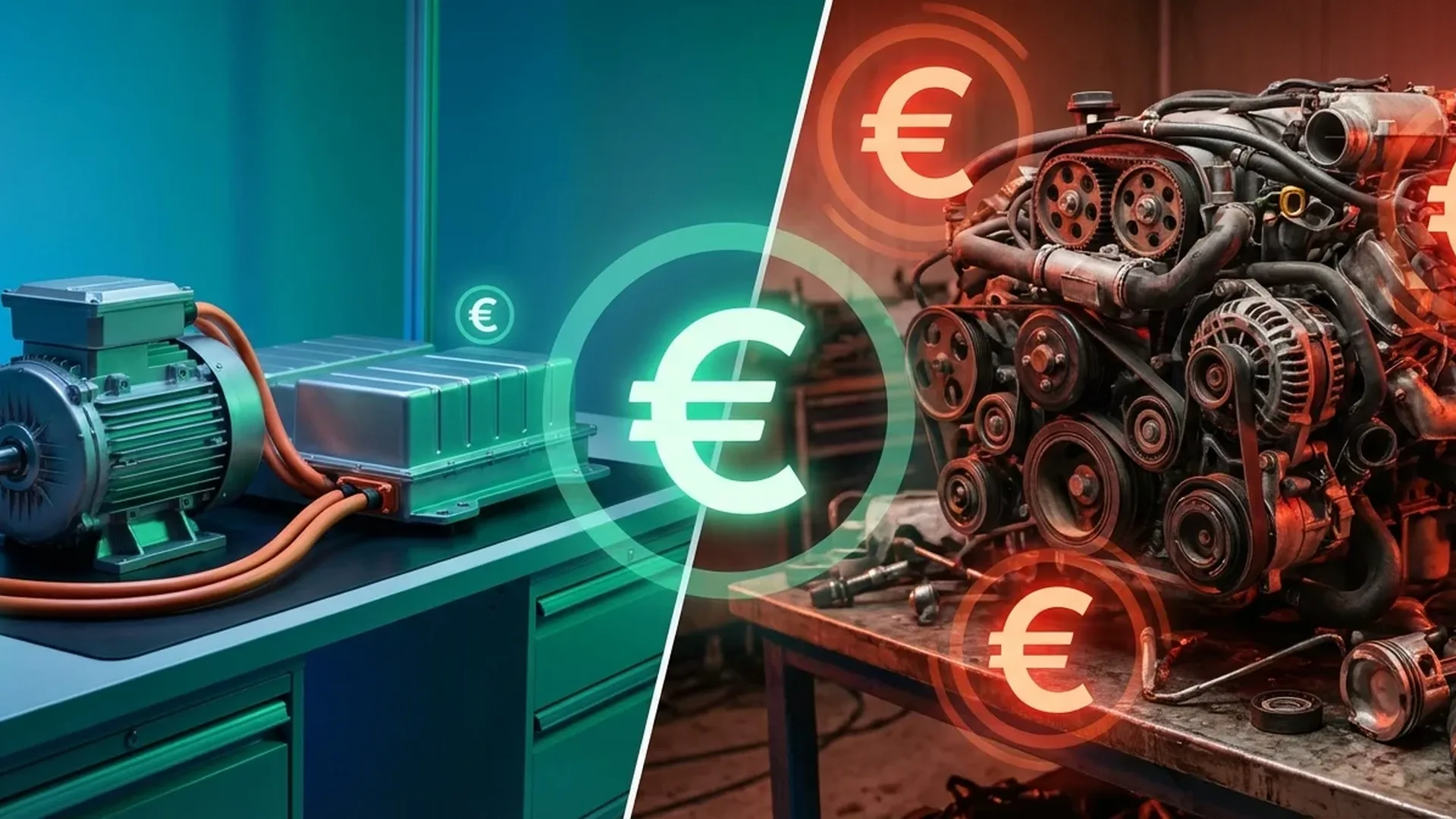
One of the strongest arguments for electric vehicles isn't the range or acceleration — it's something far more practical: how little you spend on maintenance. Remember oil filters, spark plugs, timing belts, and annual services? In an EV, most of those simply don't exist.
In this article, we break down the full maintenance cost comparison between electric and gasoline cars in the US, with real 2026 numbers. What you pay, what you save, and where you need to watch out.
Why EVs Need Less Maintenance
The reason is straightforward: fewer moving parts. An internal combustion engine (ICE) contains approximately 2,000 moving components. An electric motor? About 20. This dramatic reduction in mechanical complexity translates to fewer breakdowns, fewer consumables, and fewer trips to the shop.
According to a 2024 Consumer Reports analysis of 29 automotive brands, Tesla — the only pure EV brand studied — was found to be the least expensive to maintain over a 10-year period. Overall, EV owners save approximately 50% on maintenance and repair costs compared to gasoline vehicles.
What an EV Doesn't Need
Let's look at the maintenance items that simply don't exist in an electric vehicle:
Oil changes and engine filters: The electric motor doesn't need lubricants. In a gasoline car, an oil change costs $80–150 and happens every 5,000–10,000 miles — roughly once a year. Over 10 years: $800–1,500 you never pay. No oil filter, no fuel filter, no engine air filter.
Spark plugs and ignition coils: Spark plugs ($5–10 each) are replaced every 30,000–60,000 miles in gasoline cars. With ignition coils and labor, the cost reaches $100–300 per replacement. In EVs? They don't exist.
Exhaust system: Catalytic converters, exhaust pipes, resonators, mufflers — all of these corrode and need replacement. Catalytic converter replacement alone: $300–1,200. In an EV, no exhaust system exists whatsoever.
Transmission: Most EVs use a single-speed reduction gear — no traditional multi-gear transmission. That means zero need for transmission fluid changes, no clutch (and its expensive replacements), no gear oil. A clutch replacement in a gasoline car costs $500–1,000.
Timing belt / chain: This is a critical consumable in ICE vehicles, replaced every 60,000–100,000 miles at a cost of $300–700. In EVs? Non-existent.
Engine cooling system: EVs don't have a traditional engine radiator, thermostat valve, or water pump in the conventional sense. They do have a battery thermal management system, but it requires far less maintenance.
Brakes: The Big Surprise
Here's one of the biggest surprises. Thanks to regenerative braking, EV brakes wear 2–3 times slower than those on a gasoline car.
When you lift off the accelerator in an EV, the electric motor acts as a generator, slowing the car while simultaneously charging the battery. This means the traditional disc brakes are used far less frequently. Many EV owners report brake pads lasting 50,000–75,000 miles compared to the typical 20,000–35,000 miles in gasoline cars.
On an annual basis, brakes for a gasoline vehicle cost $100–200 in pads and rotors. In an EV, that drops to $30–80 per year.
What EVs and Gas Cars Share
Of course, not everything is free. Several maintenance items remain common to both:
Tires: Here EVs have a slight disadvantage. Due to their greater weight (the battery weighs 600–1,300 lbs) and instant torque, tires wear 10–20% faster. Additionally, many manufacturers recommend EV-specific tires (lower noise, lower rolling resistance) that cost $20–40 more per tire. Annual cost: $250–500 (vs $200–400 for gasoline cars).
Windshield wipers and washer fluid: Same cost, about $20–40 per year.
Cabin air filter: Replaced every 10,000–15,000 miles, costing $20–40. Common to all cars.
12V battery: EVs also have a small 12V battery for electronics. Replacement every 3–5 years, costing $80–150.
Climate system: EVs use either heat pumps or PTC electric resistance heaters. A/C maintenance remains roughly the same: $50–100 per year.
The Battery: The Big Fear
Let's address the “elephant in the room.” Battery replacement costs $5,000–$16,000 out of warranty. That sounds terrifying — but the real data tells a very different story.
According to a recent study (2024), only 2.5% of EV batteries have been replaced to date. The overwhelming majority lasts far longer than initially expected — researchers estimate 15–20 years of life in a vehicle, followed by a second life in stationary energy storage. The industry-standard warranty is 8 years or 100,000 miles, guaranteeing a minimum capacity retention of 70%.
Meanwhile, battery costs are falling rapidly. The price per kWh dropped from $660 in 2010 to $115 in 2024 (BloombergNEF). LFP (lithium iron phosphate) batteries are even cheaper, with prices below $56/kWh in China. This means that even if replacement is needed in 10+ years, it will cost far less than today.
The Big Comparison: 5-Year Maintenance Costs
Let's put the numbers side by side for a vehicle driving 12,000 miles per year (60,000 miles over 5 years):
| Maintenance Item | EV (5 years) | Gasoline (5 years) |
|---|---|---|
| Oil changes + filters | $0 | $500–750 |
| Spark plugs / ignition coils | $0 | $150–300 |
| Brakes (pads/rotors) | $150–400 | $500–1,000 |
| Tires | $1,200–2,500 | $1,000–2,000 |
| Timing belt | $0 | $300–700 |
| Service (annual inspection) | $500–750 | $1,000–1,500 |
| Exhaust / catalytic converter | $0 | $200–800 |
| Fluids (A/C, brake, etc.) | $100–200 | $200–400 |
| Clutch | $0 | $0–1,000 |
| TOTAL (5 years) | $1,950–3,850 | $3,850–8,450 |
On average, an EV costs $500–800 per year in maintenance, while an equivalent gasoline car runs $900–1,500 per year. The difference is noticeable from year one and grows over time.
Fuel + Maintenance: The Full Picture
If you add fuel costs, the picture becomes even clearer. For 12,000 miles per year:
EV (home charging at $0.14/kWh, 28 kWh/100mi):
Electricity cost: 12,000 × 0.28 × $0.14 = $470/year
Maintenance: ~$600/year
Total: ~$1,070/year
Gasoline (28 MPG, $3.50/gallon):
Fuel cost: 12,000 / 28 × $3.50 = $1,500/year
Maintenance: ~$1,100/year
Total: ~$2,600/year
Annual savings: ~$1,530. Over 5 years: nearly $7,650. That's enough to offset a significant portion of the initial price difference.
EV Maintenance Schedule
Most major brands (Tesla, Hyundai, Kia, VW, BMW, Mercedes, BYD, Rivian) recommend the following:
Every 10,000 miles or 1 year: Visual inspection, cabin air filter, tire rotation/alignment, wiper blades, brake fluid check, thermal management system check. Typical cost: $80–180.
Every 20,000 miles or 2 years: Full brake inspection, battery coolant replacement (if needed), electronic diagnostics, high-voltage battery health check. Typical cost: $150–300.
Every 40,000 miles or 4 years: Thermal management fluid replacement, thorough brake inspection, possible 12V battery replacement. Typical cost: $200–500.
Compare this to a typical gasoline car service (oil + filters + inspections) costing $180–350 every 5,000–10,000 miles.
Hidden EV Costs: What You Need to Know
It's not all rosy. There are some points to consider:
Specialized service centers: EVs require technicians certified for high-voltage systems. Depending on your location, authorized service centers may be fewer than those for gasoline cars, especially in rural areas. This can mean longer wait times or traveling to another city for service.
Collision repair costs: In an accident, repairing an EV can cost 20–30% more due to sensors, aluminum body panels, and the cost of battery pack inspection. EV insurance premiums in the US are on average 10–15% higher.
Charging losses: Up to 15–25% of energy can be lost during charging (conversion, thermal losses). This doesn't affect maintenance but impacts your real cost per mile.
Resale Value and Its Connection to Maintenance
A well-maintained EV with a healthy battery (e.g., >85% capacity) retains excellent resale value. “Battery health” (State of Health — SoH) is the EV equivalent of mileage on a gasoline car. Brands like Tesla and Hyundai allow SoH monitoring through their apps.
In contrast, a gasoline car with 100,000+ miles typically needs several expensive repairs — turbochargers, clutch, A/C compressor — that dramatically reduce its value.
Conclusion
Maintenance costs are one of the clearest advantages of electric vehicles. With 40–50% lower annual maintenance costs and 60% lower fuel costs, the total savings reach nearly $1,530 per year compared to an equivalent gasoline car.
Of course, the initial purchase price remains higher. But if you plan to keep the car for 5+ years and drive more than 10,000 miles per year, the total cost of ownership (TCO) of an EV is now undeniably lower — especially in the US, where electricity rates remain competitive with gasoline costs.