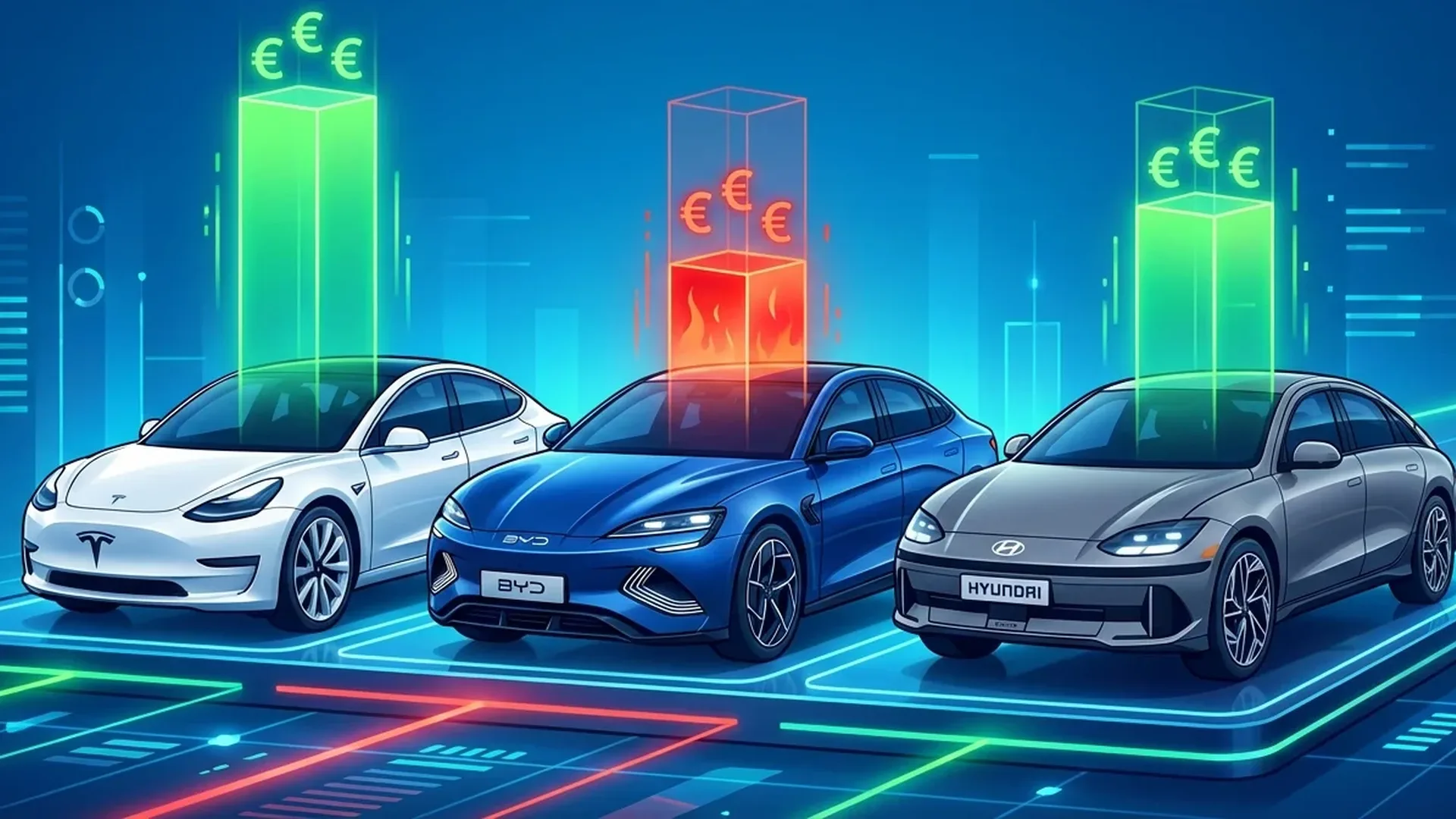
One of the most common arguments against electric vehicles is about depreciation: “EVs lose value too fast.” But does this still hold true in 2026? The latest used car market data paints a completely different picture — electric vehicles aren't just competitive, they're selling faster than conventional cars.
📖 Read more: Tesla vs BYD: Who Is Winning Globally in 2026?
Key Finding
According to an Edmunds analysis (Q3 2025), used EVs sell in just 34 days on average — a full week faster than conventional vehicles (41 days).
What the Data Says About EV Depreciation
The used car market is changing dramatically. According to Cox Automotive, a record 40,960 used EVs were sold in the US in August 2025 alone — a 59% increase compared to the same month in 2024. A similar trend is emerging across European markets.
The average transaction price for a 3-year-old used EV reached ~$29,900, roughly $1,100 less than an equivalent gas-powered vehicle — while electric models had significantly fewer miles on the clock (22,100 vs 24,500 for ICE vehicles). The price premium between used EVs and ICE vehicles shrank to just ~$900 — the lowest ever recorded.
A Car and Driver study reveals an important nuance: three-year depreciation varies enormously by model. A Hyundai Kona Electric loses about $15,300 over 3 years — roughly the same percentage (~43%) as the gas-powered version. Conversely, a Ford F-150 Lightning loses just 29% — less than the gas F-150 (34%). Depreciation is not universal; it depends on the brand, demand, and battery technology.
Which EVs Hold Their Value Best
Q3 2025 data (Edmunds) reveals which models sell fastest — a key indicator of high demand and, by extension, strong residual value. Fewer days on the lot = higher demand = better resale price.
| Model | Days on Lot | Avg. Price |
|---|---|---|
| Tesla Model S | 21.5 | ~$27,000 |
| Tesla Model 3 | 24.0 | ~$23,300 |
| Tesla Model Y | 26.3 | ~$26,000 |
| Hyundai IONIQ 5 | 29.7 | ~$28,000 |
| VW ID.4 | 30.9 | ~$25,000 |
| Kia EV6 | 32.0 | ~$29,000 |
| Ford Mustang Mach-E | 32.4 | ~$27,500 |
Source: Edmunds Q3 2025 Used Car Report.
Tesla models dominate the top spots, primarily thanks to the extensive Supercharger network, continuous software updates, and strong brand recognition. Korean brands (Hyundai, Kia) follow with excellent value propositions, while German manufacturers (VW, Audi) gain ground through build quality.
6 Factors That Determine EV Resale Value
Battery Health
The single most important factor. A battery with State of Health (SoH) above 85% after 5 years holds excellent value. Manufacturer warranties of 8 years provide buyer confidence.
Range
EVs with 250+ miles of real-world range retain value far better. Models with short range (<150 mi) depreciate faster as technology advances.
Fast Charging
Models with DC fast charging >150 kW (e.g., 800V architecture in Hyundai, Kia, Porsche) maintain demand. Slow charging = lower resale value.
Brand & Network
Brand recognition (Tesla, BMW, Mercedes) and the presence of a service network play a huge role. Chinese brands with limited market presence show more uncertainty.
Software Updates
OTA updates that add features (Tesla, Hyundai, BMW) keep the car feeling “fresh” even after 3-4 years, reducing the perception of obsolescence.
Maintenance Cost
EVs cost ~$0.08/mi in maintenance — less than $0.10/mi for gas vehicles. Fewer moving parts = fewer breakdowns = more attractive as a used purchase.
The Used EV Market Is Exploding
A few years ago, buying a used EV essentially meant choosing between a Tesla, Nissan LEAF, or Chevrolet Bolt. Today, the market is flooded with used Ford Mustang Mach-Es, Hyundai IONIQ 5s, VW ID.4s, Toyota bZ4Xs, BMW i4s, and Cadillac Lyriqs — many coming off 3-year leases.
The expiration of EV tax credits in some markets is pushing buyers toward the used market. A full 63.1% of used EVs sold fell in the $20,000-$30,000 price range (Edmunds, Q3 2025), compared to just 42.5% of conventional vehicles — showing that electric cars have hit the pricing “sweet spot.”
How to Choose an EV That Holds Its Value
If you're planning to buy an EV and want to minimize depreciation, follow these guidelines:
1. Stick with established brands — Tesla, Hyundai, BMW, Mercedes. A strong service and parts network is critical for maintaining residual value.
2. Choose 250+ mile range — Models with generous range are “future-proof” and won't feel outdated in 3-4 years.
3. Check the battery warranty — 8 years / 100,000 miles is the standard. If buying used, always request the SoH report.
4. Evaluate fast charging capability — DC fast charging ≥150 kW means the car will remain practical for years to come.
5. Calculate total cost of ownership — Lower maintenance (~20% cheaper) + cheaper “fuel” = an EV's true value isn't captured by resale price alone.
Bottom Line
The myth that “EVs lose value fast” belongs to the past. Data from 2025-2026 shows that used EVs sell faster, at comparable prices to conventional cars — but with fewer miles, lower running costs, and newer technology. Choosing the right model (strong brand, long range, solid warranty) ensures a return on investment that far exceeds traditional vehicles.