📖 Read more: Hyundai Ioniq 9: Electric 7-Seater SUV 2026
Can an Electric Vehicle Actually Tow?
Towing has always been a divisive topic among electric vehicle enthusiasts. On one hand, EVs offer instant torque — ideal for getting a heavy load moving. On the other, towing drains the battery at a rate that can alarm even the most seasoned driver. The truth, as always, lies somewhere in between — and the numbers prove it.
In 2026, the market offers electric models with towing capacities ranging from 1,650 lbs to nearly 11,000 lbs. Meanwhile, battery technology keeps improving, gradually alleviating the biggest concern: range loss. Let's take a detailed look at what an EV can and can't do when you hitch a trailer to it.
Why EVs Are (Theoretically) Great at Towing
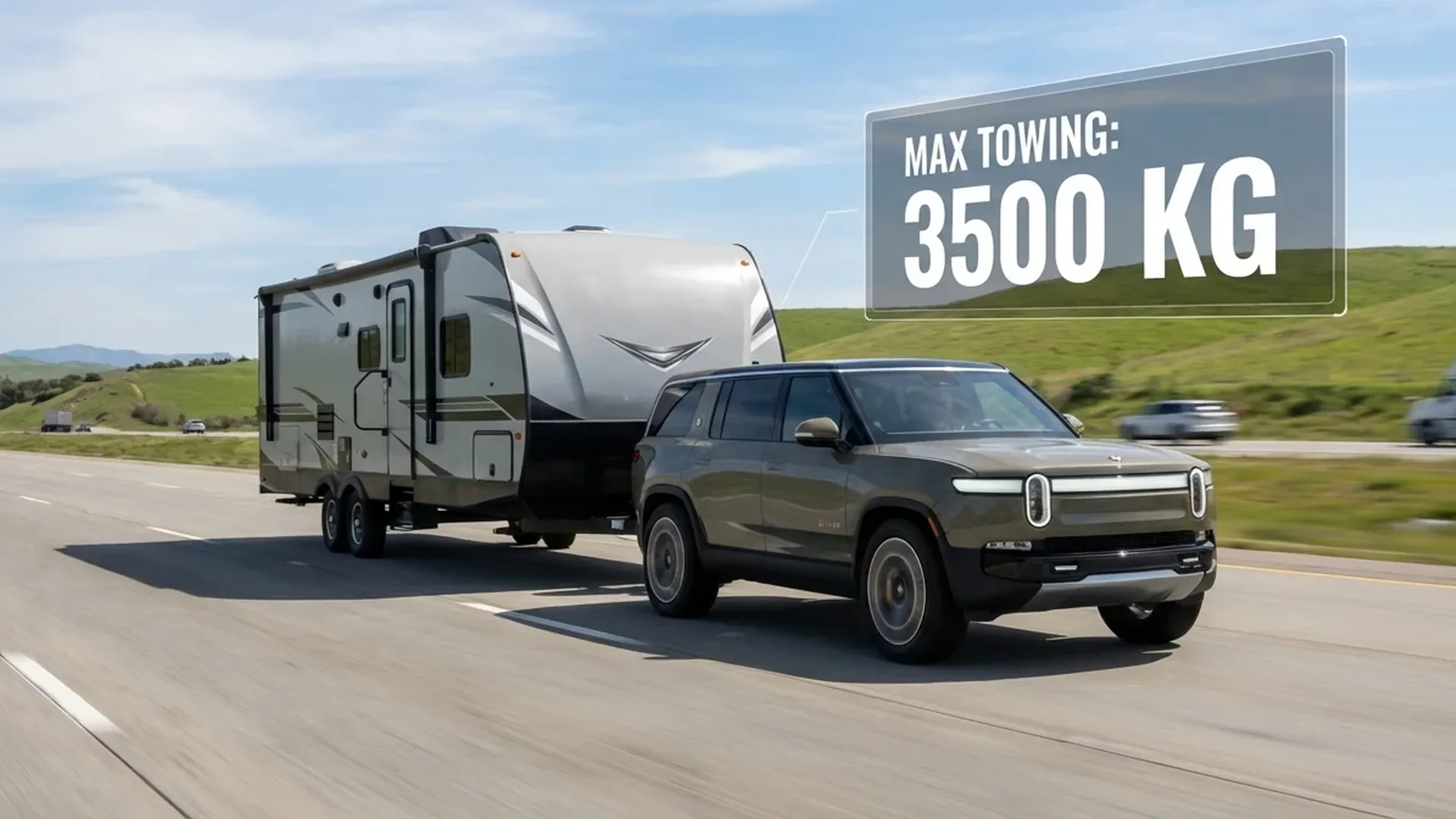
Judging purely by physics, electric vehicles are naturally built for towing. The electric motor produces maximum torque from 0 RPM, meaning you can get a heavy load moving without “hunting” for power. A Rivian R1T with its four motors produces 908 lb-ft of torque — enough force to pull virtually anything.
Additionally, the floor-mounted battery creates a low center of gravity, ensuring stability even with a heavy trailer. There's no gearbox overheating, no turbo lag. The drivetrain is simple, efficient, and nearly silent. However, these advantages come with one major challenge: energy.
The Big Problem: Range
Physics is unforgiving. Towing a trailer dramatically increases aerodynamic drag and weight, resulting in 30% to 60% higher consumption depending on load weight, speed, and weather conditions. A Tesla Model X with a 257-mile EPA range, pulling a 2,200 lb trailer at 55 mph, retains about 70% of its range — roughly 180 miles. That's a ~30% loss with a relatively light load.
At the other extreme, a Rivian R1T towing a heavy trailer near its 11,000 lb maximum can see its range cut in half. With the 135 kWh battery and ~314-mile range, that means around 155 miles of real-world range under full load. On mountain roads or into a headwind, things get even tougher.
Best EVs for Towing (2025-2026)
Not all electric vehicles are towing-capable. Many smaller models don't even come with a factory tow hitch. Below are the models that stand out in this category:
| Model | Max Towing | Battery | Range (EPA) | Est. Towing Range |
|---|---|---|---|---|
| Rivian R1T | 11,000 lbs | 149 kWh | 410 mi | ~205 mi |
| Ford F-150 Lightning | 10,000 lbs | 131 kWh | 320 mi | ~160 mi |
| Tesla Cybertruck | 11,000 lbs | 123 kWh | 340 mi | ~170 mi |
| Tesla Model X | 5,000 lbs | 100 kWh | 352 mi | ~245 mi |
| BMW iX xDrive50 | 5,500 lbs | 111 kWh | 324 mi | ~230 mi |
| Kia EV9 GT-Line | 5,500 lbs | 99.8 kWh | 304 mi | ~200 mi |
| Volvo EX90 | 4,850 lbs | 111 kWh | 310 mi | ~220 mi |
| Mercedes EQS SUV | 3,968 lbs | 118 kWh | 350 mi | ~245 mi |
* Estimated towing range is for ~2,200 lb load in mixed driving. Actual numbers depend on speed, temperature, and terrain.
World Record: The Model X and the Boeing 787
If you think EVs lack power, consider this: in May 2018, a Tesla Model X towed a Boeing 787-9 Dreamliner weighing 287,000 lbs (130 tonnes) nearly 1,000 feet at Melbourne Airport, earning the Guinness World Record for “heaviest tow by an electric production passenger vehicle.” Of course, nobody's suggesting you pull an airplane with your EV — but it proves what instant electric torque can accomplish.
📖 Read more: First EV: 10 Things You Need to Know
What Affects Range While Towing
Range loss isn't constant — it depends on multiple factors. Let's break them down:
1. Load weight: Every additional 220 lbs increases consumption by ~2-4%. A 1,100 lb trailer costs less range than a 4,400 lb trailer — simple math.
2. Aerodynamic drag: This is the biggest range killer. An enclosed camping trailer creates enormous drag compared to a low flatbed or open boat. At 75 mph, aerodynamic drag quadruples compared to 37 mph.
3. Speed: Reducing speed is the most effective way to save energy. Driving at 50-55 mph instead of 75 can improve towing range by 20-30%.
4. Elevation changes: Inclines require exponentially more energy with a load. Mountain routes can increase consumption by 40-60% compared to flat terrain. The upside: regenerative braking works more efficiently on descents due to the heavier total weight.
5. Temperature: Extreme heat or cold affect battery performance. At 14°F (-10°C), range drops 15-25% even without a load — with towing, the situation worsens significantly.
Towing with an EV: Practical Considerations
EV towing presents unique considerations compared to traditional vehicles. The growing charging infrastructure across the US and Europe — with over 50,000+ DC fast chargers across North America — makes long-distance towing increasingly feasible. Key advantage: many fast chargers (50-350 kW) are located near highways, ideal for towing stops.
From a legal perspective, every vehicle has a maximum towing capacity listed in the owner's manual and on the VIN plate. Exceeding this limit is illegal and voids your insurance. Make sure your hitch is properly rated and installed.
What Can You Realistically Tow?
Let's talk practical scenarios. The most popular towing use cases and how well EVs handle them:
Small boat/jet ski (650-1,300 lbs): Easily achievable with almost any hitch-equipped EV. Minimal range impact (~15-20%). Ideal scenario.
Camping trailer/pop-up (1,750-3,300 lbs): Feasible with EV SUVs (Model X, BMW iX, Kia EV9). Expect 25-40% range loss. Requires charging stop planning.
Horse trailer (3,300-5,500 lbs): Requires larger EVs. Possible with Model X, BMW iX, Kia EV9. Expect 35-50% range loss.
Heavy trailer/large boat (5,500+ lbs): Only EV pickups (Rivian R1T, Ford F-150 Lightning, Tesla Cybertruck). Expect 40-60% range loss. Requires careful route planning.
📖 Read more: BYD Dolphin: Affordable Electric Hatchback Under $30,000
10 Practical Tips for EV Towing
1. Plan your route in advance. Use apps like ABRP (A Better Route Planner) that calculate range accounting for towing weight.
2. Charge to 100% before departure. When towing, the full charge is worth it despite the general recommendation for 80%.
3. Drive slower. 50-55 mph is the “sweet spot.” The energy savings are impressive.
4. Maximize regenerative braking. Set it to maximum — it works even better with a heavy load.
5. Keep a safety buffer. Don't plan to arrive at a charger with 5% — aim for at least 15-20% minimum.
6. Check tire pressure. Correct pressure (slightly higher when towing) reduces rolling resistance and improves range and safety.
7. Avoid towing in extreme temperatures. Midday summer (95°F+) or winter cold (23°F and below) significantly reduce efficiency.
8. Use “Tow Mode” if available. Many EVs (Rivian, Tesla) have a dedicated towing mode that adjusts suspension, steering, and regeneration.
9. Plan charging stops near restaurants or attractions. Charging from 20-80% takes 30-45 minutes — enough for a meal.
10. Start with light loads. If towing with an EV for the first time, try a short trip with a light trailer to learn how the car responds.
EV vs Diesel Towing: Cost Per Mile
Despite the range penalty, towing with an EV remains significantly cheaper than a diesel SUV. A mid-size EV SUV consumes about 40-55 kWh/100 mi while towing 2,200 lbs. With home electricity (~$0.15/kWh), that means $6-8 per 100 miles. An equivalent diesel SUV towing the same load consumes 14-20 mpg, costing $18-27 per 100 miles ($3.80/gallon diesel). That's 3x-4x cheaper operation on electricity. Even with DC fast charging ($0.35-0.50/kWh), cost reaches $14-27/100 mi — comparable to diesel but with zero emissions.
The Future: What's Coming?
Technology is evolving fast. Solid-state batteries promise 2x energy density at the same weight, which would translate to much greater range even while towing. Fast charging is also improving, with 350 kW+ stations proliferating across North America and Europe. The combined improvement — bigger batteries, faster charging, denser networks — means that in 3-5 years, EV towing will be as natural as towing with gas or diesel is today.
Verdict
EV towing is no longer an experiment — it's reality. For light loads (boats, jet skis, small trailers), today's EVs handle them excellently. For heavier loads, planning and patience are required — charging stops, slower speeds, careful routing. The instant torque, stability, and silent operation make towing calmer and more controlled than with combustion engines. The big question is no longer “can it?” — it's “how far?” And with each passing year, the answer gets more encouraging.
Tags: