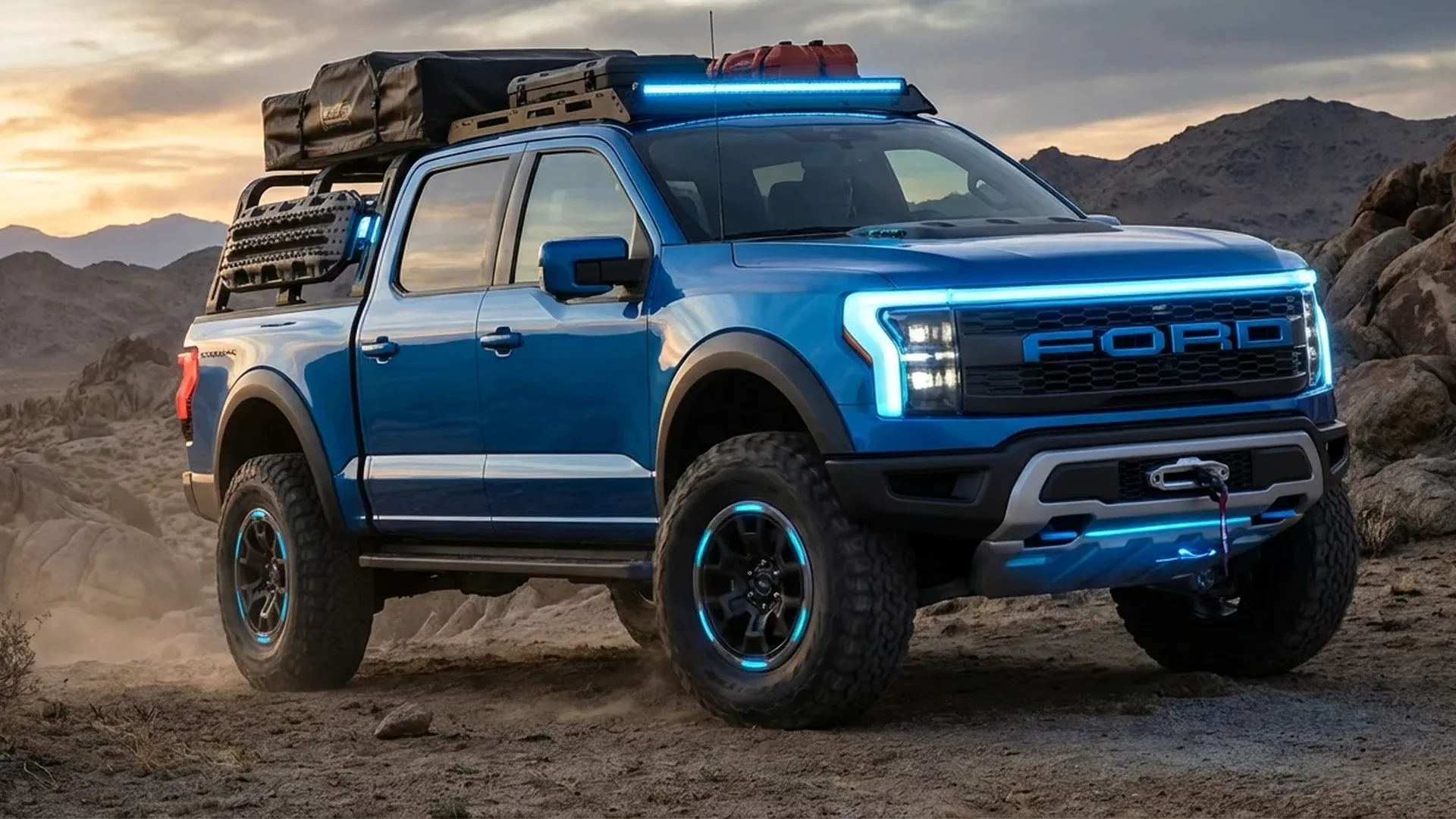
In December 2025, Ford announced what few expected: it was discontinuing the F-150 Lightning, its first fully electric pickup. At the same time, the company revealed an even more ambitious plan — a $30,000 electric pickup arriving by 2027. This isn't just a model change; it's a complete overhaul of Ford's electric vehicle strategy.
📖 Read more: BMW i3 2026: The Electric 3 Series Is Coming
F-150 Lightning: The Legacy
The F-150 Lightning was much more than an electric truck. It was an entire industry's declaration that EVs can do real work. Its story deserves telling before we look at what comes next.
Lightning by the Numbers
Sales: The Rise & Fall
The Lightning started strong but never managed to turn a profit. Ford halved production rates midway through 2024, while competition from the Cybertruck, Silverado EV, and R1T intensified:
| Year | US Sales | Change |
|---|---|---|
| 2022 | 15,617 | — |
| 2023 | 24,165 | +54.7% |
| 2024 | 33,510 | +38.7% |
| 2025 | 27,307 | -18.5% |
| Total | ~100,600 | 3.5 years |
Why It Stopped: The 3 Big Problems
In December 2025, Ford made a radical pivot: a $19.5 billion write-down on EV investments and the end of Lightning production. But rather than retreating from EVs, the company declared it remains “on track” for a $30,000 electric pickup by 2027.
The New Electric Pickup: What We Know
Ford hasn't announced an official name yet, but internal documents and executive statements paint a picture of an entirely new electric pickup that will share nothing with the Lightning:
An entirely new platform designed from scratch exclusively for EVs. Unlike the Lightning, which was based on the T3 platform (same as the gas F-150), the UEV will be optimized for low cost, light weight, and efficiency.
Instead of NMC (nickel-manganese-cobalt), the new pickup will use Lithium Iron Phosphate. 30-40% cheaper, cobalt-free, more charge cycles, and thermally safer.
📖 Read more: BYD Seal U: Electric SUV Under €35,000
Target price of $30,000 (~£24,000). Nearly half the Lightning Pro's $52,375 starting price. With federal incentives, the real cost could drop below $23,000.
Ford says sales by 2027. A prototype reveal is expected in 2026, with factory production late 2026 or early 2027. Potential location: Oakville, Ontario or a new US facility.
LFP vs NMC: Why the Battery Switch
The shift to LFP (Lithium Iron Phosphate) batteries isn't random. Tesla already uses LFP in Standard Range Model 3s with great success, and BYD has made its Blade Battery (LFP) a benchmark technology. For an affordable pickup, the advantages are decisive:
| Feature | NMC (Lightning) | LFP (New Pickup) |
|---|---|---|
| Cost/kWh | ~$110-130 | ~$60-80 |
| Energy Density | 250-300 Wh/kg | 160-190 Wh/kg |
| Charge Cycles | ~1,500-2,000 | ~3,000-5,000 |
| Thermal Safety | Moderate | Excellent |
| Cobalt | Yes | No |
| Weight (same capacity) | Lighter | +20-30% heavier |
The trade-off is clear: less range per pound of battery, but dramatically lower cost, greater longevity, and zero rare earth dependence. In a work tool like a pickup, this translates to a truck that can handle 10+ years of heavy use without significant battery degradation.
The Competition: How It Compares
The US electric pickup market is now crowded — but none cost under $50,000. That's where Ford's opportunity lies:
| Model | Price (USD) | Range | Towing |
|---|---|---|---|
| Ford New Pickup (2027) | ~$30,000 | ~250 mi* | ~7,700 lbs* |
| F-150 Lightning (2025) | $52,375+ | 240-320 mi | 10,000 lbs |
| Tesla Cybertruck | $62,235+ | 320-325 mi | 11,000 lbs |
| Chevy Silverado EV | $55,395+ | 283-493 mi | 10,000 lbs |
| Rivian R1T | $74,885+ | 260-350 mi | 11,000 lbs |
| GMC Hummer EV | $99,895+ | 312-318 mi | 7,500 lbs |
* Estimates — not officially confirmed.
What to Expect: Features & Design
While Ford hasn't released full specs, we can draw conclusions by combining executive statements, filed patents, and the engineering logic of a budget EV truck:
📖 Read more: Chinese EVs in Greece 2026: Which Ones Are Coming?
Likely mid-size, closer to the Ranger than the F-150. Easy to use in the city, capable off-road.
Single electric motor (RWD base) with AWD available. ~250-300 HP is plenty for a working truck.
~250 miles (EPA), enough for 95% of workers. With an optional larger pack reaching ~310 miles.
NACS port (Ford standard since 2024), DC fast charging ~150 kW. V2H capability likely optional.
Europe: The Opportunity
The Lightning was sold in Europe in extremely limited fashion — only in Norway initially, in one trim (Lariat Launch Edition) and one color. European pricing was prohibitive — over €90,000 in many markets.
For the new pickup, the situation could be very different:
- Mid-size = European-friendly: A Ranger-sized pickup fits European roads, unlike the massive F-150
- Competitive pricing: $30,000 = ~£24,000 / ~€28,000 base. European retail at ~€35-40,000 competes with diesel pickups
- EU CO₂ regulations: Light commercial vehicles must cut emissions 50% by 2030 — an EV pickup is strategic
- Growing market: With diesel pickup bans looming in major European cities, an electric alternative at €35-40,000 would be highly attractive for professionals
What This Means for the EV Truck Market
Ford's move represents a turning point for the entire industry. A $30,000 electric pickup would be a first — nobody comes close to that price today. At the same time, it shows that the first generation of “premium” electric trucks (Lightning, Hummer EV, Cybertruck) failed to win the mass market.
The real battle for EV pickups will be fought below $40,000 — the price point where actual truck users buy: contractors, farmers, small businesses. Ford, with 47 years as maker of America's best-selling vehicle (F-Series), knows this market better than anyone.
The question isn't whether it will launch — it's whether it can turn a profit where the Lightning failed. With LFP batteries, a new purpose-built platform, and lessons from $19.5 billion in losses, Ford has every incentive to get it right this time.