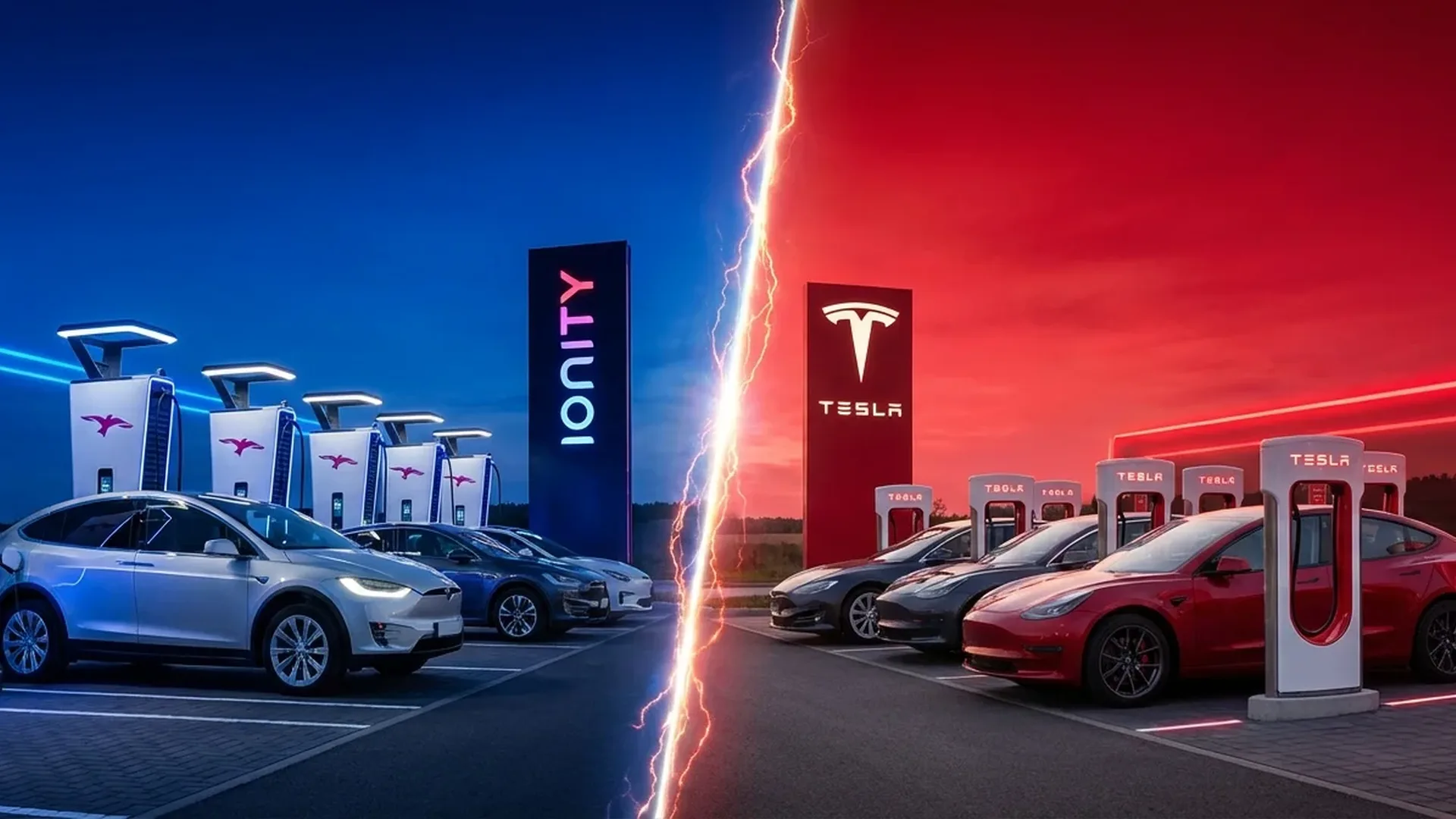
Ionity: Higher Power, Pan-European Network
Ionity launched in 2017 as a joint venture between five major automakers: BMW, Mercedes-Benz, Ford, VW Group (including Audi and Porsche), and Hyundai/Kia. The mission was straightforward — build an ultra-fast DC charging network capable of rivaling Tesla's Supercharger across the European continent. Every station delivers up to 350kW through the CCS connector, compatible with virtually every electric vehicle on the market today.
📖 Read more: Ultra-Fast Charging 350kW: How Fast Does It Actually Charge?
In 2021, Ionity announced a massive €700 million investment backed by BlackRock, targeting a fourfold capacity increase — from 1,500 to 7,000 charging points. By early 2026, the network surpassed 700 stations across 24 European countries, with locations primarily along motorways, service areas, and near restaurants or hotels.
Pricing remains a frequent point of criticism. Without a subscription, the rate hits €0.79/kWh — a figure that can make charging more expensive than gasoline in certain cases. The solution is the Ionity Passport, available in two tiers: Passport Motion (€5.99/month, €0.35/kWh) and Passport Power (€11.99/month, €0.26/kWh). For regular European road-trippers, the subscription pays for itself in just a few sessions.
An often overlooked advantage: several manufacturers (Porsche, BMW, Mercedes) bundle free or discounted Ionity charging with new EV purchases. Buy a Porsche Taycan or BMW iX and you may pay as little as €0.30/kWh or less — no separate Passport required.
Tesla Supercharger: Now Open to All EVs
Originally exclusive to Tesla owners, the Supercharger network opened to all EVs in Europe starting 2023 — a move that fundamentally reshaped the charging landscape. In Greece, stations are now open to every brand as long as the car has a CCS plug. Non-Tesla vehicles pay €0.40-0.55/kWh, while Tesla owners get slightly lower rates.
The current V3 generation delivers 250kW, while newer V4 stations — being gradually installed across Europe and the US — theoretically support up to 500kW (or even 1.2MW for the Tesla Semi). That said, this requires new V4 cabinets that only began construction in September 2025 in California. In practice, European V4 posts still run on V3 cabinets, capping out at 250-325kW.
What really sets Superchargers apart is not raw power alone. It is the user experience: plug-and-charge without cards or apps (for Tesla), automatic billing, full charging history on your phone, and integrated route planning in the navigation system. Reliability is widely considered the highest in the industry — user surveys consistently put Supercharger uptime above 95%.
Another recent addition: Tesla rolled out a digital queue system in 2025 to manage congestion at busy stations. Drivers see in real time how many people are ahead and the estimated wait time before a stall opens up.
Greece: What You'll Find Today
Greece remains at an earlier stage for fast charging infrastructure compared to Western Europe, but conditions are improving rapidly. Tesla operates over 35 Supercharger stations at strategic locations: Athens, Thessaloniki, Lamia, Larissa, Patras, Ioannina, Kavala, Alexandroupoli, and along major motorways. Coverage now allows a round trip from Athens to Thessaloniki without any range anxiety.
Ionity, by contrast, has limited presence in Greece — with scattered stations mainly along the Egnatia motorway and the Attiki Odos ring road. The coverage is not sufficient for long journeys relying solely on Ionity. However, through roaming platforms, Ionity Passport holders can access third-party charging stations at reduced rates — which increases practical usability significantly.
Real-World Charging Experience
In practice, the theoretical peak power (350kW for Ionity, 250kW for Tesla) is rarely sustained throughout an entire session. Actual speed depends on multiple factors: battery temperature, state of charge (SoC), and the car's own charging capability. A Hyundai Ioniq 6 can take full advantage of Ionity's 350kW. A VW ID.4 will cap out at 135kW regardless of the station.
This means your network choice should be driven by your specific car, not just charger specs. If your EV maxes out at 150kW, the difference between Ionity's 350kW and Tesla's 250kW is effectively zero — and price becomes the deciding factor.
What's Coming Next
Major developments are expected across both networks in 2026-2027. Tesla is rolling out V4 cabinets that will unlock speeds up to 500kW — enough to add 300km of range in under 10 minutes. Ionity aims for 7,000 chargers by end of 2026, with new stations in urban centers beyond motorways. The EU is also pushing through the AFIR regulation mandating fast chargers every 60km on major motorways — a requirement that benefits both networks.
For Greece specifically, the estimate is that DC fast charging points will triple by end of 2027, driven largely by EU funding and private investment. Shell Recharge, BP Pulse, and Greek utility DEI Blue are already adding stations — meaning the Ionity-vs-Tesla rivalry won't remain a two-horse race for much longer.
Which Should You Choose?
- For fastest charging (EV accepts 350kW): Ionity
- For reliability and better prices: Tesla Supercharger
- For trips within Greece: Tesla (more stations)
- For European road trip: Combination of Ionity + Tesla
- For lowest cost per kWh: Ionity Passport Power (€0.26/kWh) — worth it if you charge at least 3-4 times per month
The competition between Ionity and Tesla Supercharger is the best thing that's happened to European EV drivers.
— electrive.com, Jan 2026