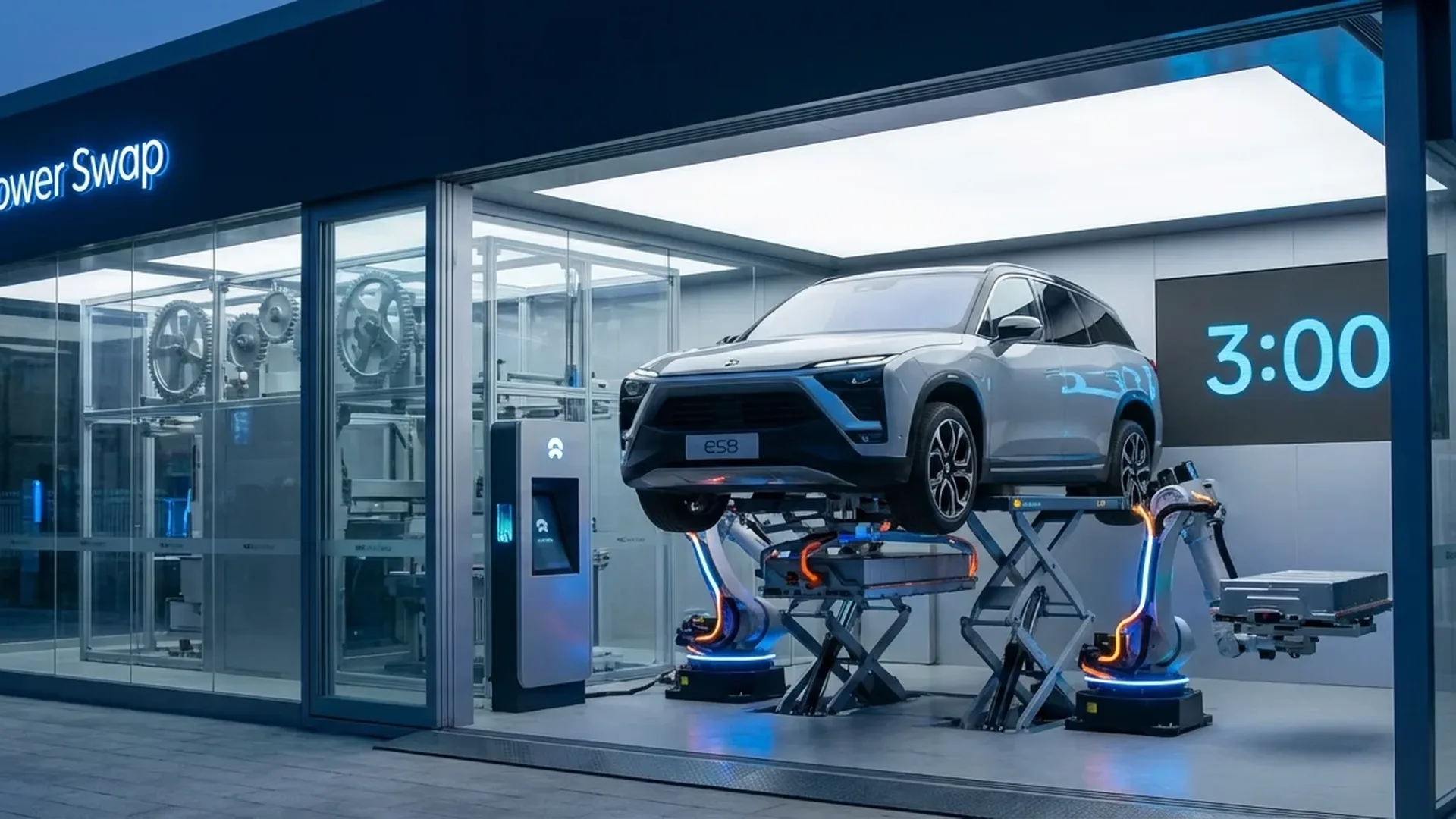
What if instead of waiting 30–60 minutes at a DC fast charger, you could replace your entire EV battery pack in under 3 minutes? That's exactly what Chinese automaker Nio has been building since 2018 — and the results are staggering. With over 2,250 stations across China and Europe, Nio is proving that battery swapping can be faster than filling up at a gas station.
📖 Read more: Second Life of EV Batteries: What Happens After the Car?
How It Works — 3 Steps, 3 Minutes
The process at Nio Power Swap second-generation stations is fully automated. The driver doesn't even need to leave the car.
Positioning
The car enters the station and is automatically positioned on the lifting platform.
Replacement
Robotic systems disconnect the depleted battery and install a fully charged replacement.
Departure
The driver leaves with full range — the entire process takes under 3 minutes.
The Numbers Speak for Themselves
Nio's Battery Packs
A critical advantage of swap technology is that all battery packs share standardized external dimensions, enabling cross-model compatibility. This means you can even temporarily upgrade your capacity — for example, rent a 150 kWh pack for a road trip.
75 kWh — Standard
100 kWh — Long Range
150 kWh — Ultra Long Range
102 kWh — Next-Gen (2025)
Network Evolution
📖 Read more: Silicon Anode Batteries: A New Era of EV Range
BaaS: Battery as a Service
The Battery as a Service (BaaS) model is arguably Nio's biggest innovation. Instead of buying the battery with the car, you lease it monthly. Here's what that means:
| Parameter | Traditional Purchase | BaaS (Nio) |
|---|---|---|
| Initial vehicle price | $48,000 – $80,000 | ~25% lower |
| Battery cost | Included | Monthly subscription |
| Capacity upgrade | Not possible | Anytime |
| Battery degradation | Owner's problem | Nio's responsibility |
| Resale value | Decreases with degradation | Stable (no battery included) |
| Charging time | 30–60 min (DC fast) | ~3 minutes (swap) |
Real-world example: A Nio ET5 owner with a 75 kWh pack can “upgrade” to 100 kWh or even 150 kWh via swap before a road trip, paying the difference only for the days they need it. Afterward, they simply swap back to the standard pack.
6 Advantages of Battery Swapping
Speed
Under 3 minutes instead of 30–60 minutes for DC fast charging. Faster than filling up gas.
Upgradability
Switch capacity based on your needs — from 75 kWh to 150 kWh on demand.
Battery Health
Each pack is optimally charged and inspected at the station — avoiding degradation from fast charging.
Lower Purchase Cost
With BaaS, the purchase price drops by ~25% — the battery doesn't belong to the buyer.
Grid-Scale Storage
Swap stations function as energy storage hubs, helping balance the electrical grid.
Second Life
Older packs are repurposed for stationary storage — circular economy in practice.
Partnerships & Open Ecosystem
Nio isn't keeping this technology to itself. Between 2023 and 2024, the company signed strategic agreements with four major Chinese automakers to share stations and standards:
This means the battery swap standard could soon become cross-brand — a Geely vehicle could use Nio stations. If standardization succeeds, battery swapping would become national infrastructure — like gas stations, but for batteries.
📖 Read more: CATL vs BYD Batteries: Who Dominates in 2026
Challenges & Drawbacks
Despite the impressive benefits, the technology faces serious challenges:
| Challenge | Analysis |
|---|---|
| Infrastructure cost | Each station costs ~$772,000 — massive upfront investment to scale. |
| Standardization | Requires a universal battery standard across manufacturers — politically difficult. |
| European expansion | Few stations outside China — Norway, Germany, and the Netherlands only for now. |
| Fast charging competition | 350 kW+ chargers close the gap to 15–20 minutes — is that enough? |
| Weight & space | Standardized batteries may not optimize every vehicle platform. |
Nio in Europe
European expansion began with Norway in 2021 (sales) and the first swap station there in 2022. Germany, the Netherlands, Denmark, Sweden, Belgium, and the UAE followed. In Oslo, Nio was selected as the electric taxi supplier in August 2023 — a significant vote of confidence.
As Nio targets 25 countries by 2025, European markets are increasingly within reach. The company's swap-enabled fleet — from the flagship ET9 to the mass-market Onvo L60 and the compact Firefly — positions it to serve everything from premium sedan buyers to urban commuters.
What's Next? The Next Generation
Nio isn't slowing down. Plans for 2025 and beyond include:
- 900V Platform: The new 102 kWh pack (CATL) supports 600 kW fast charging — insane speeds even without swapping.
- Semi-solid-state 150 kWh: WeLion's pack at 360 Wh/kg energy density delivers ranges exceeding 620 miles.
- Onvo & Firefly: The new mass-market and compact brands also use swap — the technology is going mainstream.
- Gen 4 Stations: Integrated energy storage and vehicle-to-grid (V2G) interaction.
- 1 million vehicles milestone: Reached in January 2026 — a tipping point for economies of scale.
The Final Verdict
Nio's battery swap technology isn't just an alternative to charging — it's a fundamentally different philosophy of the relationship between driver, car, and energy. The BaaS model decouples the battery from the vehicle, turning them into two independent products. If standardization is achieved at a European level, battery swapping could solve the biggest barrier to EV adoption: charging time. Three minutes for full range — think about it.