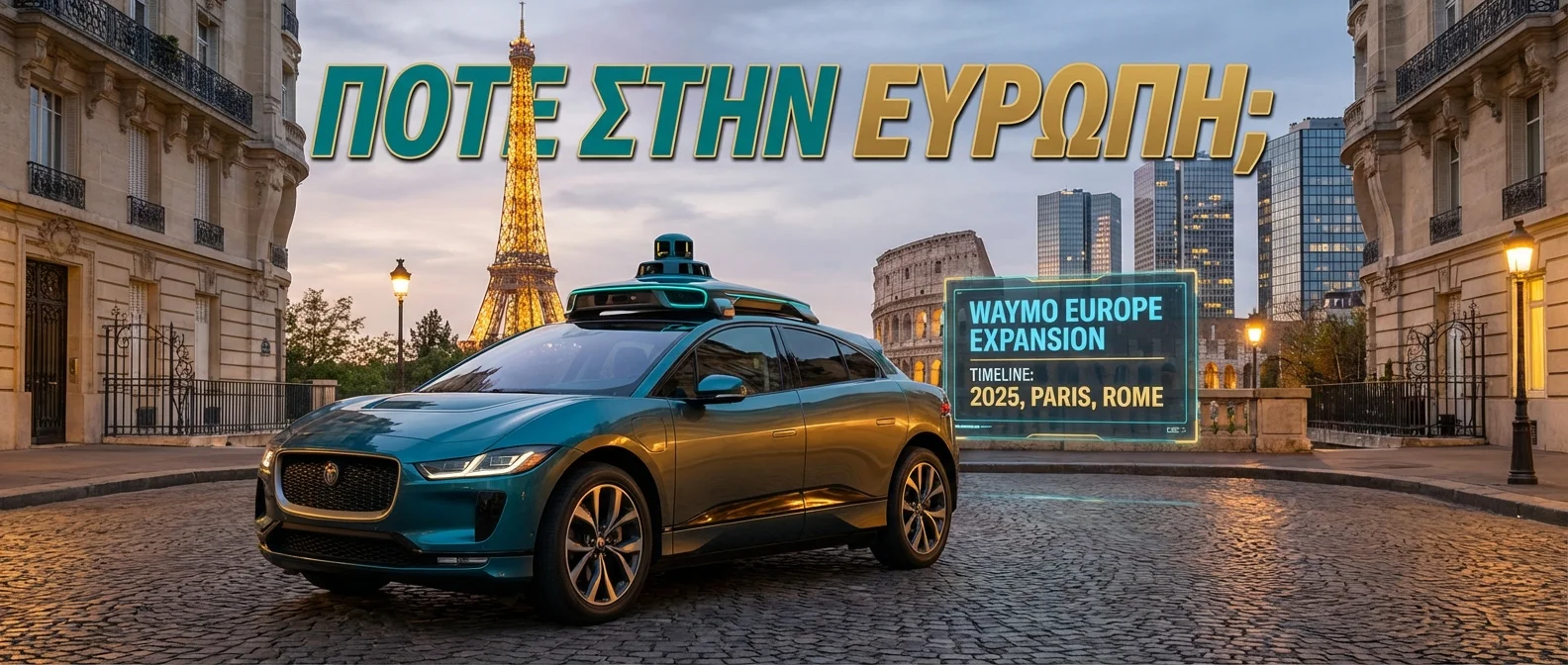
Robotaxis — driverless autonomous taxis — aren't science fiction anymore. In the US, Waymo already completes 450,000 paid rides per week across 6 cities, while in China, Baidu Apollo serves millions of passengers. The question isn't "if" but "when" we'll see robotaxis on European roads. This analysis breaks down the companies, cities, regulations, and timeline for Europe's autonomous taxi revolution.
📖 Read more: Tesla FSD vs Waymo: Which System Wins?
What Exactly Is a Robotaxi?
A robotaxi is an autonomous vehicle operating at SAE Level 4 or 5 that functions as a taxi through ride-hailing platforms — with no human driver behind the wheel. Passengers summon the vehicle via app, get in, tap "Start ride," and the car navigates to their destination. Using LiDAR, cameras, radar, and artificial intelligence, the vehicle perceives pedestrians, traffic lights, obstacles, and drives autonomously within geographically defined zones (geofenced areas).
SAE Autonomous Driving Levels
| Level | Description | Driver Required? |
|---|---|---|
| Level 0-1 | No/basic driver assistance | Always human |
| Level 2 | Partial automation (Tesla Autopilot, etc.) | Driver monitors constantly |
| Level 3 | Conditional autonomy (Mercedes DRIVE PILOT) | Driver takes over on request |
| Level 4 ⭐ | Full autonomy in zone — Robotaxis | No driver needed |
| Level 5 | Full autonomy everywhere | Theoretical — doesn't exist yet |
Who's Leading the Global Race?
Waymo (Alphabet/Google) — The Undisputed Leader
Waymo, Alphabet's (Google) subsidiary, dominates the global robotaxi market. Key stats through end-2025:
- 2,500 robotaxis in operation (November 2025)
- 450,000 paid rides/week (December 2025) — targeting 1 million by end-2026
- Operating in Phoenix, San Francisco Bay Area, Los Angeles, Austin, Atlanta, Miami
- Expanding to 20+ new cities within 2026 (Las Vegas, San Diego, Detroit, Dallas, Washington D.C., etc.)
- Uses Jaguar I-Pace (electric) and soon Hyundai Ioniq 5 & Zeekr
- Swiss Re study: 90% fewer crashes vs human drivers (25 million miles of data)
- Total funding: over $11 billion
Tesla Cybercab — The Ambitious Challenger
Tesla follows a different philosophy: instead of LiDAR, it relies exclusively on cameras + AI (Tesla Vision). The Tesla Cybercab, unveiled October 2024:
- 2-seater design — no steering wheel, no pedals
- Range ~200 miles (320 km) with 35 kWh battery
- Estimated price: under $30,000
- Wireless inductive charging with >90% efficiency
- Production: Q2 2026 (Musk confirmation, November 2025)
- Tesla Robotaxi service launched June 2025 in Austin, Texas with flat rate $4.20/ride
Baidu Apollo Go — The Chinese Giant
Baidu operates Apollo Go in 10+ Chinese cities with 400 fully autonomous robotaxis in Wuhan (24/7 service). Notable achievements:
- Over 100 million kilometers of autonomous driving without serious accidents
- Wuhan robotaxi fares: from 4 yuan ($0.55) — vs 18 yuan for regular taxi
- 6th-generation robotaxis with costs under $30,000/vehicle
- 7 million rides through July 2024
Top Companies Comparison
| Feature | Waymo | Tesla | Baidu Apollo |
|---|---|---|---|
| Technology | LiDAR + Cameras + Radar | Cameras Only (Tesla Vision) | LiDAR + Cameras + Radar |
| Fleet Size | 2,500 (2025) | Limited (Austin) | 400+ (Wuhan) |
| Cities | 6 active + 20 announced | 1 (Austin, TX) | 10+ Chinese cities |
| Europe? | London: Sep 2026 | No announcement | No announcement |
| Cost/ride | Similar to Uber | $4.20 flat | From $0.55 |
When Do Robotaxis Reach Europe?
🇬🇧 London — First European City
In October 2025, Waymo announced it will launch robotaxi service in London from September 2026. This marks the company's first international market (alongside Tokyo). According to the BBC (January 2026), testing will begin with safety drivers before public operation.
The UK is preparing legislatively: in May 2024, the Automated Vehicles Act 2024 passed, establishing a comprehensive framework for autonomous vehicles — covering liability, insurance, and criminal sanctions.
🇩🇪 Germany — Pioneer Level 4 Legislation
Germany became the world's first country to legislate Level 4 autonomous driving on public roads (July 2021). The "Federal Act Amending the Road Traffic Act" allows autonomous vehicles to operate without drivers in defined zones. In February 2022, implementing regulations (AFGBV) were issued governing licensing and operation.
🇫🇷 France — Autonomous Mobility Strategy
France passed the Mobility Orientation Law in December 2019 and updated its strategy in 2020 to become Europe's preferred location for autonomous mobility. The legislative framework was completed with a decree in April 2021 and implementing regulations in June 2021.
🇪🇺 EU — Unified Regulatory Framework
At European level, Regulation (EU) 2019/2144 (General Safety Regulation) took effect July 2022, creating the legal framework for approving automated and fully autonomous vehicles (Level 3 and above). Simultaneously, UNECE R157 for Automated Lane Keeping Systems (ALKS) was updated in June 2022, raising the permitted speed limit from 60 to 130 km/h.
European Robotaxi Timeline
How Much Does a Ride Cost?
According to The Economist and McKinsey, robotaxis still operate at a loss (2025). Operating costs run $7-9 per mile, while private car ownership costs $1/mile. McKinsey estimates costs won't drop below $2/mile until 2035.
| Provider | Cost/Ride | Comparison |
|---|---|---|
| Waymo (US) | Similar to Uber/Lyft | ~$15-25 average urban ride |
| Tesla Robotaxi (Austin) | $4.20 flat | Much lower — introductory pricing |
| Baidu (Wuhan) | From $0.55 | 75% cheaper than regular taxi |
| Regular taxi (Athens) | €5-15 urban | Reference baseline |
📖 Read more: Tesla vs BYD: Who Wins Globally 2026
Safety: Are They Safer Than Humans?
The data so far is encouraging but comes with caveats:
Waymo-Swiss Re Study (2024):
- 25 million autonomous miles driven
- 2 bodily injury claims (Waymo at fault) vs 26 expected from humans — 90% reduction
- 9 property damage claims vs 78 expected — 88% reduction
- Note: the sample (25M miles) is considered statistically small
However, there are problems: robotaxis blocking traffic lights, passing school buses, creating traffic jams, or entering police operation zones. In January 2026, NHTSA opened an investigation after a Waymo collision with a child near a school (minor injuries).
What About Greece?
Greece doesn't yet have specific legislation for Level 4 autonomous vehicles or robotaxis. However, as an EU member, it's subject to Regulation 2019/2144 and UNECE regulations. Realistically:
- 2026-2027: Possible pilot tests in controlled environments (e.g., Thessaloniki, Athens)
- 2028-2030: Potential commercial operation in tourist zones or airports
- Challenges: Narrow roads, illegal parking, poor signage, lack of HD mapping
- HD mapping (prerequisite for robotaxis) doesn't exist yet for Greek cities
Challenges & Concerns
Regulation
Each country has different rules. No unified global framework exists. In Europe, legislation is progressing but slowly.
Job Displacement
Millions of taxi/ride-hailing drivers at risk. In Boston, unions and city councilors are already opposing deployment.
Weather Conditions
Snow, rain, fog drastically reduce LiDAR and camera capabilities. Tests in Buffalo, NY are ongoing for winter conditions.
Profitability
Costs $7-9/mile vs $1 private car. McKinsey estimate: break-even at $2/mile after 2035.
Social Acceptance
Reactions are intense: in San Francisco, protesters placed cones on robotaxis, while in February 2024 they torched a Waymo. In Los Angeles, many vehicles were vandalized in June 2025. Social acceptance will determine the speed of European expansion.
Verdict
Robotaxis are coming to Europe, but at a measured pace. The first real service will be London (September 2026) via Waymo. Continental Europe — Germany, France, Switzerland — has the legislation but lacks commercial momentum.
For Greece, realistically we're looking at post-2028-2030 in pilot form. Greek roads (narrow, irregular, with poor signage) pose challenges, but tourist zones and airports could be first deployment points.
What's certain: the technology is maturing rapidly. With 450,000 rides/week already in the US and 90% fewer crashes, the question isn't "if" but "when" robotaxis become mainstream.