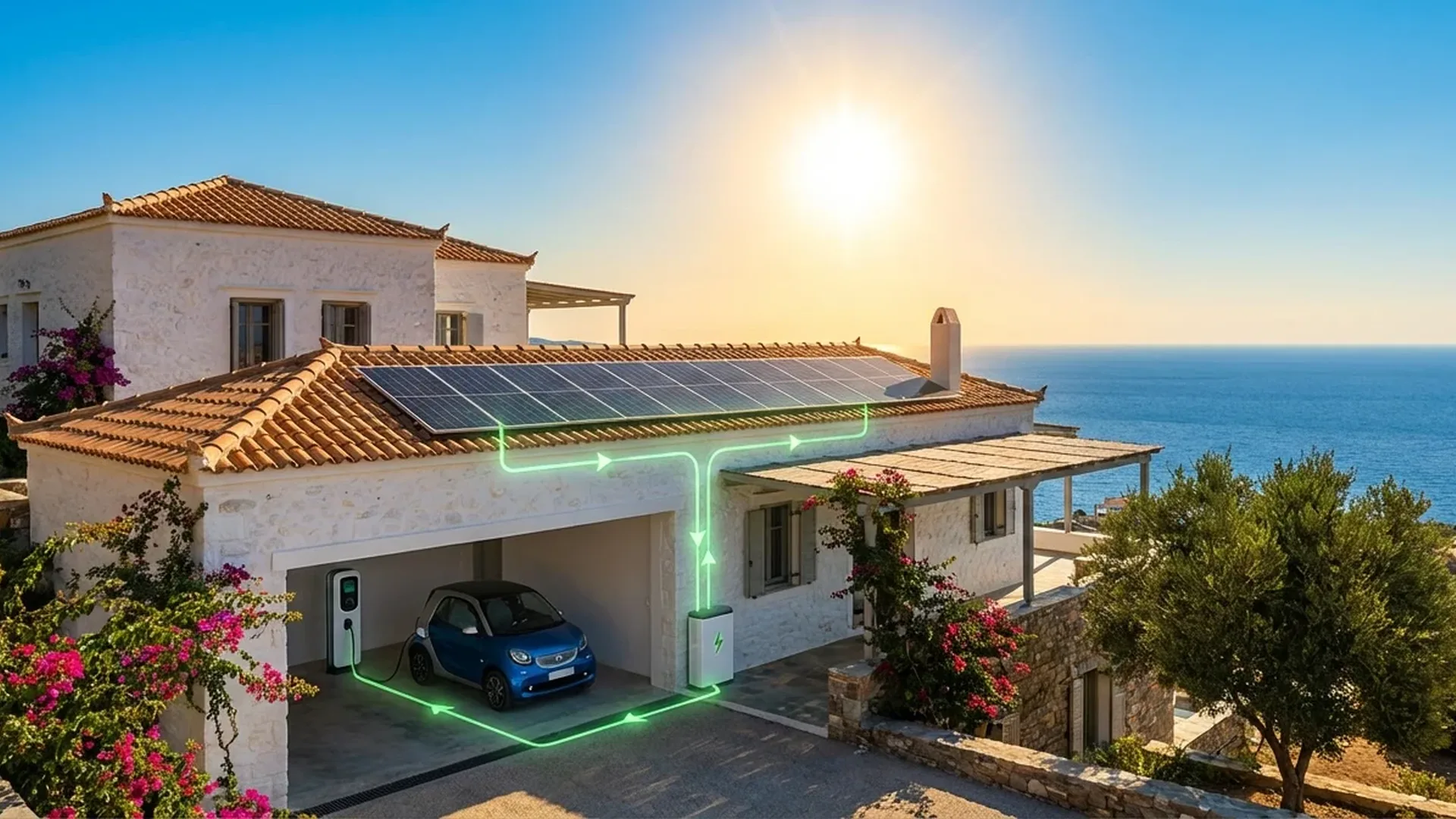
The idea sounds almost too good: install solar panels on your roof, charge your electric car, and never pay for electricity again. In reality, for thousands of EV owners in sunny countries like Greece, this isn't fantasy — it's everyday life. With abundant sunshine, the math works out more easily than you might think.
📖 Read more: EV Charging in Apartment Buildings: Law & Rights
Why Sun-Rich Countries Are Ideal for Solar + EV
Greece boasts one of the highest levels of solar irradiance in Europe, at 1,500–1,800 kWh/m² annually — far surpassing Germany (~1,000 kWh/m²) or the Netherlands (~1,050 kWh/m²), countries that nonetheless lead in solar installations. This means a 5 kWp system in the Athens region produces 7,500–8,500 kWh per year — enough to cover both a household's needs and EV charging.
Quick calculation: An electric car consumes ~15-18 kWh/100km. If you drive 7,500 miles (12,000 km) per year, you need ~2,000 kWh just for the car. A 5 kWp system in Greece produces 7,500+ kWh — leaving 5,500 kWh for the home!
What You Need: Equipment & Costs
A residential solar installation includes panels, an inverter, mounting frames, and the licensing for grid connection. Here's a breakdown of the essentials:
| Component | 5 kWp System | 10 kWp System |
|---|---|---|
| Solar panels (monocrystalline) | 12-14 panels | 24-28 panels |
| Required roof area | ~270 sq ft (25 m²) | ~540 sq ft (50 m²) |
| Annual production (Athens region) | ~7,500 kWh | ~15,000 kWh |
| Installation cost | $5,400–$7,600 | $9,700–$14,100 |
| Cost with battery storage | $9,700–$13,000 | $16,200–$21,700 |
Monocrystalline panels now dominate the market thanks to their higher efficiency (20-22%). Bifacial panels, which absorb light from both sides, increase production by 5-10% but cost slightly more.
Net Metering: How It Works
Net metering is the key mechanism that makes solar viable even without battery storage. The principle is simple: electricity you generate during the day but don't consume is “credited” to the grid, and you use it later — at night, in winter, or whenever needed. Net metering originated in the United States in 1979, with Minnesota passing the first state-level law in 1983. In Europe, Denmark was a pioneer (1998), followed by the Netherlands (2004).
Advantages
- Annual settlement — use summer production in winter
- No battery storage required
- Eliminates electricity bills (only fixed fees remain)
- Locked-in rate for 25 years
Good to Know
- Fixed grid fees still apply (~$11-16/month)
- Surplus energy not compensated — lost at annual settlement
- Bi-directional meter required
- Permit approval can take 2-4 months
Across Europe, traditional net metering is gradually being replaced by net billing (lower compensation for surplus energy), making battery storage increasingly attractive.
How Much Do You Actually Save?
Let's run a realistic calculation for a household in a sunny European location:
📊 Scenario: Home + EV with 5 kWp System
Home consumption: 4,500 kWh/year
EV consumption: 2,000 kWh/year
Total: 6,500 kWh/year
Panel production: 7,500 kWh/year
Power cost without panels:
📖 Read more: Ionity vs Tesla Supercharger 2026: Which Network Wins?
6,500 kWh × $0.19 = $1,235/year
Cost with panels (fees only):
~12 × $13 = $156/year
Annual savings: ~$1,079 → Payback in 5-6 years
After payback, the panels continue producing free electricity for 20+ years. Over a 25-year lifespan, savings exceed $21,000 — and that's without factoring in rising electricity prices, which would make the return even greater.
Subsidies & Financing in 2026
Many governments actively support residential solar through various programs. In Greece specifically:
- "Solar on the Roof" program: Subsidies up to 60% of installation cost for systems up to 10 kWp, based on income criteria
- Energy Upgrade programs: Solar subsidies as part of broader home energy renovation
- Tax incentives: Income tax reductions for green energy expenditures
- "Green" bank loans: Preferential rates (2.5-4%) with 5-10 year repayment
With full subsidies, the initial investment drops dramatically: a 5 kWp system costing €6,000 (~$6,500) can come down to just $2,600–$3,250 out of pocket, with payback in as little as 2-3 years.
With or Without Battery Storage?
The big question. With net metering, a battery isn't essential — the grid acts as a “virtual battery.” However, battery storage offers significant advantages:
| Criterion | Without Battery | With Battery (10 kWh) |
|---|---|---|
| Installation cost (5 kWp) | $5,400–$7,600 | $9,700–$13,000 |
| Self-consumption rate | 30-40% | 70-85% |
| Nighttime EV charging | From grid (net metering) | From stored energy |
| Grid independence | Low | High |
| Blackout protection |
Our recommendation: if your home has net metering and you charge your EV primarily at night, start without a battery and add one later, when prices drop. Lithium battery prices are falling ~15% annually.
Smart Solar EV Charging
Maximum savings are achieved when EV charging is synchronized with solar production. Modern “solar-aware” home chargers (wallboxes) can:
- Automatically adjust charging power based on available solar energy
- Start charging only when production exceeds home consumption
- Schedule charging for peak sunshine hours (10:00 AM – 4:00 PM)
- Communicate with the inverter via WiFi/Modbus for real-time optimization
Popular “solar” chargers on the market include the Fronius Wattpilot, SolarEdge EV Charger, myenergi Zappi, and Wallbox Pulsar Plus (with solar integration). They cost $540–$1,300 plus installation.
📖 Read more: Ultra-Fast Charging 350kW: How Fast Does It Actually Charge?
Practical Installation Guide
Step 1: Check your roof condition — it needs to last 20+ years without replacement.
Step 2: Calculate your consumption (home + EV). Gather your last 12 electricity bills.
Step 3: Get 3+ quotes from certified installers. Compare equipment, warranty, and after-sales service.
Step 4: Check current subsidy programs — applications are typically submitted online.
Step 5: Submit your net metering application to the grid operator. Approval time: 2-4 months.
Step 6: Installation (1-2 days), grid connection, and bi-directional meter activation.
The Global Picture
The Netherlands, with far less sunshine, has had net metering since 2004 and hundreds of thousands of installations. Poland introduced energy offsetting in 2015 with a 15-year state guarantee, triggering a solar boom. Denmark pioneered the concept in 1998, while Italy combines net metering with feed-in tariffs. Spain, after years of a “sun tax,” activated net metering in 2019 and is now one of the fastest-growing solar markets in Europe.
The common thread: everywhere, the combination of solar panels + EV emerges as the most efficient use of solar energy at the household level.
What to Watch Out For
- Shading: Even partial shading (trees, neighboring buildings, antennas) can significantly reduce output. Request a shading analysis.
- Orientation: Ideally south-facing at 25-35° tilt. East/west reduces production by 15-20%.
- Equipment quality: Don't skimp on the inverter — it's the “heart” of the system. Tier-1 panels (Longi, JA Solar, Canadian Solar, Trina) ensure reliability.
- Warranty: Panels should carry a 25-year performance guarantee (≥80% of original output). Inverters: 10-15 years.
- Insurance: Add the panels to your home insurance — risks from hail, fire, or theft are real.
The Future: V2H & Bidirectional Charging
The next evolution is Vehicle-to-Home (V2H): your electric car becomes the battery storage itself. Models supporting bidirectional charging (Nissan Leaf, Hyundai Ioniq 5, Kia EV6, Ford F-150 Lightning) can power a home for 2-3 days. With panels charging the car during the day and the car powering the house at night, you create a nearly autonomous energy cycle.
Conclusion
Combining solar panels with an electric vehicle isn't a luxury — it's the most sensible energy investment a household can make. For $5,400-$7,600 (much less with subsidies), you can zero out both your electricity and fuel bills. In a country bathed in sunshine, free charging isn't a slogan — it's mathematics.