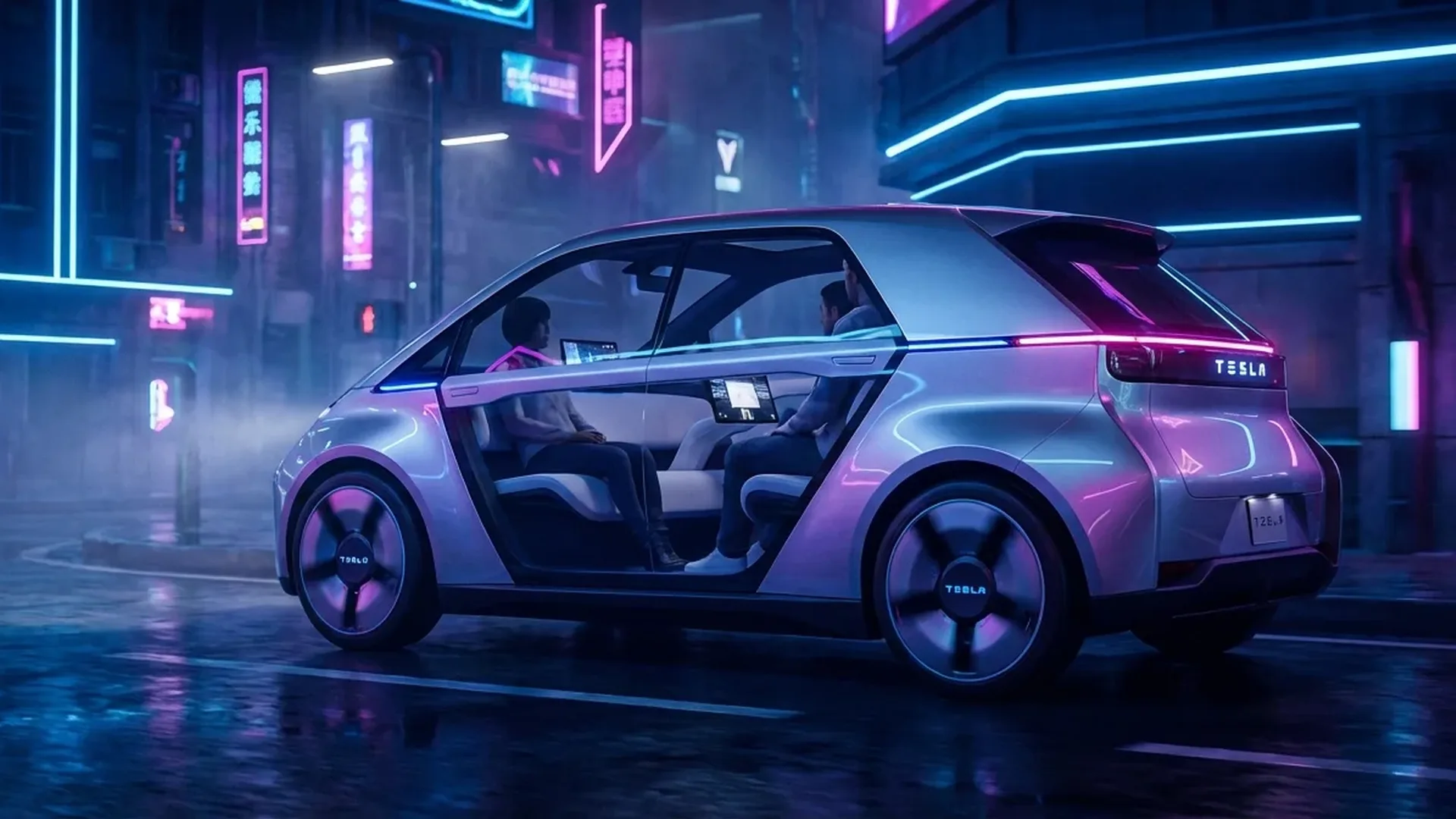
In October 2024, Elon Musk unveiled what Tesla calls the Cybercab (or Robotaxi — the name hasn't been fully clarified). A two-passenger electric car with no steering wheel, no pedals, designed exclusively for fully autonomous operation. Production is expected to begin in April 2026, as confirmed by Musk at the November 2025 shareholder meeting.
📖 Read more: Tesla FSD vs Waymo: Which System Wins?
It's a bold gamble that, if successful, could radically change how we get around. A car under $30,000 that takes you wherever you want without a driver. Here's what we know.
The Story: From Vision to Prototype
The idea isn't new. As early as 2019, Musk declared that Tesla would have one million autonomous robotaxis on public roads by the end of 2020. That never happened — but the idea persisted.
Inside the company, Musk was pushing since 2022 to make the robotaxi Tesla's next vehicle. However, his close collaborators — designer Franz von Holzhausen and engineer Lars Moravy — proposed something more realistic: a next-generation platform that would support both a small, inexpensive mass-market car and a steeringless robotaxi. Musk ultimately accepted the recommendation.
In October 2022, Tesla publicly announced that the team was focused on the new platform, which would produce cars at half the cost of the Model 3/Y.
The Reveal: “We, Robot” Event
On October 10, 2024, at Warner Bros. Studios Burbank in California, 20 prototype Cybercabs drove autonomously around the studio lot, giving rides to attendees. The event was called “We, Robot” — a nod to Isaac Asimov's classic book I, Robot.
What was revealed at the event:
• 20 prototype Cybercabs in autonomous operation
• The Cybercab: two-seater, no steering wheel, no pedals
• Price under $30,000
• Production before 2027 (later confirmed as Q2 2026)
• Robovan: prototype van for up to 20 passengers
• Optimus robot demonstration
Investor reaction was muted, primarily due to the long timeline before production. As New Scientist noted, "the Cybercab won't be available for two years while Waymo self-driving cars are operating on streets today."
Technical Specifications
| Feature | Specification |
|---|---|
| Type | 2-door coupe, 2 seats |
| Range | ~200 miles (320 km) |
| Battery | 35 kWh |
| Efficiency | 5.5 miles/kWh (8.9 km/kWh) |
| Doors | Butterfly doors (open automatically, no handles) |
| Steering wheel / Pedals | None |
| Charging | Wireless (inductive), efficiency >90% |
| Exterior | No rear window, no side mirrors |
| Roof | Polyurethane with embedded pigment — not painted |
| Sensors | Cameras only (vision-only, no LiDAR/Radar) |
| Estimated price | Under $30,000 |
| Production target | 2 million/year at full capacity |
The 5.5 miles/kWh efficiency (about 6.9 kWh/100 km) is remarkably low — even lower than the Tesla Model 3 Standard Range. This comes from the small size, low aerodynamic drag (no mirrors, no rear glass), and lightweight body.
📖 Read more: Robotaxis 2026: When Will We See Them in Europe?
Design: A Future Without Drivers
Designer Franz von Holzhausen created a vehicle that pushes the boundaries of what we consider a “car.” No steering wheel, no pedals, no traditional dashboard — the interior feels more like a lounge than a cockpit.
The butterfly doors with no handles open automatically — you approach, it recognizes you, it opens. There's a hatchback opening in the rear for luggage. The charging port isn't visible externally — charging is done wirelessly via an inductive charging pad.
The roof is made from polyurethane panels with embedded pigment during manufacturing — meaning no painting is required. Tesla says “no more orange peel or paint bleed” — a quality improvement solving a chronic paint issue on their vehicles. Plastic parts are ultrasonically welded.
Wireless Charging: A First for a Mass-Market Car
Perhaps the most interesting technical feature: the Cybercab will have no external charging port. It will support exclusively inductive charging — wireless charging over a floor pad.
Efficiency is expected to be above 90% — much higher than typical wireless charging systems at 85-88%. This means minimal energy loss, but also something practical: a robotaxi doesn't need someone to plug in a cable — it parks over the pad and charges on its own. Perfect for 24/7 autonomous operation.
Autonomous Driving: Vision-Only Approach
Tesla, unlike competitors such as Waymo (Google) and Cruise (GM), doesn't use LiDAR or radar. It relies exclusively on cameras — what Tesla calls “Tesla Vision.”
This approach has cost advantages (no expensive sensors) but also controversy. Waymo already operates autonomous taxis in San Francisco, Phoenix, and LA using LiDAR + cameras + radar. Tesla claims its AI, trained on billions of miles of real-world data from the global Tesla fleet, is sufficient.
Cybercab vs Waymo: Philosophical Differences
Tesla Cybercab: Vision-only (cameras only), purpose-built two-seater, sub-$30,000, mass production (2M/year), private ownership or fleet, wireless charging.
Waymo: LiDAR + cameras + radar, modified Jaguar I-PACE & Zeekr vehicles, not for sale, fleet-only, wired charging, already operational in 4+ cities.
Key difference: Waymo already works. Tesla promises. But Tesla aims for massive scale — 2 million annually vs Waymo's ~1,000 vehicles.
Timeline: From Idea to Road
Musk promises 1 million robotaxis by end of 2020. Never happens.
Musk accepts von Holzhausen/Moravy proposal for shared affordable car + robotaxi platform.
Tesla announces next-gen platform — half the cost of Model 3.
📖 Read more: AI in EVs: How Artificial Intelligence Transforms Cars
Musk announces August reveal, later postponed to October.
"We, Robot" event: 20 prototype Cybercabs in autonomous rides, Robovan concept, Optimus demo.
Investor call: target volume production by end of 2026, 2M/year capacity.
Musk confirms: production starts Q2 2026 (April–June).
The $30,000 Price: How?
The sub-$30,000 price seems ambitious, but Tesla explains the logic:
- Small 35 kWh battery — just half of a Model 3 Standard Range (60 kWh). Less battery = lower manufacturing cost.
- No steering wheel/pedals/driver screens — major savings on components.
- Unpainted body — polyurethane instead of metal + paint shop = huge production line savings.
- Vision-only — no LiDAR ($10,000+) or radar ($500-2,000).
- New platform — designed from scratch for mass production with Giga Press unibody casting.
Robovan: A Bonus
At the same event, Tesla also revealed a Robovan prototype — an autonomous van that can carry up to 20 passengers. Few details have been released, but the logic is clear: autonomous buses for cities, airports, and campuses.
Criticism & Skepticism
There's no shortage of questions:
- Timeline: Musk has missed deadlines repeatedly — one million robotaxis before 2020, full self-driving “next year” every year.
- Regulation: Even if produced, legislation may not permit steeringless operation in many countries.
- Only 2 seats: Significantly limits usefulness — no families, no groups.
- 200-mile range: Sufficient for city use but not intercity trips.
- Blade Runner lawsuit: Alcon Entertainment sued Tesla for similarities between their Cybercab marketing and Blade Runner 2049.
- Waymo's head start: Waymo already operates, giving 100,000+ rides/week, while Tesla still doesn't have a single fully autonomous car on public roads.
How Will It Work as a Service?
The concept is twofold:
1. Buy a Cybercab → Earn Income: You buy a Cybercab and, when you're not using it, put it on the Tesla Network. The car does robotaxi rides on its own and generates revenue for you. Think Airbnb, but with a car.
2. Tesla Fleet: Tesla will operate its own fleet of Cybercabs in major cities, competing with Uber/Lyft/Waymo at lower cost since there's no driver to pay.
The goal, according to Musk, is a cost per mile lower than even public transit. If realized, the impact on cities would be enormous: fewer privately owned cars, less parking demand, less traffic congestion.
The Verdict: The Tesla Cybercab is perhaps the most ambitious project in automotive history. A car with no steering wheel, wireless charging, a price under $30,000, and a target of 2 million units per year. If Tesla pulls it off, we're looking at a revolution in transportation. If it fails, it'll be added to Elon Musk's long list of over-promises. Either way, the technology behind the Cybercab — wireless charging, AI vision, polyurethane body panels — will find its way into the cars of the future.