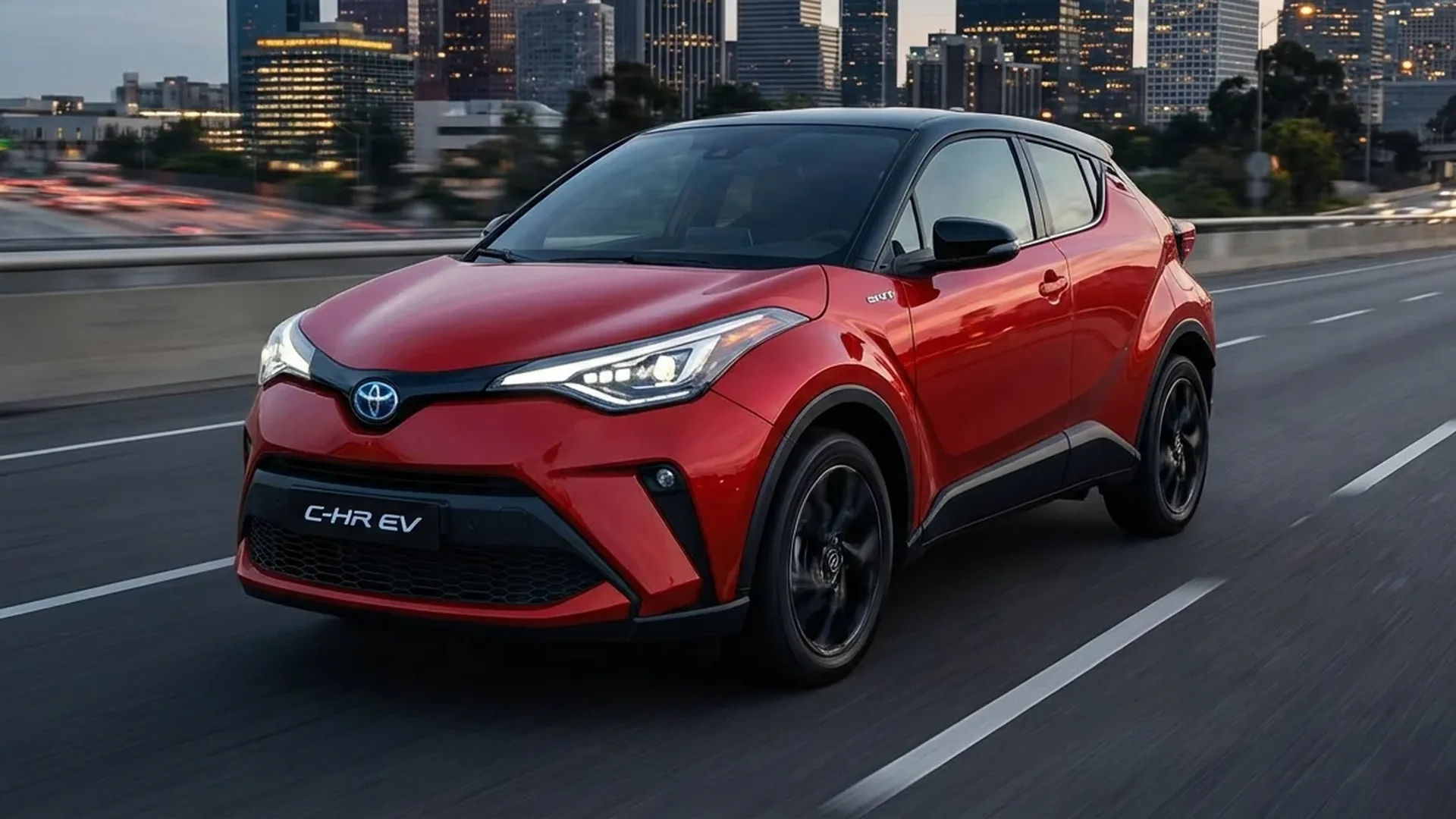
Toyota — the automaker that resisted full electrification for years — is now making a serious statement. The Toyota C-HR (marketed as C-HR+ in Europe) is an all-electric compact crossover SUV with a top spec of 338 horsepower and up to 290 miles of EPA-estimated range. Here's everything you need to know.
📖 Read more: Nissan Leaf 2026: The New Generation Electric
What Is the Toyota C-HR EV?
The new C-HR isn't just an electrified version of the quirky subcompact crossover that was discontinued in the US after 2022. It's an entirely new vehicle built on Toyota's e-TNGA platform — the same architecture underpinning the bZ (formerly bZ4X), Subaru Solterra, and Lexus RZ.
Unveiled in March 2025 and debuted for the US market in May 2025, the C-HR will reach American dealerships in 2026. Subaru is also selling a rebadged version called the Subaru Uncharted.
Styling follows Toyota's “hammerhead” design language — sharp headlights, a coupe-like rear roofline, and aggressive body creases. This is Toyota's boldest EV yet, closer to a concept car than a conventional crossover. Those dimensions place it right alongside the Hyundai Kona Electric and Kia Niro EV in size.
Powertrain: US Gets the Top Spec Only
In Europe, the C-HR+ offers three powertrain options. In the US, things are simpler — every C-HR comes with the 338-hp dual-motor AWD setup.
| Variant | Power | Battery | Range | Drive |
|---|---|---|---|---|
| FWD 165 (EU only) | 165 hp | 57.7 kWh | ~283 mi WLTP | FWD |
| FWD 221 (EU only) | 221 hp | 77 kWh | ~373 mi WLTP | FWD |
| AWD 338 (US & EU) | 338 hp | 77 kWh (74.7 usable) | 290 mi EPA | AWD |
The 338-hp AWD version uses two permanent-magnet synchronous motors — one on each axle, without axle disconnect. The result: 0-60 mph in 5.0 seconds (per Car and Driver), making this one of the most powerful vehicles Toyota has ever built, excluding the GR Supra.
Battery & Range
Every US-spec C-HR gets the larger 74.7 kWh usable (77 kWh total) battery. Toyota estimates an EPA range of 290 miles — competitive with the Hyundai Kona Electric's 261 miles and the Kia Niro EV's 253 miles.
290 miles estimated. In real-world mixed driving, expect around 240-260 miles — more than enough for daily commuting plus weekend trips.
338 hp, dual-motor AWD, 0-60 in 5.0 seconds. For context, the original C-HR had just 144 hp and no AWD option.
📖 Read more: Rivian R2: The Affordable Adventure EV of 2026
Charging
A key advantage for US buyers: the C-HR has a NACS charge port — meaning it's compatible with Tesla's vast Supercharger network. Combined with CCS via adapter, you'll have access to virtually every public fast charger in the country.
Interior & Tech
Inside, the C-HR borrows heavily from the refreshed bZ — and that's a good thing:
Infotainment display with wireless Apple CarPlay and Android Auto.
Mounted high on the dash, minimizing the need to look away from the road.
Two wireless charging pads on the center console — one for each occupant.
Phone-based key, remote parking, and traffic-jam hands-free driving assist.
Cargo space is rated at 25 cubic feet behind the rear seats. That's slightly less than the bZ, but the coupe-like roofline is the trade-off for that head-turning style.
📖 Read more: Electric Planes: The Revolution in Flight
Pricing & Trims
Toyota hasn't released official pricing yet, but the C-HR will come in two trims:
With the $7,500 federal EV tax credit (if Toyota qualifies under IRA battery sourcing rules), the SE could effectively start at just ~$27,500 — making it one of the most affordable 338-hp AWD vehicles on the market.
How It Compares
| Model | Power | Range (EPA) | Est. Price |
|---|---|---|---|
| Toyota C-HR AWD | 338 hp | 290 mi | ~$35,000 |
| Hyundai Kona Electric | 201 hp | 261 mi | ~$34,000 |
| Kia Niro EV | 201 hp | 253 mi | ~$35,000 |
| Toyota bZ AWD | 214 hp | ~250 mi | ~$38,000 |
| Chevy Equinox EV | up to 300 hp | 319 mi | ~$35,000 |
The C-HR stands out in three areas: horsepower (338 hp is unmatched at this price point), styling (it's the boldest-looking option by far), and NACS charging support out of the box.
Strengths & Weaknesses
- 338 hp — best-in-class power
- 290-mile EPA range
- NACS port = Tesla Supercharger access
- Bold, head-turning design
- Toyota reliability & dealer network
- Dual wireless charging, 14″ screen
- e-TNGA platform is aging (400V only)
- 150 kW DC — slower than 800V competitors
- Coupe roofline limits rear headroom
- No FWD/single-motor option in the US
- Toyota was late to the BEV game
The Bottom Line
The 2026 Toyota C-HR is proof that Toyota can build an EV that excites. With 338 horsepower, impressive range, a NACS port for Supercharger access, and styling that turns every head — this isn't “just another EV.” It's Toyota's strongest statement yet in the electric era.
It's worth noting that the C-HR+ rides on the e-TNGA platform — the same architecture underpinning the bZ4X — but with substantial upgrades to its battery thermal management and energy control software. Toyota backs the battery with a 10-year/150,000-mile warranty, guaranteeing 90% capacity through the first 8 years. In the European competitive landscape, the closest rivals are the Hyundai Kona Electric (65.4 kWh, 305 miles range) and the Volvo EX30 — yet neither blends sporty character, Toyota reliability, and a choice of two battery sizes (58 or 77 kWh) as cohesively. The C-HR+ also earned a 5-star Euro NCAP rating in 2024, outperforming hybrid rivals like the Honda HR-V and Hyundai Kona that managed only four stars.
If you want a compact electric SUV that combines performance, range, Toyota reliability, and bold design — the C-HR just became a top contender for 2026.
Tags: #Toyota C-HR EV #338 hp #e-TNGA #NACS #crossover