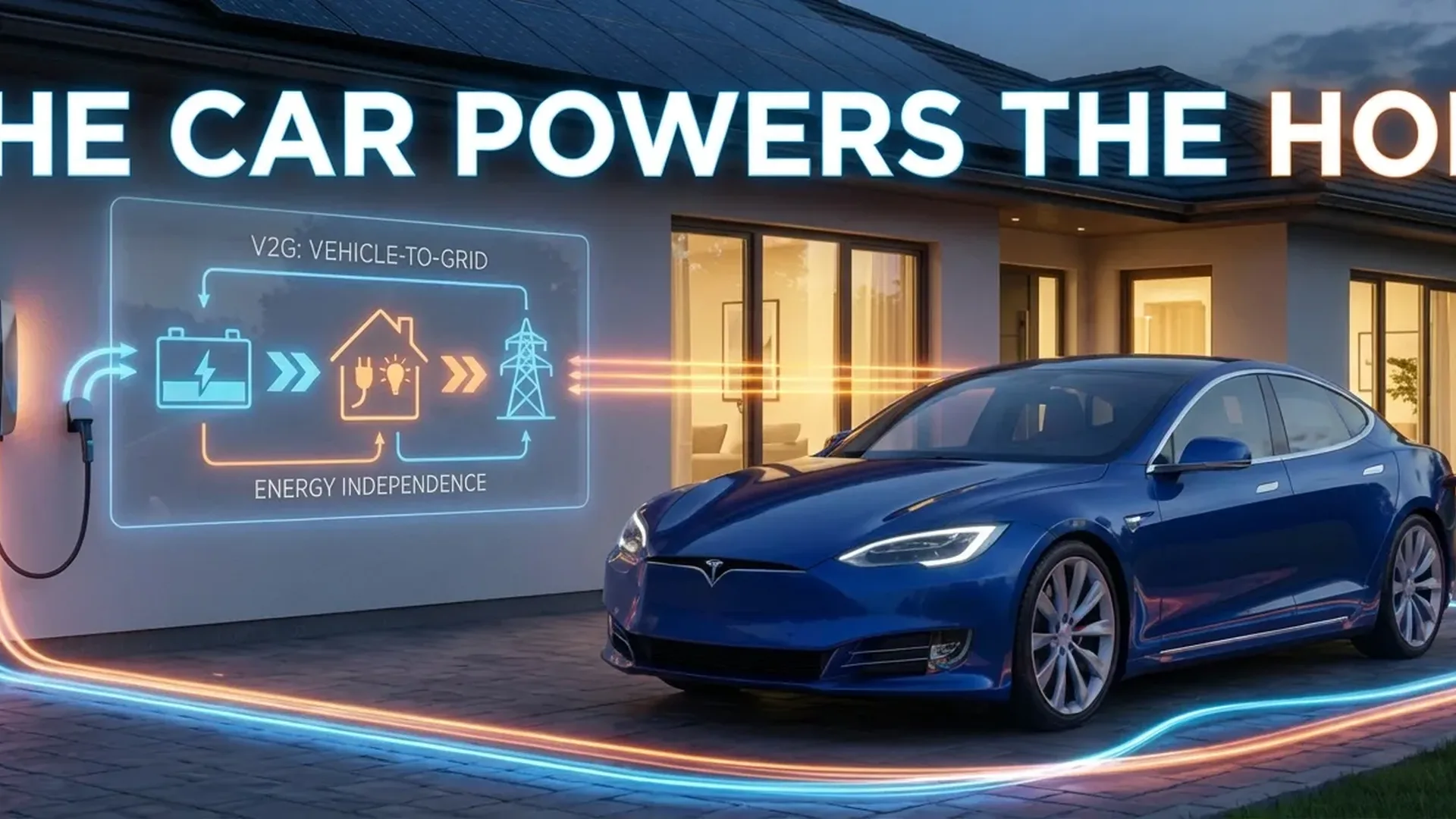
Imagine your electric car not just being a means of transportation, but a mobile battery that can power your home or even sell energy to the electrical grid — earning money while you sleep. This isn't science fiction. It's Vehicle-to-Grid (V2G) technology, and it's already a reality in 2026.
📖 Read more: Sodium Batteries for EVs: The End of Expensive Lithium?
In this guide, we'll explore how V2G works, which cars support it, what equipment you need, and how you can actually make money (yes, really!) from your EV's battery. Let's dive in!
What Is Vehicle-to-Grid (V2G)?
Vehicle-to-Grid (V2G) is a bidirectional charging technology that allows your electric car to send energy back to the electrical grid. Instead of your EV's battery sitting idle in the garage while you're working or sleeping, it can function as a decentralized energy storage unit.
Consider that a typical EV has a 60-100 kWh battery. A household consumes 10-15 kWh per day. This means your car's battery could power a home for 4-7 days. Now imagine millions of EVs connected to the grid — that's a massive virtual power plant!
🔄 How It Works — Step by Step
- Connection: The EV connects to a bidirectional charger
- Communication: The charger communicates with the grid operator via cloud
- Charging: During off-peak hours (e.g., 2-6 AM), the EV charges with cheap electricity
- Discharging: During peak hours (e.g., 6-9 PM), the EV sells energy back to the grid
- Profit: The price difference between buying and selling = your profit
V2G, V2H, V2L: The Differences
Bidirectional energy flow isn't limited to the grid. There are three main variants:
V2L is the simplest form and already available in many cars — you literally plug an outlet into the car and connect whatever you want. Ideal for camping, job sites, or emergencies. V2H is more complex but extremely useful in areas with frequent power outages. V2G is the most ambitious application — and the one that can actually earn you money.
Which Cars Support V2G/V2H/V2L?
Not all EVs support bidirectional charging. It requires specialized hardware in the onboard charger. Here are the cars that do:
⚠️ Important Note About Tesla
Tesla has announced that it will enable V2H/V2G via OTA update on the newer Model 3 Highland and Model Y Juniper. The hardware is already in place — the software activation is expected soon. The Tesla Powerwall 3 already supports bidirectional charging. This could be a game-changer given the size of the Tesla fleet.
How Much Money Can You Earn?
Let's do the math. The logic behind V2G is based on buying electricity at a low price and selling at a high price:
💰 V2G Earnings Example
- Buying electricity (night): €0.10-0.15/kWh
- Selling electricity (peak): €0.25-0.40/kWh
- Profit per kWh: €0.10-0.25
- If you sell 20 kWh/day: €2-5/day
- Annual earnings: €500-1,500+
Note: Amounts depend on electricity prices, country, V2G program, and battery capacity.
In countries like the Netherlands, Denmark, and the United Kingdom, V2G pilot programs have demonstrated earnings of €500-1,000 annually. In some cases, V2G can essentially eliminate the cost of using your EV.
What Equipment Do You Need?
For V2G/V2H you need a bidirectional charger. These differ significantly from regular wallboxes:
V2G Pilot Programs in Europe
Europe is at the forefront of V2G. Dozens of pilot programs are already running:
🇳🇱 Netherlands — We Drive Solar
500+ EVs in a V2G program in Utrecht. Earnings of €600-800/year. Using Hyundai Ioniq 5 & Renault 5.
🇩🇰 Denmark — Parker Project
Pioneering V2G program. Proven earnings of €1,000+/year. Partnership with Nissan & Enel.
🇬🇧 United Kingdom — Octopus V2G
Octopus Energy offers a V2G tariff. Earnings of £400+/year. Compatible with Ford, Hyundai, BYD.
🇩🇪 Germany — Elli (VW Group)
VW is developing V2G through Elli. Pilot with ID.Buzz & ID.4. Target: commercial launch 2026-2027.
V2G Advantages & Disadvantages
✅ Advantages
- 💰 Real financial gain — reduce or eliminate EV usage costs
- 🌍 Grid stabilization — helps integrate renewables (solar, wind)
- 🏠 Energy independence — your home has backup power
- 🌿 CO₂ reduction — replaces peaker plants (natural gas)
- ⚡ Distributed storage — millions of small “power plants” instead of a few large ones
- 🔋 Utilizing idle batteries — 90% of the time your EV is parked
❌ Disadvantages
- 💸 High bidirectional charger cost (€3,500-6,000)
- 🔋 Potential additional battery wear (though studies show minimal impact)
- 📜 Regulatory gaps — many countries still lack a V2G framework
- 🚗 Limited compatibility — few cars fully support it
- ⚙️ Installation complexity — requires an electrician & certifications
- 🇬🇷 Greece: No regulatory framework yet (expected 2027+)
⚠️ Battery Degradation: Myth or Reality?
Many worry that V2G “wears out” the battery faster. Studies from the University of Warwick and Nissan show that V2G degradation is minimal (1-2% annually), as the charge/discharge cycles are shallow (e.g., 50-80% instead of 0-100%). In some cases, V2G's intelligent charging can actually improve battery longevity.
V2G + Solar Panels: The Perfect Combination
If you combine V2G with residential solar panels, you create an energy ecosystem that's nearly self-sufficient:
- ☀️ Daytime: Solar panels charge the EV for free
- 🌙 Nighttime: The EV powers the home (V2H) or sells to the grid (V2G)
- 💰 Result: Near-zero energy costs — and profit
This model is particularly attractive for Greece, with its high sunshine levels and rising electricity prices. A solar panel + EV + V2H system can reduce your electricity bill by 80-90%.
⚡ Conclusion
Vehicle-to-Grid is not just a technology — it's a new energy model. It transforms every EV into a small energy storage and distribution unit, creating a more flexible, decentralized, and sustainable grid. If you're planning to buy an EV, choose one with V2L/V2H capabilities — you'll thank yourself later. And if you live in a country with a V2G program, start today: your car can literally pay for itself.
📖 Also Read
- → EV Charging in Greece: Complete Guide 2026
- → LFP vs NMC Batteries: Which Suits Your EV?
- → EV Cost in Greece: Electricity vs Gasoline
- → Ultra-Fast Charging 350 kW: What You Need to Know
- → More Articles on EVs & Cars