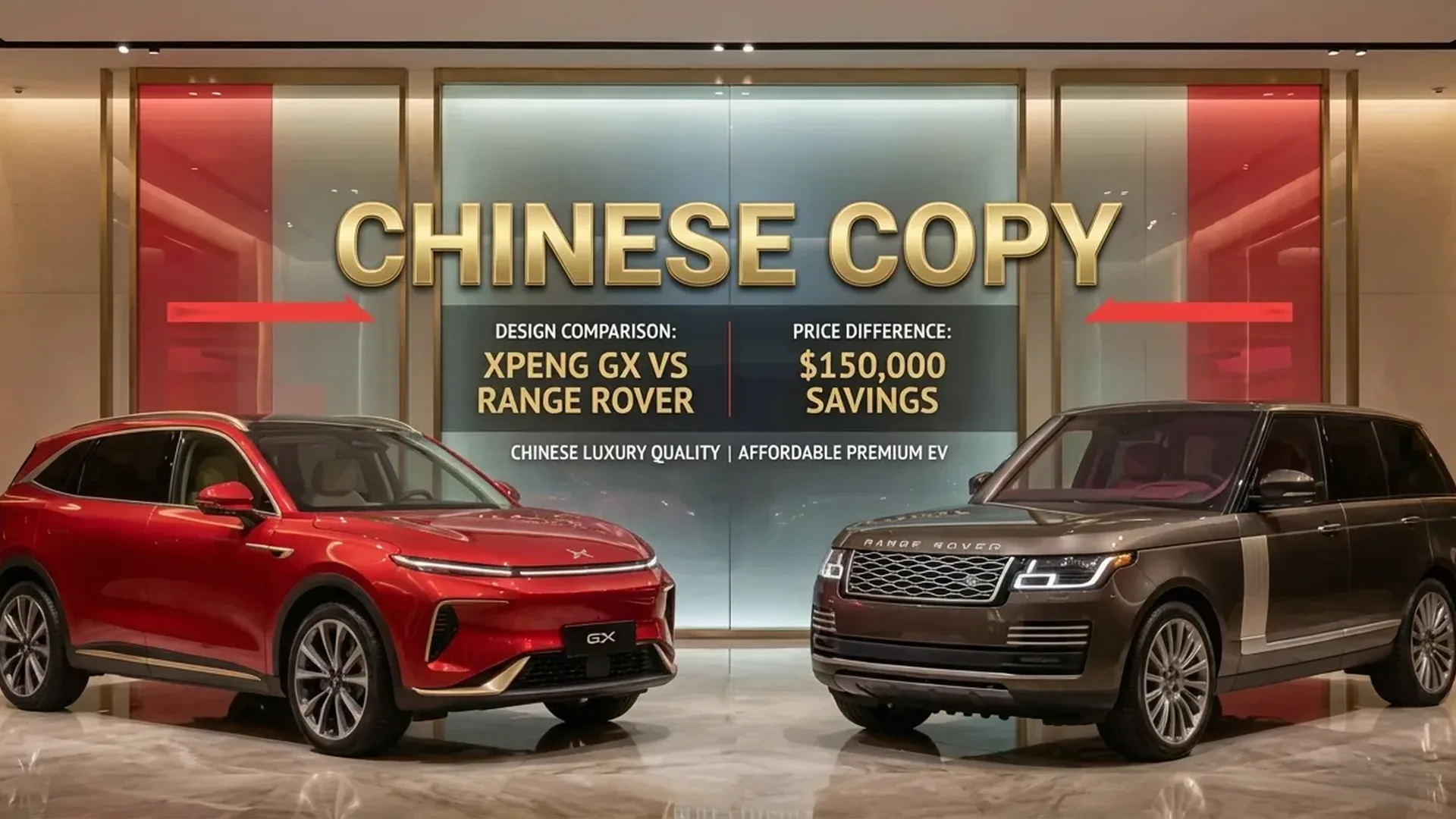
XPeng unveiled the GX on 5 February 2026 via Weibo — a full-size luxury F-segment SUV reminiscent of the Range Rover but at a fraction of the price. Built on the SEPA 3.0 platform with 800V architecture, 6 seats in a 2+2+2 layout, and autonomous driving technology powered by a custom Turing chip, the GX aims to shake up the premium SUV segment — especially in Europe, where XPeng already manufactures vehicles in partnership with Magna Steyr in Austria.
📖 Read more: Polestar 4: The Premium EV Without a Rear Window
XPeng in Numbers
Before discussing the GX, let's look at who XPeng is. Founded in August 2014 in Guangzhou by Xia Heng, He Tao, and He Xiaopeng (chairman). It went public on the NYSE in August 2020, raising $1.5 billion, and is now also listed in Hong Kong. Major shareholders include He Xiaopeng (18.7%), the Volkswagen Group (4.95%), and BlackRock (4.4%).
XPeng's lineup includes the Mona M03, P7 (2nd gen), and P7+ sedans, the G6, G7, G9 SUVs and the upcoming GX, as well as the X9 MPV. Since 2025, the company manufactures vehicles for the European market in partnership with Magna Steyr in Graz, Austria — a strategic advantage for avoiding tariffs.
XPeng GX — Design & Dimensions
The GX (codename G01) was unveiled on 5 February 2026 via Weibo. The “X” in GX stands for "eXploration", according to CEO He Xiaopeng. The design is strongly reminiscent of the Range Rover — split headlights, a single light bar at the rear, flush door handles, chrome wheels, and sculpted air channels. Essentially, it's a Chinese luxury SUV that doesn't hide its British influences.
At 5,265 mm long with a 3,115 mm wheelbase, the GX falls into the F-segment category — the same class as the Range Rover, BMW X7, and Mercedes GLS. The 2+2+2 layout means this isn't a cramped third row, but genuinely usable seats across three rows.
Interior & Premium Equipment
The GX's interior aims for a “business class” feel. The seats were co-developed with Nissan and are branded “Zero Gravity” — designed for maximum ergonomics on long journeys. The second row features:
- Entertainment screens for each passenger
- Built-in refrigerator
- Nissan Zero Gravity seats
- Dual-chamber air suspension
- Steer-by-wire (no mechanical steering connection)
- Rear-wheel steering
GX Philosophy
CEO He Xiaopeng explained that the “X” in GX stands for “eXploration”. The car was designed as the ultimate road-trip SUV, with a range reaching 1,400 km (EREV), a premium 6-seat interior, and cutting-edge autonomous driving technology.
Powertrain — BEV vs EREV
The GX is built on XPeng's SEPA 3.0 platform with 800V architecture. It's offered in two technologies: pure electric (BEV) and range-extended (EREV) with a gasoline generator.
The AWD version combines a Luxshare 362 hp electric motor (rear) with an XPeng 215 hp motor (front) for a combined 577 hp. The EREV version adds a 1.5L turbo 4-cylinder gasoline engine (148 hp) that operates exclusively as a generator — it never drives the wheels — achieving a total range of 1,400 km (870 miles).
Ultra-fast Charging with 800V
📖 Read more: Cupra Tavascan: Sporty Electric Coupé-SUV Review
Thanks to the 800V architecture and 5C charge rate batteries, the GX charges from 10% to 80% in about 12 minutes. XPeng operates a network of over 1,000 charging stations in China and has partnerships with Volkswagen and BP Pulse for a shared network.
Technology — Turing AI Chip & ADAS
The GX is equipped with XPeng's custom Turing AI chips — a technological milestone, as the company designs its own chips instead of relying on Nvidia/Qualcomm. Each chip features a 40-core processor, two NPUs, 64 GB LPDDR5x RAM, and delivers 750 TOPS of sparse compute — capable of running AI models with 30 billion parameters.
- 40-core processor
- 2x NPUs (Neural Processing)
- 64 GB LPDDR5x-8533 RAM
- 750 TOPS sparse compute
- 2x ISPs (AI perception + image)
- Runs 30B parameter models
- 2nd-gen VLA model
- VLM (Vision Language Model)
- Vision-only sensors (no LiDAR)
- 4D mmWave radar
- LOFIC cameras (anti-glare)
- 20% better utilization vs off-the-shelf
Key development: since late 2024, XPeng abandoned LiDAR sensors and switched to a “vision-only” system with 4D mmWave radars and LOFIC cameras (anti-glare) — a similar philosophy to Tesla, but with additional radar. XPeng also developed a narrow-road navigation system, set to launch in Q1 2026, with Volkswagen as its first customer.
The Strategic Partnership with Volkswagen
The XPeng-Volkswagen partnership is arguably the most significant in the automotive industry right now. It began in July 2023 with a $700 million investment from VW for a 4.99% stake. Since then, it has expanded across multiple levels:
- February 2024: Joint development of 2 electric VW models for China (2026)
- April 2024: Joint development of E/E Architecture for VW's CMP platform
- January 2025: Shared charging network with VW China + BP Pulse
- August 2025: ¥1.72 bn technology licensing profit from VW (first half)
- August 2025: E/E Architecture expansion to ICE + PHEV VW platforms
- 2026: Turing chip in Chinese Volkswagen models
Essentially, XPeng is selling technology to Volkswagen — a reversal of the historic China-Europe relationship in the automotive industry. The ¥1.72 bn ($235 million) in licensing fees in just the first half of 2025 shows that XPeng isn't merely a manufacturer — it's a tech company.
GX vs European Premium SUVs
The table speaks for itself: the GX offers premium equipment at a price that could be less than half that of a Range Rover. Of course, the Range Rover's build quality and brand prestige remain unmatched — but for the first time, the technology advantage tips in favor of the Chinese competitor.
XPeng in Europe & Greece
XPeng began European exports in 2021, with Norway as its first market. Since then, it has expanded significantly:
A critical advantage: since September 2025, XPeng manufactures vehicles in Europe, in partnership with Magna Steyr in Graz, Austria. This means European XPeng vehicles are not imported from China — avoiding the EU's 17-36.3% tariffs on Chinese EVs (since October 2024).
What does this mean for Greece?
📖 Read more: EV Sales in Greece 2026: Numbers & Trends
XPeng doesn't officially sell in Greece yet, but its expansion to Italy (2025) and production in Austria suggest that Southern Europe is in its sights. If the GX reaches Greece priced around €50,000-60,000, it could take advantage of EV subsidies (up to €8,400) and zero road tax — making it extremely competitive.
Beyond Cars — Robots & Flying Cars
XPeng isn't just a car manufacturer — it's a tech company active on multiple fronts:
A humanoid robot standing 1.72m / 70 kg with 60+ joints and 200 degrees of freedom. It's already working on the P7+ production lines. Unveiled in November 2024.
A 6x6 flying car by subsidiary XPeng AeroHT. Mass production expected in 2026. It's an EREV van that carries a detachable eVTOL drone. Price: under $280,000.
Sales & Growth
The explosive +126% growth in 2025 (429,445 vehicles) proves that XPeng's strategy works. The entry into the premium segment with the GX is expected to further increase average revenue per vehicle.
Verdict — Is It Worth the Wait?
Why YES
- Premium specs at mid-range price
- 577 hp AWD — top-tier performance
- 1,400 km EREV range (goodbye range anxiety)
- 12 minutes charging 10-80% (800V)
- 6 seats 2+2+2 — truly premium
- Turing chip 750 TOPS — state-of-the-art ADAS
- European production = no tariffs
- VW partnership = tech credibility
Why NOT (Yet)
- No final European price yet
- No service network in Greece
- Brand awareness is virtually zero in the country
- Weight ~2,890 kg (EREV) = heavy
- Resale value uncertain
- Production hasn't started yet
- BEV range not announced
Final Assessment
The XPeng GX is what many European buyers would want: Range Rover specs at BMW X3 pricing. With 577 hp, 1,400 km range, a premium 6-seat interior, a custom AI chip, and ultra-fast charging, it's technologically more advanced than several European competitors. The strategic production in Austria and the VW partnership add credibility. The biggest question mark remains the final European price and the availability of an after-sales network. If XPeng solves these two issues, European premium brands should be seriously concerned.