📖 Read more: Aerotropolis: Cities Built Around Airports
🏙️ What Is the 15-Minute City
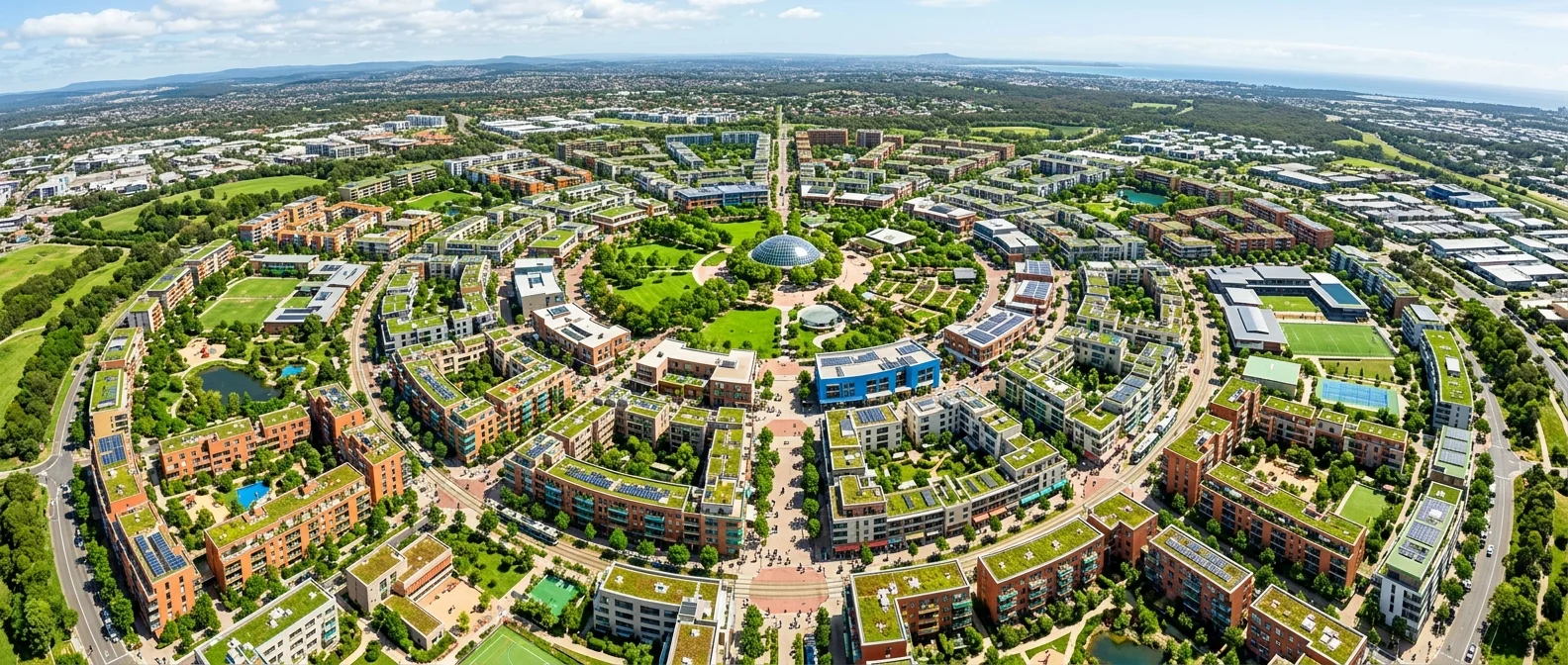
The idea is simple and old at the same time: every city resident should be able to reach the basics of daily life — work, school, healthcare, shops, recreation — within 15 minutes on foot or by bike. Nothing more. No traffic jams, no car dependency.
Carlos Moreno, a professor of urban planning at the Sorbonne, named this philosophy “chrono-urbanism” in 2016. The core principle: stop designing cities around roads and cars — design them around people's time.
Four pillars define the model: density, proximity, diversity, and digitalization. Mixed-use neighborhoods with shops next to homes, workspaces nestled between parks. No separate industrial zones, residential dormitories, and shopping malls on the city outskirts.
🇫🇷 Paris Is Leading the Way
Mayor Anne Hidalgo made the 15-minute city the centerpiece of her 2020 re-election campaign. And she followed through.
The city is converting old military buildings and parking structures into mixed-use spaces — housing, offices, and shops under one roof. School playgrounds become parks after hours. The Place de la Bastille is filled with trees again. Every street gets a bike lane.
The goal isn't to bully drivers — that's a myth. The goal is to give residents alternatives. If you can bike to work in 12 minutes, why sit in traffic for 45?
"We need to break the rhythm people are living in. Commuting is costly on every level — there's no pleasure in it, no comfort. That's why we need this revolution."
— Carlos Moreno, Sorbonne📖 Read more: Sandbox Cities: Technology Testing Zones
🌍 Who Else Is Trying
Paris isn't alone. Cities worldwide are copying the model, each with their own spin.
- Utrecht (Netherlands): 100% of residents can reach every service within a 15-minute bike ride. 94% within 10 minutes.
- Copenhagen (Nordhavn): Designed around the 5-minute rule — every amenity within 400 meters of a metro stop.
- Melbourne: “20-minute neighborhoods” in the Plan Melbourne 2017-2050 framework.
- Cleveland (USA): Mayor Justin Bibb created a “15-Minute City Index” evaluating every district.
- Shanghai: “15-minute community life circles” since the 2016 Master Plan. Adopted in Chengdu, Guangzhou, Baoding.
- Dubai: Dubai 2040 plan for a “20-minute city” — 55% of residents within 800 meters of a transit station.
🇬🇷 What About Greece?
Athens wasn't designed as a 15-minute city. It was essentially designed around the car. But its density — part of the problem — is also an advantage. Many central neighborhoods already offer proximity to services: bakeries, pharmacies, schools, open-air markets.
What's missing is infrastructure: wide sidewalks, bike lanes, green spaces. The “Grand Walk” project was a first step — controversial, incomplete, but in the right direction. Cities like Thessaloniki, Chania, and Trikala are also experimenting with pedestrianization and traffic calming.
The rule of 6 functions: According to Moreno, every “15-minute city” must serve 6 essential needs within close range: living, working, commerce, healthcare, education, and recreation. If even one is missing, the model doesn't fully work.
⚡ The Obstacles
The obstacles are real. In the US, the biggest threat is called single-family zoning — laws that only allow detached houses across vast stretches of land. In San Jose, 94% of residential land is zoned exclusively for single-family homes. There's no room for a bakery, let alone a clinic.
In many countries, the resistance is political. NIMBYism (Not In My Backyard): residents oppose any new construction near their homes. Banks refuse loans for mixed-use buildings because they're unfamiliar. And car dependency runs deep in the cultural fabric.
📖 Read more: Self-Sufficient Cities 2050: Zero Waste
🤦 Conspiracy Theories
Yes, you read that right. Starting in early 2023, waves of misinformation erupted — mainly in the US and UK — claiming that “15-minute cities” are tools of oppression. That governments would lock citizens inside their neighborhoods. “Open-air prisons,” they called them.
None of this is true. No 15-minute city proposal includes restrictions on movement. The confusion started because some cities (e.g., Oxford) introduced bus priority lanes — an unrelated measure — that got conflated with the concept. Moreno even received death threats.
🔮 Why It Matters
Car-based transport accounts for nearly 10% of global CO₂ emissions, according to the International Energy Agency. Reduce cars in cities, and you actually move the needle on emissions. But the case isn't just about climate.
More parks mean less stress, better sleep, more physical activity. Fewer cars mean fewer pedestrian deaths, less noise, cleaner air. Mixed-use neighborhoods mean foot traffic past storefronts — and that means thriving local businesses.
Moreno doesn't like the word “utopia.” He puts it differently: “There's no magic wand. It's a question of political will.” Political will depends on the residents. On us.
Sources:
NPR — "It's a global climate solution": npr.org
The Guardian — "Paris mayor unveils '15-minute city' plan": theguardian.com
Nature Cities — “A universal framework for inclusive 15-minute cities” (2024)