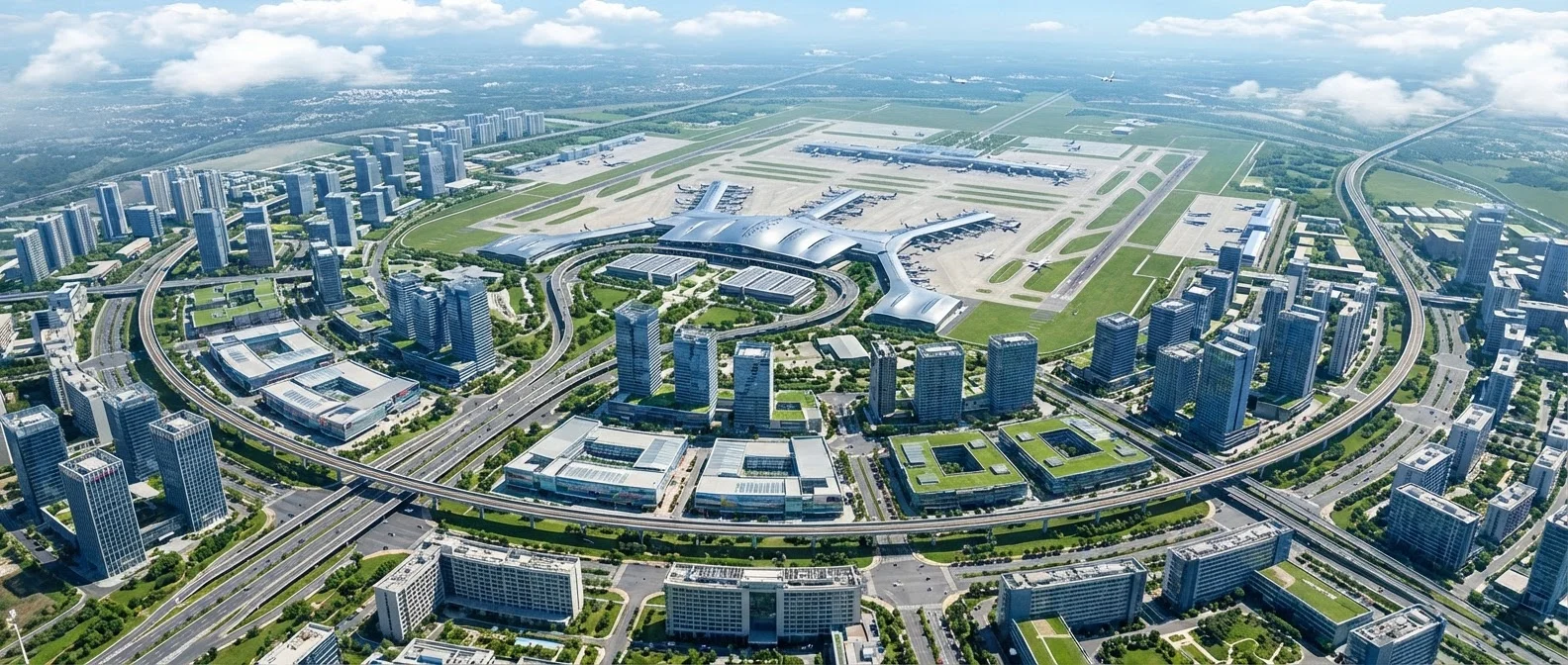
Imagine a city where everything — work, housing, entertainment, commerce — is within 15 minutes of a runway. This isn't science fiction. It's the Aerotropolis: a new model of urban planning built around airports as economic engines.
What Is an Aerotropolis?
The word “aerotropolis” combines “aero” (aviation) and “metropolis.” It first appeared in 1939 in a sketch by Nicholas DeSantis in Popular Science, depicting a skyscraper rooftop airport. The term was repurposed in 2000 by John D. Kasarda, a professor at the University of North Carolina, to describe a metropolitan area centered around an airport.
Kasarda argues that airports drive urban development in the 21st century, just as highways did in the 20th, railroads in the 19th, and seaports in the 18th century. In the aerotropolis model, “economies of speed” replace “economies of scale” — what matters isn't how far, but how fast you can connect.
How Does It Work?
An aerotropolis consists of two zones: the core (airport city) — featuring logistics, hotels, malls, and exhibition centers — and the broader periphery, with housing, offices, entertainment, education, and healthcare. The two zones are connected by rapid transit networks — metro, tram, and highways.
Pioneering Aerotropolises Around the World
🇳🇱 Amsterdam Schiphol
Schiphol exemplifies the model: 500+ companies, a shopping center, casino, and hotels. It is the 3rd largest employer in the Netherlands with 65,000+ workers.
🇰🇷 Songdo / Incheon
South Korea built the most ambitious version: an entire smart city from scratch next to Incheon Airport. Sensors everywhere, pneumatic waste collection, 40% green spaces.
🇺🇸 Dallas-Fort Worth
Dallas-Fort Worth pioneered the US model, attracting Fortune 500 headquarters like ExxonMobil and AT&T. Over 325,000 workers within a 10-mile radius of the airport.
🇸🇬 Changi / Jewel
Singapore's Changi Airport with its Jewel — the 40-meter indoor waterfall — redefines what an airport means. 280+ shops, gardens, cinemas, trampolines inside the terminal.
🇹🇼 Taoyuan Aerotropolis
A massive urban development program around Taiwan's Taoyuan International Airport. It includes an industrial zone, technology park, commercial center, and residential areas.
🇦🇪 Dubai World Central
Al Maktoum International in Dubai South was designed from scratch as an aerotropolis: 140 sq km with 1 million residents, logistics hub, aviation industry, and free trade zone.
Why Aerotropolises Change Everything
Speed Beats Distance
In the traditional model, proximity was the advantage. In the aerotropolis, connection speed replaces physical distance. A company may depend more on a supplier on the other side of the planet than one next door. Airports become “gateways” to the global economy.
In an era of globalization and time-sensitive logistics (pharmaceuticals, electronics, perishable foods), access to a hub airport provides a competitive advantage. It's no coincidence that companies like Amazon, FedEx, and UPS build massive logistics hubs next to airports.
Criticisms & Challenges
The idea is not without pushback. Critics argue the aerotropolis favors business interests over residents, locks up vast tracts of arable land, and commits to high-carbon infrastructure for decades. Aircraft noise, energy consumption, and dependence on fossil fuels remain major concerns.
The next generation emphasizes sustainability: electric aircraft, sustainable aviation fuels, green buildings, and renewable energy integration. Smart growth principles are now applied from the design phase.
The Future: Aerotropolis 2.0
Future aerotropolises will integrate eVTOL vertiports for air taxis, autonomous vehicles, 6G networks, and AI traffic management. These aviation cities will blur the line between urban centers and transportation hubs.
"Airports will become the hubs around which all urban development of the 21st century will be built."