📖 Read more: Artificial Consciousness: Can an AI Think?
The Loneliness Epidemic
In May 2023, the U.S. Surgeon General issued an unprecedented warning: loneliness and social isolation constitute a public health epidemic. The data is stark. Social isolation increases the risk of premature death by 29%. It raises the risk of heart disease by 29% and stroke by 32%. Among the elderly, chronic loneliness increases the risk of dementia by approximately 50%.
People who frequently feel lonely are more than twice as likely to develop depression. Meanwhile, time spent in face-to-face social interaction has been declining steadily for two decades. AI companions are filling that gap.
What Are AI Companions?
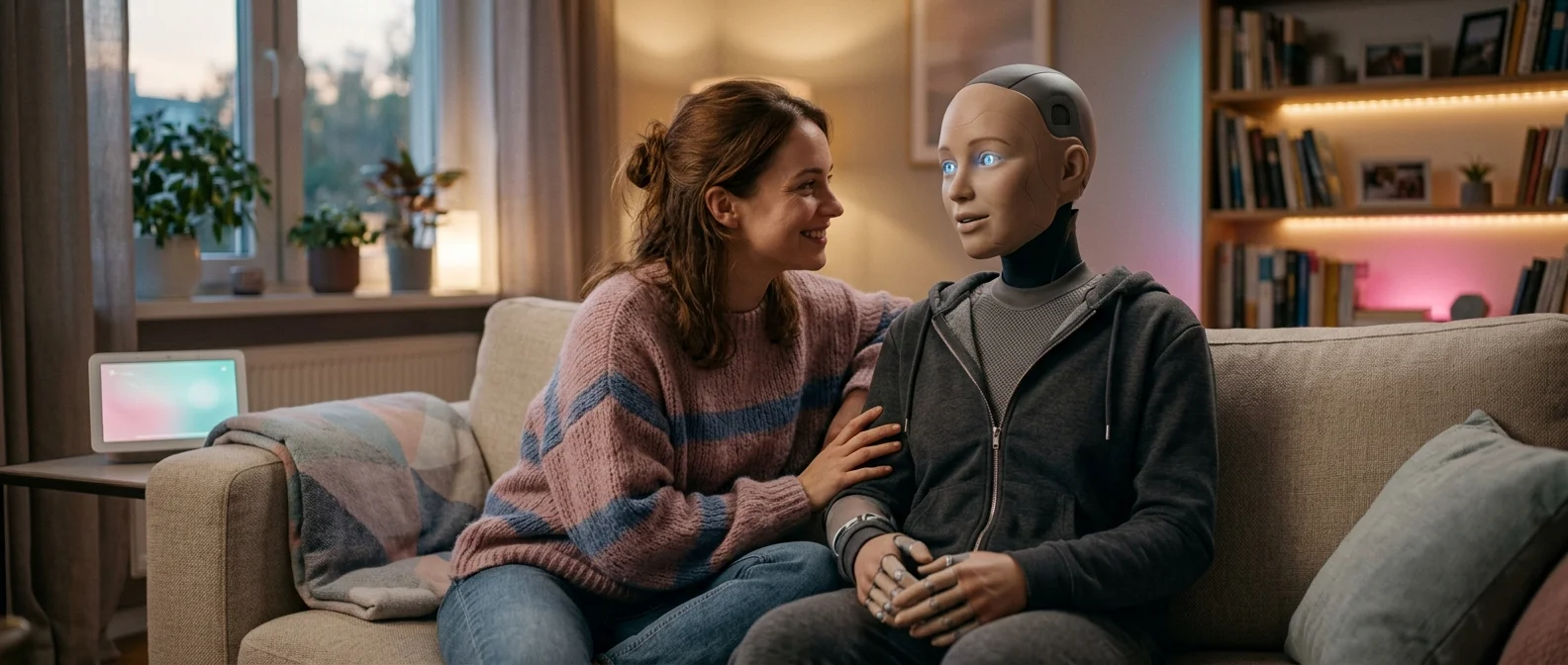
AI companions are chatbots (or robots) designed exclusively for companionship. Unlike AI assistants (Siri, Alexa, Google Assistant) that perform tasks, these systems aim at emotional connection. They learn your preferences, remember what you told them months ago, and adapt their tone to your mood.
The best-known platform is Replika, founded in 2017 by Luka, Inc. With over 10 million users, Replika offers a friend, partner, or mentor — depending on the user's choice. It runs on neural networks trained on massive language datasets, with additional features: video calls with 3D avatars, augmented reality (AR), mental health coaching, and a diary.
Character.AI, Nomi, Kindroid: The Competition
Replika isn't alone. Character.AI (founded 2021 by former Google engineers) surpassed 20 million monthly users, offering thousands of characters — from fictional heroes to therapists. Nomi AI focuses on deeper personalization, while Kindroid emphasizes realistic voice calls.
The Chinese market follows its own path: Xiaoice (originally a Microsoft research project) acquired 660 million users before becoming independent, while in Japan companion robots like LOVOT are gaining popularity as physical companions — warm, huggable robots with no practical function beyond companionship.
📖 Read more: Digital Clones: AI Avatars After Death
Elderly Care Robots
Companion robots are making their biggest impact where loneliness hits hardest. The robotic seal PARO — FDA-approved — is used in elderly care facilities to reduce anxiety and depression in dementia patients. ElliQ by Intuition Robotics, designed specifically for seniors, initiates conversations, suggests activities, reminds about medication — functioning as a digital companion that reduces loneliness without replacing human bonds.
AI companion platforms and companies (2024-2025):
- Replika (Luka, Inc.) — 10M+ users, 3D avatars, AR, video calls
- Character.AI — 20M+ monthly users, thousands of characters
- Nomi AI — deep personalization profiles, selfie photos
- PARO — therapeutic robotic seal, FDA-approved
- ElliQ (Intuition Robotics) — companion robot for seniors
- LOVOT (Groove X) — huggable robot with body temperature
Ethical Dilemmas and Risks
In February 2023, the Italian Data Protection Authority banned Replika due to insufficient age verification measures, as minors could interact with romantic AI features. The company removed erotic functions — provoking outrage from users who felt they were “losing” their digital partner. Some described the experience as grief.
The risks aren't theoretical:
- Emotional dependency: Users replace human relationships with AI, reducing motivation for real social contact
- Illusion of reciprocity: AI doesn't feel — but mimics empathy so convincingly that users treat it as a real entity
- Minor protection: Inadequate age verification mechanisms on many platforms
- Data and privacy: Enormous volumes of personal disclosures stored on corporate servers
Can an AI Become a “Partner”?
Psychologist Sherry Turkle (MIT) has studied human-machine relationships for decades. Her position is clear: AI cannot replace human relationships because real connection requires mutual vulnerability — something AI cannot offer. Other researchers argue that for people with social anxiety, autism, or chronic loneliness, an AI companion can function as a “bridge” toward real relationships — as long as it doesn't become a substitute.
By 2035, companion AI will likely combine voice, physical presence (through humanoid robots), long-term memory, and an emotional “model” of the user so detailed it will know when you need comfort before you ask. These advances are inevitable. The challenge now is regulating them before they replace what we need most: connection with actual people.
Key takeaways:
- Loneliness is now a recognized public health epidemic (Surgeon General, 2023)
- Replika exceeds 10M users, Character.AI over 20M monthly
- Companion robots (PARO, ElliQ) demonstrably help the elderly
- Italy became the first country to ban AI companion features (2023)
- Core risk: replacing human relationships instead of supplementing them
Sources: Replika — The AI Companion Who Cares, U.S. Surgeon General — Our Epidemic of Loneliness and Isolation (2023)