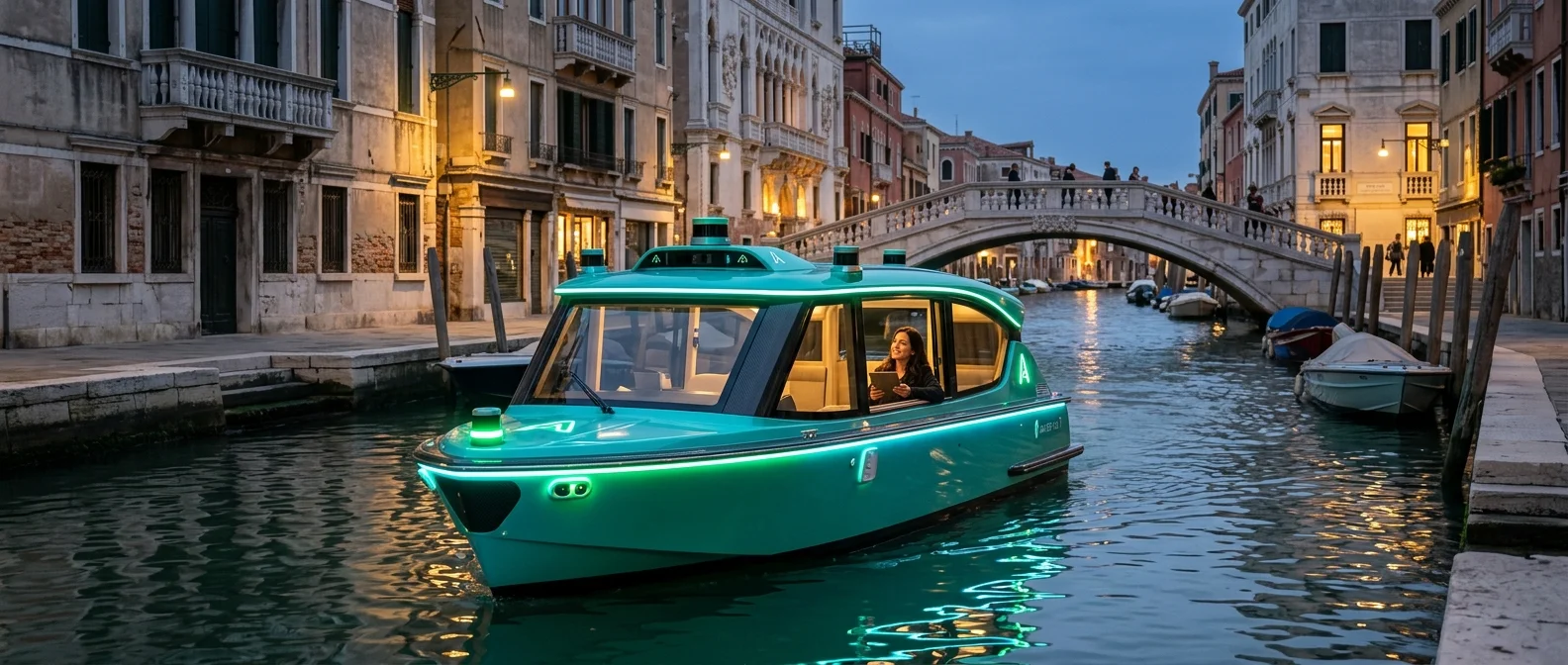
Amsterdam's canals, Venice's waterways, Asia's harbors. Wherever there's water, there's now artificial intelligence steering vessels. Autonomous boats are already operating in real-world conditions — and they're transforming how cities use their waterways.
Roboat: MIT's Autonomous Vessel
The most prominent project in this space is Roboat, a collaboration between MIT and Amsterdam's AMS Institute. What began as an academic research program has evolved into a commercial company (Roboat Tech), headquartered in the center of Amsterdam, developing add-on automation solutions for existing vessel fleets.
Roboat's system operates on three levels: Insights (aggregating fleet data onto a single platform for real-time monitoring and reporting), Assist (enhanced situational awareness for crew with live mapping and energy tracking), and Control (fully automated sailing and precision docking for repeated routes). Operators don't need to purchase new vessels — the technology retrofits onto existing boats.
Roboat already works on real-world applications: ferries on Amsterdam's IJ River (GVB IJ Ferries), water taxis, floating waste containers that autonomously collect trash from canals, and the Zoev City Barge — an autonomous cargo vessel transporting goods within the city. Each application tests a different aspect of the technology.
"We are a startup that is revolutionizing the way we use the inland waterways. Our goal is to transform the way boats operate through the use of automation."
— Roboat TechWhy Water Is Easier Than Roads
Water navigation sidesteps many challenges that plague autonomous cars. There are no pedestrians jumping into the lane, no traffic lights, speeds are lower, and reaction times are more forgiving — a collision at 5 knots is fundamentally different from one at 50 km/h. The environment is more predictable and obstacles are fewer and more detectable.
The technology is ready now. LiDAR, cameras, and GPS combined with machine learning algorithms allow a vessel to map its surroundings, avoid obstacles, and dock with centimeter-level precision. In the latest models, docking is fully automated — the vessel approaches on its own with accuracy that exceeds human capability, even in challenging wind and current conditions.
Urban Applications
But passenger transport is just the beginning:
- On-demand water taxis: Summon a boat via app, get picked up at the nearest dock, and ride to your destination — bypassing road traffic entirely
- City logistics: Transport goods, food, and packages through canals, reducing road congestion and delivery truck emissions in historic city centers
- Waste collection: Floating containers that autonomously navigate canals collecting garbage, keeping waterways clean around the clock
- Environmental monitoring: Water quality and atmospheric sensors on every vessel, creating a continuous real-time environmental data network
- Dynamic bridges: Vessels that connect to each other forming temporary floating pedestrian bridges on demand
Circular economy vision: Roboat's vision for Amsterdam includes an integrated system where autonomous vessels transport passengers during the day, collect waste at night, and continuously monitor water quality — one fleet serving multiple urban functions around the clock.
Autonomous Navigation at Sea
Autonomous watercraft extend well beyond city canals. Norway's Yara Birkeland is the world's first fully autonomous electric container ship, transporting fertilizer on short-haul routes along the Norwegian coast. America's Saildrone operates a fleet of autonomous sailing drones that traverse oceans collecting climate and oceanographic data for NOAA and other research organizations.
In recreation and tourism, Swedish company Candela builds electric hydrofoil vessels that “fly” above the water surface, reducing energy consumption by 80% compared to conventional boats. The Candela P-12 is already operating as an electric ferry in Stockholm, cutting commute times in half while producing zero emissions and minimal wake — a critical factor in protecting waterfront infrastructure.
Economic Benefits
Autonomous maritime transport offers a triple benefit. First, efficiency: crew costs are dramatically reduced, energy consumption is optimized through AI-powered route planning, and fleet management is simplified through centralized platforms. Second, safety: approximately 90% of maritime accidents are attributed to human error, and AI systems provide superhuman reaction capabilities and 360-degree awareness. Third, comfort: crew is freed from routine navigation duties and can focus on passenger service and experience.
Island Nations and Archipelago Potential
For countries with extensive coastlines and island networks, autonomous water transport could be revolutionary. Small autonomous electric vessels could connect islands at low cost, deliver food and medicine to remote communities, and offer high-tech tourism experiences. An on-demand water taxi system — electric, silent, emission-free — could connect island communities within years, not decades.
The Future of Water Transport
The sea has always been humanity's oldest road. Now it's becoming its future too. Autonomous AI-powered vessels, electric hydrofoils, self-configuring floating infrastructure — water is ready to become the most important transportation corridor for our cities once again. The companies building these technologies today are creating the maritime equivalent of the smartphone revolution — and the first passengers are already on board.