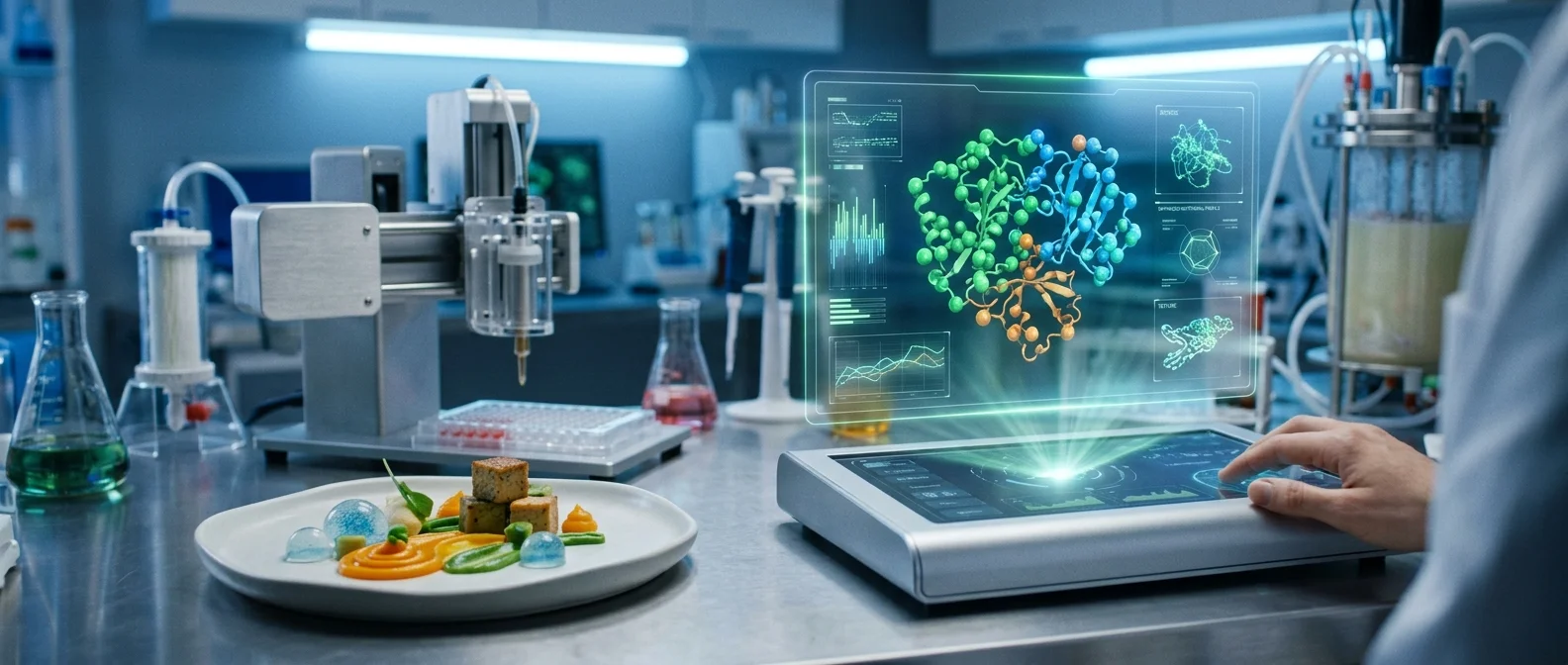
In October 2024, the Royal Swedish Academy of Sciences awarded the Nobel Prize in Chemistry to David Baker “for computational protein design.” Baker's prize reaches into kitchens, pharmaceutical labs, and manufacturing plants. What if we could design proteins that don't exist in nature, with atomic-level precision?
📖 Read more: AI Scientists: Discoveries Without Humans
🧬 Proteins: The Molecules That Do Everything
Proteins control and drive nearly every chemical reaction within living organisms. They're built from 20 different amino acids — life's building blocks — arranged in chains. How that chain folds determines the protein's shape and function.
Until recently, discovering new proteins meant looking in nature. Need a protein with a specific property? You had to find an organism that already produces it. Today, we can design them from scratch on a computer.
🏆 Nobel Prize in Chemistry 2024: David Baker
In 2003, David Baker at the Institute for Protein Design (IPD), University of Washington, achieved what many considered impossible: he designed a protein completely unlike anything found in nature, using computational methods he developed himself. That work — “computational protein design” — earned him half of the 2024 Nobel Prize in Chemistry.
The implications are immediate. We no longer need to find proteins in nature — we can invent them. Baker's team developed AI tools like RFdiffusion (which by December 2025 had already reached its third version), capable of designing proteins for specific purposes: drugs, vaccines, enzymes, sensors, even materials.
Baker's technology already has real-world results. A COVID-19 vaccine designed using computational methods was approved in the United Kingdom and South Korea — making it the 12th COVID-19 vaccine to receive Emergency Use Listing from the World Health Organization. In February 2026, human clinical trials began for the first vaccine targeting the entire SARS virus family.
📖 Read more: AI Gondolas: Autonomous Boats on Water
🍔 Precision Fermentation: Food Without Animals
The connection runs through your refrigerator. What does protein design have to do with what we eat?
Precision fermentation uses microorganisms as “cell factories” to produce specific food ingredients. A DNA sequence encodes the instructions, the microorganism executes them, and the result is exactly the protein you want — no animals, no slaughterhouses, at a fraction of the environmental footprint.
According to the Good Food Institute, precision fermentation can produce enzymes, flavoring agents, vitamins, natural pigments, and fats. Already, the majority of vitamins in nutritional supplements (B12, riboflavin, and others) are produced through fermentation. The technique isn't new — but AI has turned fermentation into precision manufacturing.
Three types of fermentation in alternative foods:
🔹 Traditional: Live microorganisms transform plant-based ingredients (tempeh, cheese, yogurt).
🔹 Biomass: The microbial biomass itself becomes food (Quorn, Meati — fungi with high protein content).
🔹 Precision: Microorganisms produce individual target molecules (dairy proteins, heme, collagen).
📖 Read more: AI Legal Rights: Should Robots Have Them?
🌱 Who's Building Tomorrow's Food Today
Perfect Day uses precision fermentation to produce whey protein without cows. This protein is combined with plant-based ingredients — sugar, coconut oil, sunflower oil — to create an ice cream base biologically identical to the “real thing.”
Impossible Foods took it further. They use soy leghemoglobin — a heme protein — produced through the yeast Pichia pastoris. This “heme” gives their plant-based burger the taste, color, and aroma of meat when cooked. Not marketing — molecular engineering.
Quorn uses the fungus Fusarium venenatum (discovered in the 1960s, commercialized in the '80s) and pioneered an energy-efficient air-lift bioreactor design. Meati also relies on filamentous fungi to produce whole “meat” cuts.
Even more exotic: Geltor — a precision fermentation collagen platform — can produce collagen from any species. Even extinct ones. In 2018, they showcased gummy snacks made with mastodon collagen. Yes, mastodon.
Nature's Fynd produces protein from extremophile fungi found in thermal springs at Yellowstone National Park, while Air Protein uses gaseous feedstocks — hydrogen, methane, even CO₂ — as raw materials.
🔬 Beyond the Plate
AI protein design doesn't stop at food. At Baker's IPD, designed proteins are being tested as drugs, vaccines, nanoscale drug carriers, biological sensors, and self-assembling nanomaterials.
Consider KumaMax: KumaMax, an enzyme designed at the IPD for treating Celiac disease. It started as an undergraduate project, evolved into a company, and Takeda Pharmaceuticals is now testing it in human clinical trials.
In December 2025, Baker's team released RFdiffusion2, which designs efficient enzymes directly from prompts, followed immediately by RFdiffusion3 — the third generation of their core design tool. In medicine, designed proteins have already entered clinical trials: in February 2026, human trials began for a vaccine targeting the entire SARS virus family.
📖 Read more: AI Teachers: How We'll Learn in the Future
📊 Numbers and Outlook
Precision fermentation is advancing fast, but challenges remain. Scaling production, reducing costs to competitive levels, and regulatory approval for new microbial strains are still open questions.
Key challenges:
🔸 Feedstocks (fermentation raw materials) represent the largest operational cost — a shift toward diverse sources (agricultural byproducts, gases) is needed.
🔸 Very few microbial species (out of hundreds of thousands known) have been commercialized for food — regulatory barriers slow adoption of new strains.
🔸 AI-based molecular structure prediction dramatically reduces development time: instead of years in the lab, proteins can be designed in hours.
The convergence of two fields — computational protein design and precision fermentation — creates a chain: AI designs the molecule, fermentation produces it. What sounds theoretical is already happening in factories.
It won't replace traditional foods tomorrow. But within a decade, the likelihood that some of the proteins on your plate were designed on a computer is no longer science fiction — it's engineering.