📖 Read more: Green vs Blue Hydrogen: The Great Battle
📖 Read more: Deep Geothermal: Energy from Earth's Core
The Artificial Photosynthesis Revolution
A 4-inch square leaf floats on Cambridge's River Cam. It's not real — it's an artificial device that mimics plant photosynthesis, converting sunlight into fuel. This breakthrough opens new pathways for energy production where land space is scarce.
Cambridge University researchers, led by Erwin Reisner, developed a solar fuel cell from lead perovskite — a crystal type that captures light energy. The device produces hydrogen and carbon monoxide bubbles, which can be mixed to create a fuel called syngas.
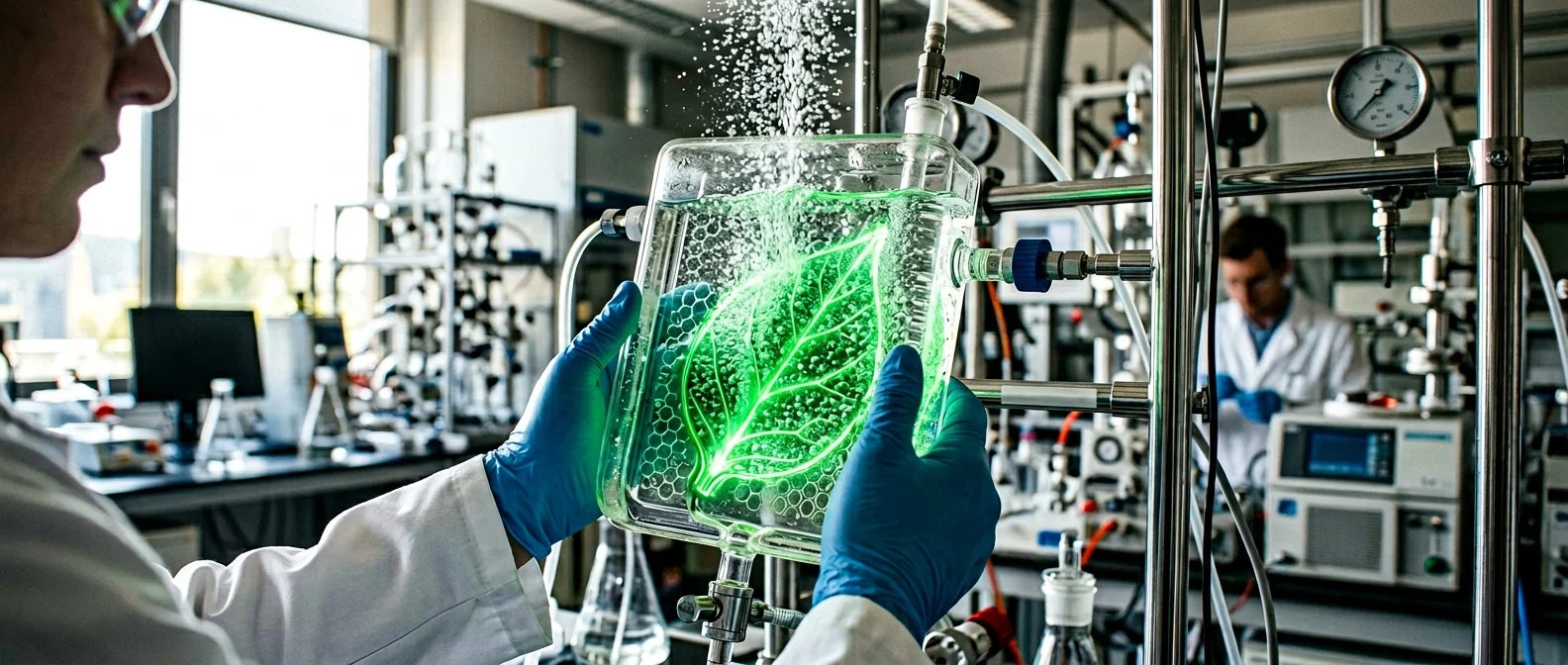
How Artificial Photosynthesis Works
Solar fuel cells use sunlight energy to power chemical reactions that produce fuels, unlike photovoltaic cells that convert sunlight into electricity. Researchers have pursued mimicking plant photosynthesis for years with a synthetic process that produces fuel from carbon dioxide, water, and sunlight.
The prototype measures roughly 4 inches wide and one millimeter thick. In River Cam tests, it produced hydrogen with 0.58% efficiency and carbon monoxide with 0.0053% efficiency. Gram for gram, it matches current solar fuel technologies and even some plants.
Floating Technology for Marine Applications
The device's floating capability is a major advantage. As Reisner explains, "it's the first of its kind for solar fuels." There are many significant developments for photovoltaics where people are looking at floating photovoltaic farms, and they thought something very similar could be done for solar fuels.
The manufacturing process, involving depositing a thin perovskite film on polyester coated with indium and tin, is easily scalable. However, several problems remain to be solved.
Key Challenge: Efficiency must approach 10% for commercial applications, while materials used in the prototype could be potentially toxic to aquatic systems, though they're contained within the device.
📖 Read more: OTEC: Energy from Ocean Temperatures
Challenges and Future Developments
Reisner and his team haven't yet designed a method for collecting gas bubbles from the device, but they hope the leaf will serve as proof of concept for commercial devices. This represents one of the main technical hurdles to overcome.
Meanwhile, the solar energy industry has made stunning progress. According to Harry Atwater, director of the Joint Center for Artificial Photosynthesis at California Institute of Technology, in the mid-1980s there were only a few megawatts of solar energy globally — enough to power a supermarket. Now, solar technology has global production of roughly 500 gigawatts.
Solar Energy Evolution
| Period | Global Capacity | Characteristics |
|---|---|---|
| Mid-1980s | Few MW | Laboratory use |
| Today | 500 GW | Mass commercial use |
| Target | 10% efficiency | Commercial viability |
Economic Prospects
Solar energy has become so cheap it will soon surpass fossil fuels as the world's preferred electricity source. In 2018 alone, $131 billion was invested in solar energy. Jenny Chase, a Bloomberg NEF analyst examining clean energy costs, says she's been surprised by solar energy's progress.
Artificial photosynthesis could play a crucial role in this evolution, particularly in areas where available land space is limited. The ability to install floating systems on seas and lakes opens new possibilities for harnessing solar energy.
Floating Technology
Installation capability on water surfaces without using land
Direct Fuel Production
Converts sunlight directly into useful fuels
Scalable Manufacturing
Simple production process for mass application
Nature Mimicry
Based on natural photosynthesis process
📖 Read more: Green vs Blue Hydrogen: The $500B Energy Battle
Environmental Impact
Artificial photosynthesis offers a promising solution for reducing carbon emissions. Using carbon dioxide as raw material, the technology could help decrease atmospheric CO2 concentrations while producing useful fuels.
Cheap solar energy will be critical if we want any chance of limiting global warming to 1.5°C. Artificial photosynthesis could be a significant tool in this effort, especially as the technology matures and its efficiency improves.
Environmental Benefits: The technology uses CO2 as raw material, contributing to carbon emission reduction while producing clean fuels from renewable sources.
Technical Barriers and Solutions
Despite progress, significant challenges must be addressed. The device's current efficiency is still too low for commercial use. To become viable, efficiency must reach roughly 10%, a substantial increase from current levels.
The materials used in the prototype could be potentially toxic to aquatic ecosystems. While materials are contained within the device, developing safer alternatives will be necessary for mass application in aquatic environments.
Advantages
- Floating technology
- Direct fuel production
- Scalable manufacturing
- Uses CO2 as raw material
Challenges
- Low efficiency (0.58%)
- Potentially toxic materials
- No collection system
- Need for 10% efficiency
The Future of Artificial Photosynthesis
Artificial photosynthesis is still in early development stages, but prospects are encouraging. As researchers continue improving efficiency and addressing technical barriers, the technology could become a significant tool in fighting climate change.
The ability to produce fuels from sunlight, water, and carbon dioxide represents a fundamental shift in how we think about energy. Instead of relying on fossil fuels stored for millions of years, we could produce fuels in real-time using solar energy.
Artificial photosynthesis represents one of the most promising technologies for energy's future. Despite current challenges, the ability to convert sunlight directly into fuels could revolutionize how we produce and use energy, contributing significantly to the fight against climate change.
Sources: