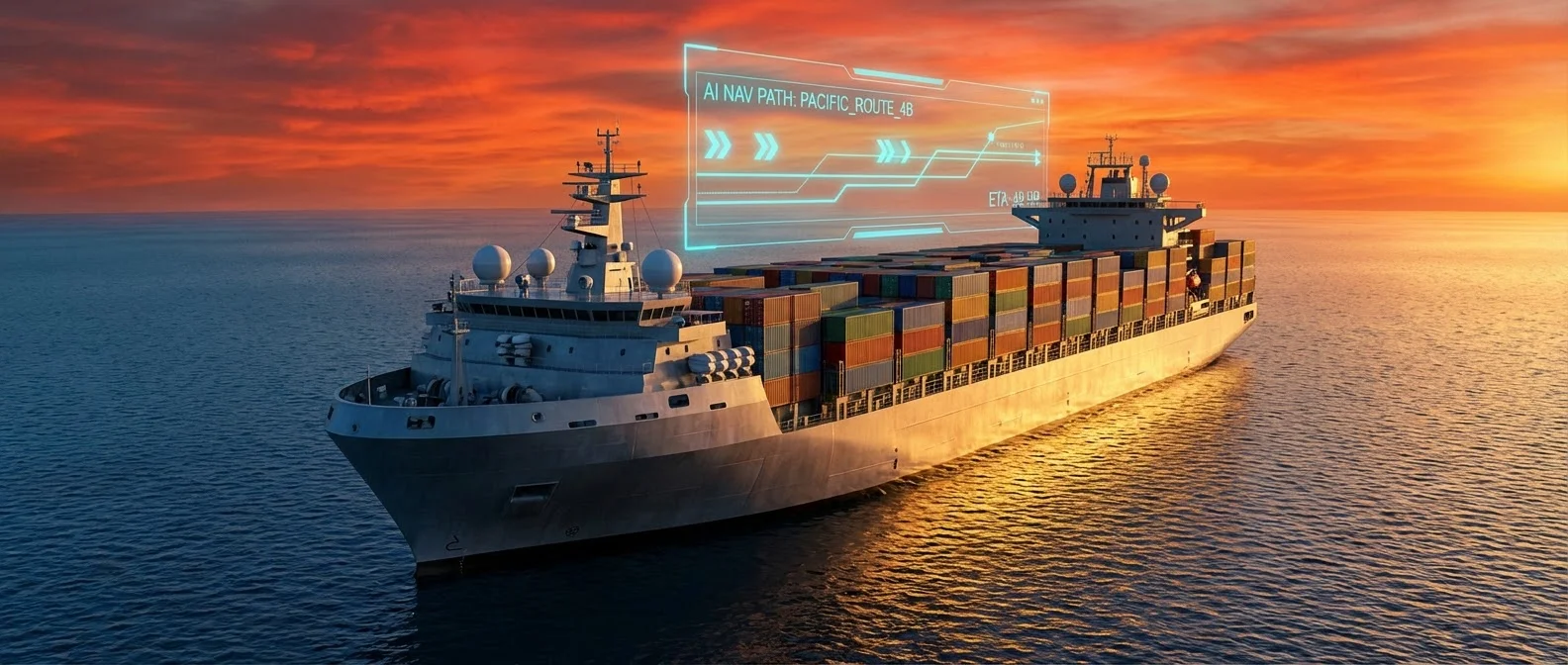
Imagine cargo containers crossing the Atlantic with no one on the bridge. This isn't science fiction — autonomous ships already exist, and shipping is preparing for its most radical transformation in centuries. From the first autonomous container vessel in Norway to floating robots in Amsterdam's canals, the sea is changing face.
Why Autonomous Ships?
Maritime shipping is the backbone of global trade, carrying over 90% of the goods we consume. However, it faces enormous challenges: human error accounts for 75-96% of maritime accidents, crew fatigue is a chronic issue, and the industry emits roughly 2.5% of global greenhouse gases.
Autonomous ships promise to radically change this landscape. By eliminating or reducing the human factor, using artificial intelligence for optimal navigation, and adopting electric propulsion, shipping can become safer, more economical, and greener.
Autonomy Levels in Shipping
The International Maritime Organization (IMO) defines Maritime Autonomous Surface Ships (MASS) at four autonomy levels, similar to self-driving cars:
📍 Degree 1: Crew with Support
Automated systems support decisions. Crew is present and takes over when needed. Already operational on many modern vessels.
🛰️ Degree 2: Remote Control with Crew
The ship is controlled remotely, but crew remains on board for safety. They take over in emergency situations.
🤖 Degree 3: Remote Control without Crew
Full remote control from a shore-based center. No crew on board. Human operator makes decisions at critical points.
🧠 Degree 4: Full Autonomy
The AI system makes all decisions autonomously. No human intervention. A goal considered achievable after 2035.
Yara Birkeland: The First Autonomous Cargo Ship
In November 2021, Norway made history: the MV Yara Birkeland, the first fully electric and autonomous container vessel, began its voyages. Named after Yara International and Norwegian scientist Kristian Birkeland, the ship represents a massive step toward the future of shipping.
🚢 Yara Birkeland Technical Specifications
Length 80 meters, capacity 120 TEU, battery 6,800 kWh, cost $25 million, designed by Marin Teknikk, navigation system by Kongsberg Maritime. Sails between Herøya and Brevik (13 km) replacing 40,000 truck trips annually. Prime Minister Jonas Gahr Støre attended the maiden voyage.
The significance of Yara Birkeland goes beyond technology: it proves that autonomous ships can eliminate thousands of truck trips, dramatically reducing CO₂ emissions and traffic congestion. Despite its 3,200 DWT, it serves as a proof of concept for much larger vessels of the future.
Japanese Pioneering
Japan leads autonomous shipping development with two breakthroughs:
In February 2022, the passenger ferry Sunflower Shiretoko sailed autonomously for 750 km, showing the technology works on large car ferries too.
The Technology Behind Autonomous Ships
An autonomous ship isn't simply a ship without a wheel. Rather, it's a complex ecosystem of technologies:
🛰️ Satellite Navigation
Multi-frequency GPS/GNSS, ECDIS, AIS receiver, INS (inertial navigation). Ensuring centimeter-level accuracy even in open ocean.
🎯 Sensors & Radar
LiDAR, thermal cameras, ultrasonic sonar, X-band and S-band radar. Creating 360° environmental awareness, day and night, in any weather condition.
🧠 Artificial Intelligence
Deep learning for object recognition, predicting other vessels' movements, route optimization based on weather and ocean currents. Machine learning from millions of nautical miles of data.
📡 Satellite Communications
VSAT, Starlink, 5G maritime networks. Continuous connection with shore-based control centers for remote operation, over-the-air software updates, and telemetry data streaming.
Floating Robots in Cities
Autonomous shipping isn't just about the oceans. In 2021, Roboats — autonomous floating vessels built by three academic institutions — were deployed in Amsterdam's canals. These floating robots can carry up to 5 passengers, collect waste, deliver goods, monitor the environment, and even create “on-demand infrastructure” — bridges, floating platforms, temporary docks.
"Autonomous vessels can transform urban waterways into transportation arteries, decongesting roads and reducing pollution."
Saildrone: Autonomous Ocean Explorers
Saildrones represent the cutting edge of autonomous ocean research. Powered exclusively by wind and solar energy, these research robots perform missions that would be impossible or prohibitively expensive for humans:
- First autonomous Antarctic circumnavigation: 12,500 miles over 7 months, collecting climate data
- First double Atlantic crossing: SD 1021 completed the Bermuda-UK route and back (2019)
- First research vessel inside a Category 4 hurricane: SD 1045 entered Hurricane Sam (2021), providing unprecedented video and data
- Baltic Sea surveillance (2025): Denmark deployed 4 Saildrones to monitor Russia's “shadow fleet” of embargo-breaking oil tankers
Military Use: Sea Drones
The war in the Black Sea during Russia's invasion of Ukraine revealed the strategic value of naval drones. Ukrainian autonomous vessels (USVs) — lightweight, cheap ($250,000 each), 5.5 meters long, with a speed of 80 km/h and 60-hour endurance — achieved:
- Sinking the Russian corvette Ivanovets (February 2024) using a USV swarm
- Sinking the landing ship Tsezar Kunikov using MAGURA V5 USVs
- Forcing the Russian fleet into a defensive posture, locked in port
- Shooting down a Russian Su-30SM fighter jet with an R-73 missile from a sea drone (May 2025) — a world first
⚔️ Strategic Value
The attack on Sevastopol Naval Base (October 2022) with 7 USVs forced the Russian fleet into a defensive posture. According to the U.S. Naval Institute, “the Russian Navy now knows it is vulnerable in its main naval base.” An entire maritime strategy is being reshaped by vessels that cost a fraction of the ships they threaten.
Challenges and Obstacles
The shift to autonomous shipping still faces major obstacles:
The Future: Timeline of Developments
📅 2025-2028
Remotely operated ships on fixed routes. Autonomous ferries in fjords and protected waters. Commercial Saildrone use in meteorology and fisheries.
📅 2028-2033
Autonomous container ships in coastal shipping. First crewless vessels with full IMO regulatory coverage. Autonomous “floating warehouses” in major ports.
📅 2033-2040
Transoceanic autonomous cargo ships. Crewless floating logistics centers. Maritime drones in blockade operations, search and rescue, and environmental monitoring.
Greece and Autonomous Shipping
Greece, as the world's largest shipping power (Greek-owned ships carry ~20% of global trade), cannot ignore autonomous vessels. Greek shipping companies are closely monitoring developments, while Greek universities (NTUA, University of the Aegean) are researching AI navigation and maritime cybersecurity.
Greek maritime tradition and tech innovation could make the country a leader — if it invests in R&D, education, and regulations.
"Autonomous shipping isn't just about technology. It's about redesigning the entire way we transport goods, energy, and people across the seas."
What Does This Mean for Us?
Autonomous shipping will reshape daily life in unexpected ways. Cheaper products (reduced transport costs), cleaner air in port cities (electric ships), faster deliveries (24/7 operation without fatigue), new professions (ship control center operators, maritime AI engineers) — but also the disappearance of traditional maritime jobs.
The sea, the oldest trade route, stands on the brink of a new era. Ships without humans, with artificial intelligence at the helm, will cross the oceans non-stop — 365 days a year, without fatigue, without errors, without emissions. The question isn't whether it will happen — but how fast.