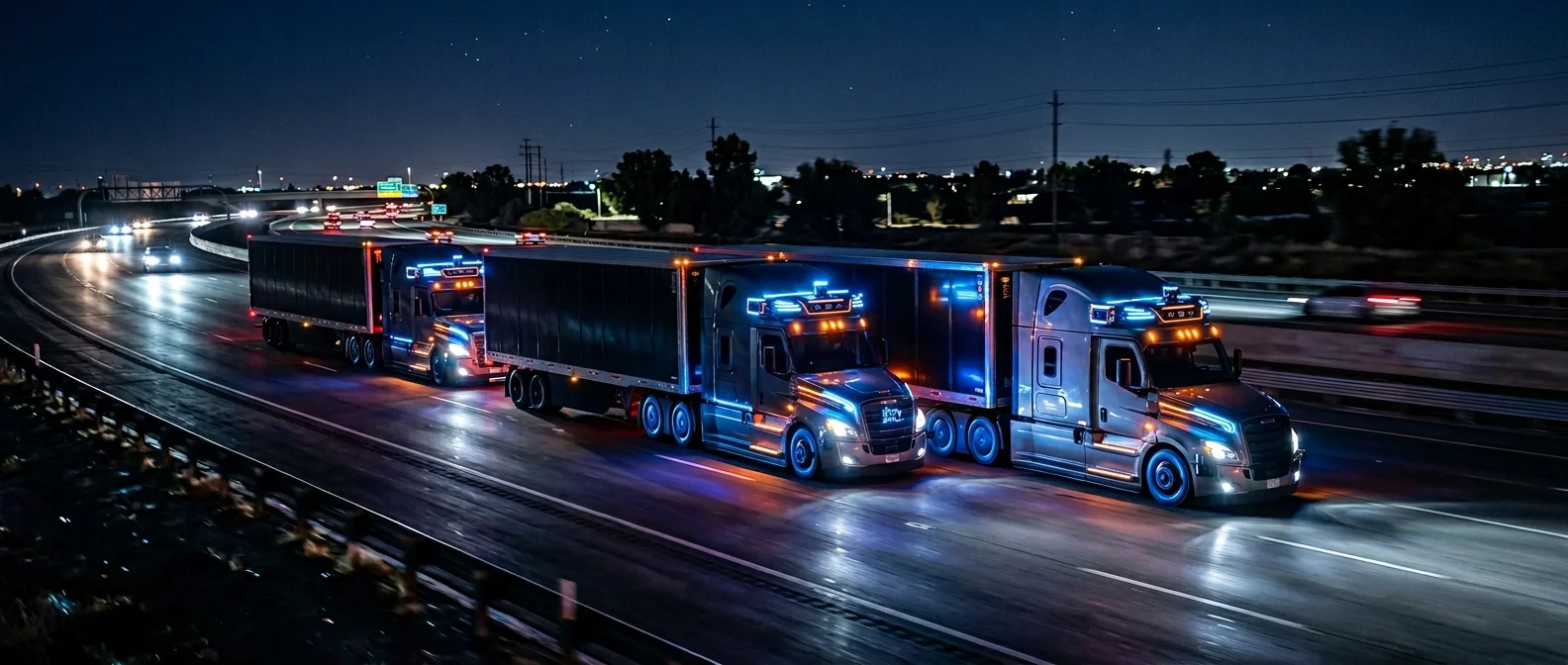
Picture a Texas highway at three in the morning. An 18-wheeler rolls along at 65 mph, hauling freight from Fort Worth to El Paso. Inside the cabin sits nobody. Nobody is falling asleep at the wheel — because the wheel, for all practical purposes, is no longer needed. This is not science fiction. It has been happening commercially since May 2025.
Why Freight Transport Is Changing Radically
The U.S. trucking industry is worth over $800 billion annually. It moves virtually everything — food, medicine, electronics, raw materials. Yet it faces a crisis that deepens every year: there aren't enough drivers.
The American Trucking Associations estimates the country needs roughly 80,000 additional truck drivers. The average driver age exceeds 55, while younger workers show little enthusiasm for a job that means weeks away from home, overnight runs, and a poor quality of life. Meanwhile, demand for faster deliveries keeps climbing — e-commerce exploded after the pandemic and shows no sign of slowing down.
Then there's safety. According to data cited by Kodiak AI, more than 85% of crashes involving heavy vehicles in the U.S. are caused by human error. Between 2021 and 2023, large truck crashes claimed over 15,000 lives on American roads. Fatigue, distraction, pressure — problems that an AI system, in theory, doesn't face.
Aurora Innovation — The First Commercial Reality
On May 1, 2025, Aurora Innovation made history. Trucks equipped with the Aurora Driver system began commercial driverless routes in Texas, hauling real freight for major logistics companies. It was the first time Level 4 autonomous trucks operated commercially on public highways.
Three months later, in August 2025, Aurora's trucks cleared another milestone: routes running day and night, with no time-of-day restrictions. A human crew must take mandatory rest breaks every 11 hours under federal regulations. An autonomous truck stops only for fuel.
In October 2025, the Fort Worth – El Paso lane was added, a route spanning nearly 600 miles through barren desert terrain where monotony makes nighttime driving particularly dangerous for humans. In December, energy services company Detmar commissioned an expanded fleet of Aurora autonomous trucks.
The biggest announcement came in February 2026: Aurora tripled its network to 10 routes and is gearing up to expand across the entire U.S. Sun Belt — the band of southern states stretching from Texas to Florida and Arizona. Customers include FedEx, Werner, Schneider, Uber Freight, and Ryder.
What Is the Aurora Driver?
It's an integrated autonomous driving system combining LiDAR, radar, and high-resolution cameras. Each truck is “born” with millions of miles of driving experience — virtual and real — and improves continuously via OTA (over-the-air) updates. Aurora partners with PACCAR (Peterbilt, Kenworth) and Volvo Autonomous Solutions for the vehicles.
Kodiak AI — From Highways to the Battlefield
Kodiak AI, headquartered in Dallas, follows a different strategy. It isn't limited to commercial trucks — it's building a unified autonomous driving platform that works on highways, city streets, and even off-road over rough terrain.
The technology's core is called the Kodiak Driver: an AI-powered virtual driver with a multi-sensor architecture that adapts to every platform. It improves continuously through real-world data and advanced simulation.
In January 2026, Kodiak announced a strategic agreement with Bosch — the world's largest automotive supplier — to scale autonomous driving sensor hardware. This partnership marks Kodiak's transition from testing to commercial manufacturing.
Beyond commercial transport, Kodiak has military ambitions. In February 2026, the U.S. Marine Corps (USMC) awarded the company an autonomous ground vehicle development contract under the Rogue Fires program. The goal: autonomous vehicles transporting ammunition, supplies, or even weapon systems into combat zones without exposing military personnel.
How an Autonomous Truck “Sees”
An autonomous truck doesn't have eyes — it has sensors that never blink. A typical system includes:
- LiDAR (Light Detection and Ranging): Emits millions of laser pulses per second, building a real-time 3D map of the surroundings. Detects objects at 300+ meters even in total darkness.
- Radar: Works reliably in rain, fog, and dust where LiDAR struggles. Measures speed and distance of moving objects.
- High-resolution cameras: Read signs, traffic lights, and lane markings — information the laser sensor can't pick up.
- Navigation AI: Fuses data from all sensors 40+ times per second. Predicts the behavior of nearby vehicles, pedestrians, and cyclists. Plans trajectories and executes decisions in milliseconds.
Aurora describes its system as “superhuman perception” — it sees 360 degrees simultaneously, never tires, never gets distracted, never takes a phone call while driving. In test videos, Aurora trucks automatically detect and avoid drivers running red lights, vehicles making unpredictable lane changes, and dark objects sitting in the middle of the road.
SAE Level 4: What It Means in Practice
Autonomous driving is classified into 6 levels (0-5). At Level 4, the system handles everything within a defined operational domain — e.g., highways with clear markings. If something goes wrong, the system brings the vehicle to a safe stop on its own. No human intervention is required.
The Hard Questions
Technology is outpacing both legislation and public acceptance. Key questions still need answers.
Jobs: About 3.5 million people work as truck drivers in the United States. Automation won't replace them overnight — the first autonomous routes target long-haul highways, not urban deliveries. Companies like Aurora emphasize that human drivers will still be needed for the “last mile,” loading, and complex urban routes. Still, the concern is legitimate: over 10-15 years, demand for long-haul drivers will drop dramatically.
Legal framework: Who's liable when an autonomous truck causes an accident? The vehicle manufacturer? The software company? The fleet owner? In the U.S., Texas allows autonomous driving without a special permit — which is precisely why every company launched there first. Aurora explicitly calls for federal standards: a January 2026 blog post is titled “Driverless, Not Ruleless: Why 2026 Is the Year for Federal AV Standards.”
Edge cases: Ice on the road, a sudden landslide, a police officer directing traffic by hand, a military convoy. These scenarios keep autonomous systems engineers awake at night. Kodiak developed a specialized system for recognizing “negative obstacles” — potholes, dips in the road, open manholes — published in January 2026.
When Will They Reach Europe?
The European Union approved a regulatory framework for automated vehicles in July 2022, but implementation remains slow. European roads are narrower, urban areas denser, and labor regulations stricter.
Daimler Truck, through its subsidiary Torc Robotics, is developing autonomous Freightliner Cascadias for the U.S. while planning European versions featuring Mercedes-Benz trucks. Volvo Autonomous Solutions — already partnering with Aurora — is preparing hub-to-hub routes in Scandinavia.
The reality? By 2028-2030, autonomous trucks will be running commercially across dozens of American states. In Europe, the first highway pilot programs are expected by 2027-2028, with full commercial operations likely after 2030. In Greece, where highway digital infrastructure is still incomplete, a realistic timeline stretches past 2032.
A new era in transport isn't knocking on the door — it has already walked in. Driverless trucks are no longer experimental prototypes on closed tracks. They're driving on real highways, hauling real freight, getting paid for real services. The question is no longer “if” but “how fast” every highway we know will change.