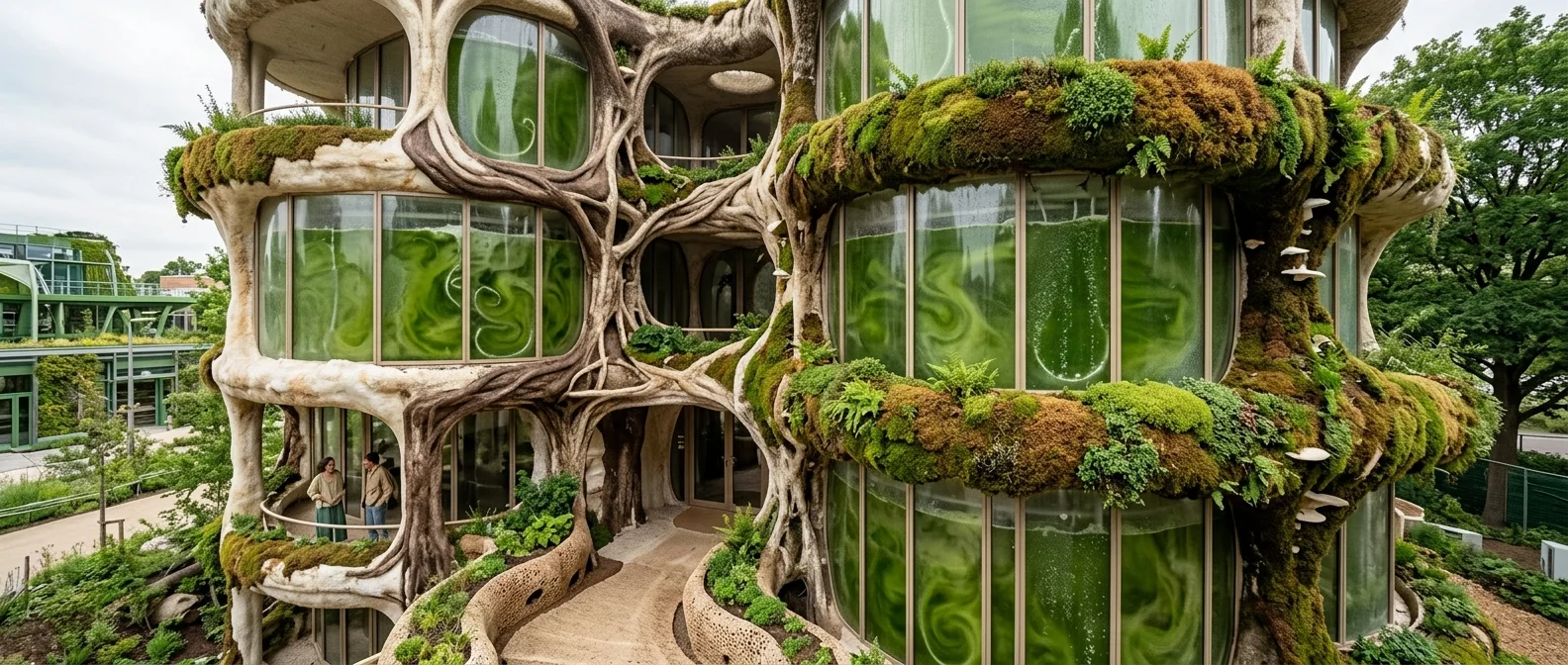
Imagine a building that wasn't built — it grew. Its walls are mycelium that developed in molds within a single week. Its concrete was produced by bacteria at room temperature, without kilns and without emissions. And when a crack appears, it doesn't need repair — the material seals itself. This isn't the future of 2050. These are technologies being tested right now.
📖 Read more: Bioluminescent Buildings: Architecture That Glows
Why Buildings Are Part of the Problem
Cement production accounts for roughly 8% of global CO₂ emissions — more than all airlines combined. Producing a single ton of Portland cement requires temperatures of 1,450°C in rotary kilns burning limestone. Each year, 4.1 billion tons of cement are produced worldwide — and demand is rising as Asia and Africa urbanize.
Beyond cement, construction generates about 35% of solid waste globally. Concrete, steel, glass — materials demanding enormous energy inputs that never decompose. Bio-architecture proposes a radically different philosophy: instead of mining and burning, we grow.
Mycelium — The Material That Grows Itself
Mycelium is the underground network of threads (hyphae) of fungi. Biologically, it's closer to animals than plants — which explains why it bonds so tightly when dried. If you let it develop in a mold filled with agricultural waste, in 7 days you get a compact, lightweight, fire-resistant, compostable block.
The company that pioneered this field is Ecovative, founded in 2007 by Eben Bayer and Gavin McIntyre in New York. They started with Mushroom Packaging used by Dell and Steelcase — grows in 7 days, composts in 45. In 2018 they moved to mycelium building insulation: fire-resistant, carbon-negative, with 40+ patents worldwide.
Today, Ecovative operates a 180,000 sq ft facility in Green Island, New York, converts 10+ million pounds of feedstock (mainly wood waste) into mycelium products annually, and has secured $26M+ in federal funding from DARPA, NSF, USDA, and EPA. In 2025 it achieved positive profit margins at commercial scale with 4× revenue growth.
Hy-Fi: The Mushroom Tower at MoMA
In 2014, architect David Benjamin (The Living studio) built the Hy-Fi tower at MoMA PS1 in New York entirely from Ecovative mycelium bricks. After the exhibition ended, the bricks were fully composted — zero waste.
Bio-Cement — Bacteria Instead of Kilns
Biomason, based at Research Triangle Park in North Carolina, drew inspiration from nature — specifically from the way corals build reefs. It uses bacteria that form calcium carbonate crystals in the pore spaces between aggregate particles, at room temperature. The result? Concrete containing zero Portland cement that sequesters carbon instead of emitting it.
In 2023 the Biobeton factory was qualified in Denmark, in partnership with IBF — Denmark's largest precast concrete producer. The factory uses the same industrial equipment (mixer, press) as conventional plants, with adapted feeding and curing systems to enable biocementation.
📖 Read more: AI vs Creativity: Does It Surpass the Average Human?
Self-Healing Concrete
Dutch microbiologist Henk Jonkers at Delft University of Technology developed concrete that repairs its own cracks. The idea is simple and elegant: capsules containing Bacillus bacteria and nutrients are embedded within the concrete. When a crack appears and water seeps in, the bacteria activate and produce limestone that seals the crack.
The company Basilisk (Netherlands) commercialized Jonkers' technology. Their product can seal cracks up to 0.8 mm wide. For infrastructure — bridges, tunnels, parking structures — this means saving millions of euros in repairs over decades. The bacteria remain dormant for decades inside the concrete, waiting for moisture to “wake up.”
Other Living Materials
Mycelium and bio-cement lead a broader wave of biological materials entering construction:
- Hempcrete: A mixture of hemp and lime. Negative carbon footprint (100 kg CO₂ sequestered per cubic meter), excellent thermal insulation, humidity regulation. Already in use for residential buildings in France and Belgium.
- Algae facades: The BIQ building in Hamburg (2013) was the world's first with a façade of microalgae photobioreactors. The algae produce biomass and heat while regulating the building's shading.
- Mass timber (CLT): Cross-laminated timber panels that rival concrete in strength. Mjøstårnet in Norway (85.4 m) is the world's tallest timber building.
The Scaling Challenge
The bottleneck isn't technology — it's regulations and habits. Building codes were written for cement and steel. Approving a new material for construction requires years of durability testing, fire safety, seismic behavior, and aging studies.
Cost also remains high compared to conventional concrete. Solar panels followed the same trajectory 15 years ago — scale drives prices down. Ecovative has already cut unit costs by 65% in a single year. Biomason uses existing industrial equipment to reduce capital entry costs.
A conventional building is dead matter that deteriorates from day one. A biological building repairs itself, grows stronger over time, and returns to the earth when no longer needed. These technologies have already moved from lab benches to factory floors.