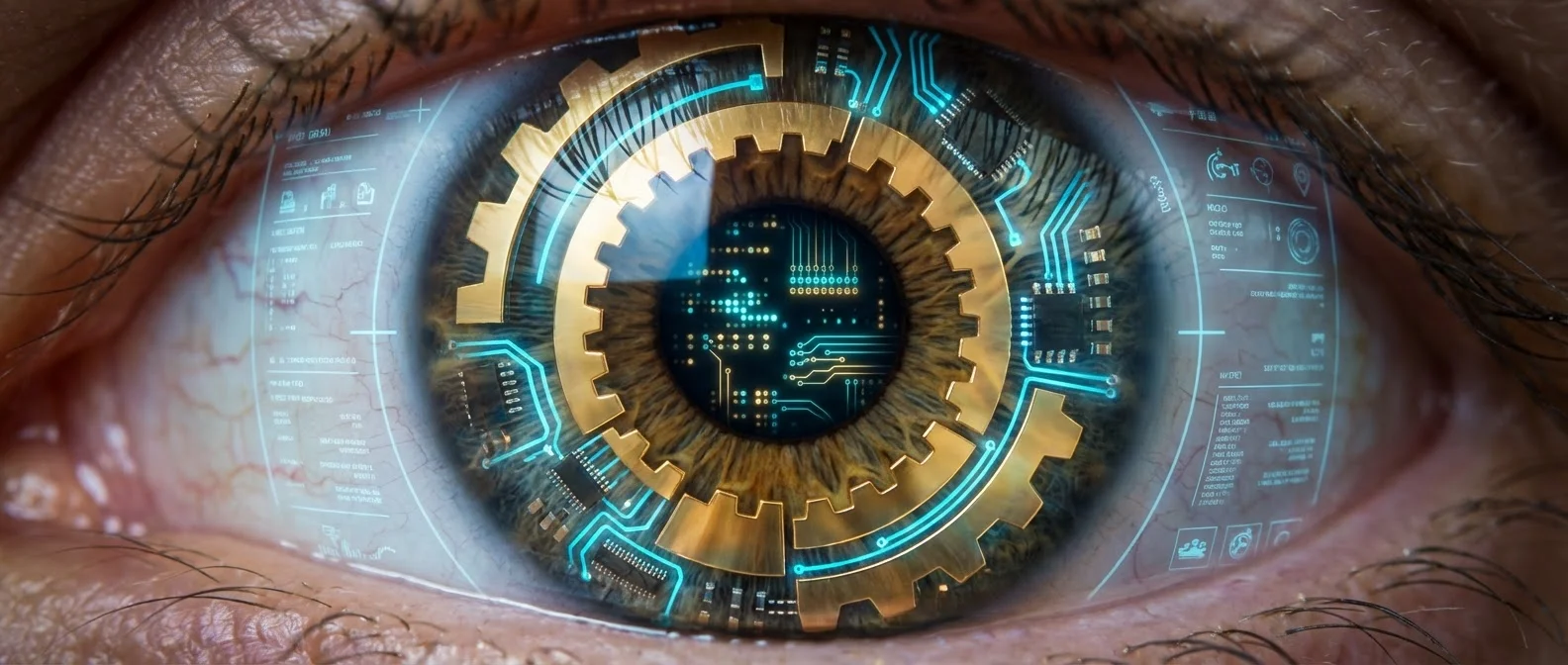
In February 2013, Mark Humayun of USC made medical history: the Argus II, the first bionic eye, received FDA approval. With just 60 electrodes, blind patients could distinguish shapes and light for the first time after years of darkness. Today, bionic eye technology is evolving rapidly — from retinal implants and photovoltaic chips to cortical prostheses that bypass the eye entirely. With 43 million blind people worldwide and 2.2 billion people with vision impairment, restoring — and surpassing — human vision is no longer science fiction.
📖 Read more: Implantable Health Chips: The Doctor Inside You
How Human Vision Works
Bionic eyes attempt to replace a biological masterpiece. The human retina contains approximately 130 million photoreceptors — 120 million rods (detecting light/dark) and 6-7 million cones (detecting color). Light enters through the cornea, is focused by the lens, hits the retina, and is converted into electrical signals that travel via the optic nerve to the brain.
Retinal Implants
Placed on or beneath the retina. They receive signals from an external camera and stimulate retinal ganglion cells with electrical pulses.
Cortical Prostheses
Bypass the retina and optic nerve entirely. Electrodes are implanted directly in the visual cortex of the brain in the occipital lobe.
Optogenetics
Uses light-sensitive proteins introduced into retinal cells via viral vectors, enabling their activation with light — no electrodes needed.
Pioneering Implants
| Device | Type | Electrodes | Status |
|---|---|---|---|
| Argus II | Epiretinal | 60 | FDA 2013 / CE 2011 |
| Alpha IMS | Subretinal | 1,500 | CE 2013 / Discontinued 2019 |
| IRIS II | Epiretinal | 150 | CE 2016 |
| PRIMA | Photovoltaic subretinal | 378 pixels | Clinical trial 2018+ |
| BVT Wide-View | Suprachoroidal | 98 | Clinical trial 2019 |
| Orion (Cortigent) | Cortical | 60 | Experimental |
Argus II: The Pioneer
📍 The First Approved Bionic Eye
Mark Humayun of USC, along with Eugene Dejuan and Robert Greenberg, developed the first active retinal prosthesis in the early 1990s at Johns Hopkins. Second Sight was founded in the late 1990s and released the first-generation implant with 16 electrodes (2002-2004). The Argus II, with 60 electrodes, was tested on 30 patients across 10 sites in 4 countries. It received CE Mark in Europe in 2011 and FDA approval in the US on February 14, 2013.
The system works as follows: a miniature camera embedded in glasses captures images. A small pocket processor converts the images into electrical signals transmitted wirelessly to the implant on the retina. The 60 electrodes stimulate the remaining ganglion cells, producing light patterns (phosphenes) that the brain interprets as images.
Alpha IMS: German Innovation
At the University Eye Hospital in Tübingen, Eberhart Zrenner led a team from 1995 in developing a subretinal implant. The Alpha IMS contains 1,500 electrodes — 25 times more than the Argus II — using microphotodiode arrays (MPDA) that convert light directly into electrical pulses.
In a clinical study with 11 patients with retinitis pigmentosa, blind patients were able to read letters, recognize unknown objects, and even locate plates, cups, and cutlery. Unfortunately, Retina Implant AG discontinued business in March 2019, citing an “innovation-hostile climate” in Europe's rigid regulatory systems.
PRIMA: Stanford's Photovoltaic Implant
☀️ Wireless Power via Infrared Light
Daniel Palanker at Stanford developed an innovative approach: a photovoltaic subretinal implant powered wirelessly by near-infrared light (880-915 nm). Images from a video camera are processed in a pocket PC and displayed via AR goggles using pulsed infrared light onto the retina. Photodiodes convert the light into electrical current, stimulating bipolar cells. The technology is being commercialized by Pixium Vision as PRIMA.
Cortical Prostheses: Bypassing the Eye
For patients with optic nerve damage, retinal implants aren't enough. This is where cortical visual prostheses come in — electrodes placed in the primary visual cortex of the brain (occipital lobe).
Dobelle Eye (2002)
William Dobelle placed stimulator chips in the primary visual cortex. Many subjects were implanted with a high success rate and limited negative effects.
Orion — Cortigent
Successor to Second Sight, developing a cortical implant with 60 electrodes. Instead of sending signals to the retina, it transmits them directly to the brain.
OBServe — Optogenetic
Stephen Macknik and Susana Martinez-Conde are developing a system using LEDs, optogenetics, and adeno-associated viral vectors to stimulate the visual cortex.
Australian Innovation: Bionic Vision Technologies
Australia invested massively in bionic eyes. Bionic Vision Australia (BVA), a consortium of the Bionics Institute, UNSW, CSIRO, CERA, and the University of Melbourne, was funded with $42 million AUD from the Australian Research Council. They developed two devices: the Wide-View (98 electrodes, suprachoroidal placement) for mobility and the High-Acuity (1,024 electrodes, epiretinal) for face recognition.
Dianne Ashworth was the first person implanted with the BVA device — she was able to read letters and numbers, and later wrote a book titled "I Spy with My Bionic Eye", about her life, vision loss, and experience with the bionic eye.
📖 Read more: Nanobots in the Blood: Doctors Inside the Body
Beyond Restoration: Superhuman Vision
Night Vision
Bionic implants with infrared sensors could enable sight in complete darkness without additional equipment
Optical Zoom
Digital magnification built into the implant — from 2x to 10x — controlled by brain signals
AR Overlay
Augmented reality information projected directly into the visual field — navigation, face recognition, translation
Real-Time Health
Embedded sensors measuring glucose, eye pressure, and biomarkers through tears
Extended Spectrum
Perception of ultraviolet and infrared radiation — a spectrum invisible to the naked human eye
Perfect Clarity
Automatic correction of myopia, hyperopia, and astigmatism through digital image processing
Who Benefits?
Retinitis Pigmentosa
The most common inherited cause of blindness. Photoreceptors degenerate gradually, but ganglion cells remain alive — ideal candidates for retinal implants.
Macular Degeneration
Leading cause of central vision loss in the elderly. Implantable miniature telescopes (VisionCare) offer 2.2-2.7x magnification for compensation.
Optic Nerve Trauma
When the retina cannot be used, cortical prostheses (Orion, Dobelle) bypass the eye by sending signals directly to the brain.
Gene Therapy: An Alternative Path
💉 Luxturna: The First Gene Therapy for Vision
In 2017, Luxturna (voretigene neparvovec) became the first approved gene therapy for inherited retinal dystrophy. Instead of replacing photoreceptors with electrodes, it introduces functional copies of the RPE65 gene via an adeno-associated viral vector, restoring natural function. It costs approximately $850,000 per eye.
Global Perspective
🌍 Worldwide Research Landscape
Bionic eye research spans the globe, with major contributions from multiple regions:
- The United States leads with USC's Argus II, Stanford's PRIMA, MIT/Harvard retinal research, and Neuralink's Blindsight
- Germany's Tübingen University pioneered the 1,500-electrode Alpha IMS subretinal implant
- Australia's $42M investment through BVA produced the first suprachoroidal implant tested outside a lab
- The EU granted CE marks for three bionic retinas (Argus II, Alpha IMS, IRIS II)
- France's Pixium Vision is commercializing the wireless PRIMA system
Timeline of Bionic Vision
Challenges and Ethical Questions
Resolution vs Natural Eye
60 electrodes (Argus II) vs 130 million photoreceptors. Even the 1,500 of Alpha IMS deliver extremely low resolution. Enormous progress is needed.
Cost of Access
Argus II cost ~$150,000. Luxturna $850,000 per eye. Social inequality in access to bionic restoration is a serious concern.
Long-Term Viability
What happens when a company shuts down? Second Sight went bankrupt, leaving patients with unsupported implants. Retina Implant AG closed in 2019.
Superhuman Vision
If bionic eyes surpass natural ones, will healthy people choose replacement? Who regulates body “upgrades”?
The Future: 2030 and Beyond
The next ten years will determine which technologies survive. Neuralink announced the Blindsight program — a cortical prosthesis inspired by their work in brain-computer interfaces. Science Corp is developing the Science Eye with micro-LED technology. Optogenetics promises electrode-free implants, while nanotechnology could shrink components to sizes invisible to the naked eye.
The ultimate vision isn't just restoration — it's transcendence. Implants that see infrared and ultraviolet, zoom 10x, project AR information, automatically recognize faces with AI, and monitor health in real time. From a therapeutic tool, bionic eyes may become the most compelling “upgrade” in the history of the human body.