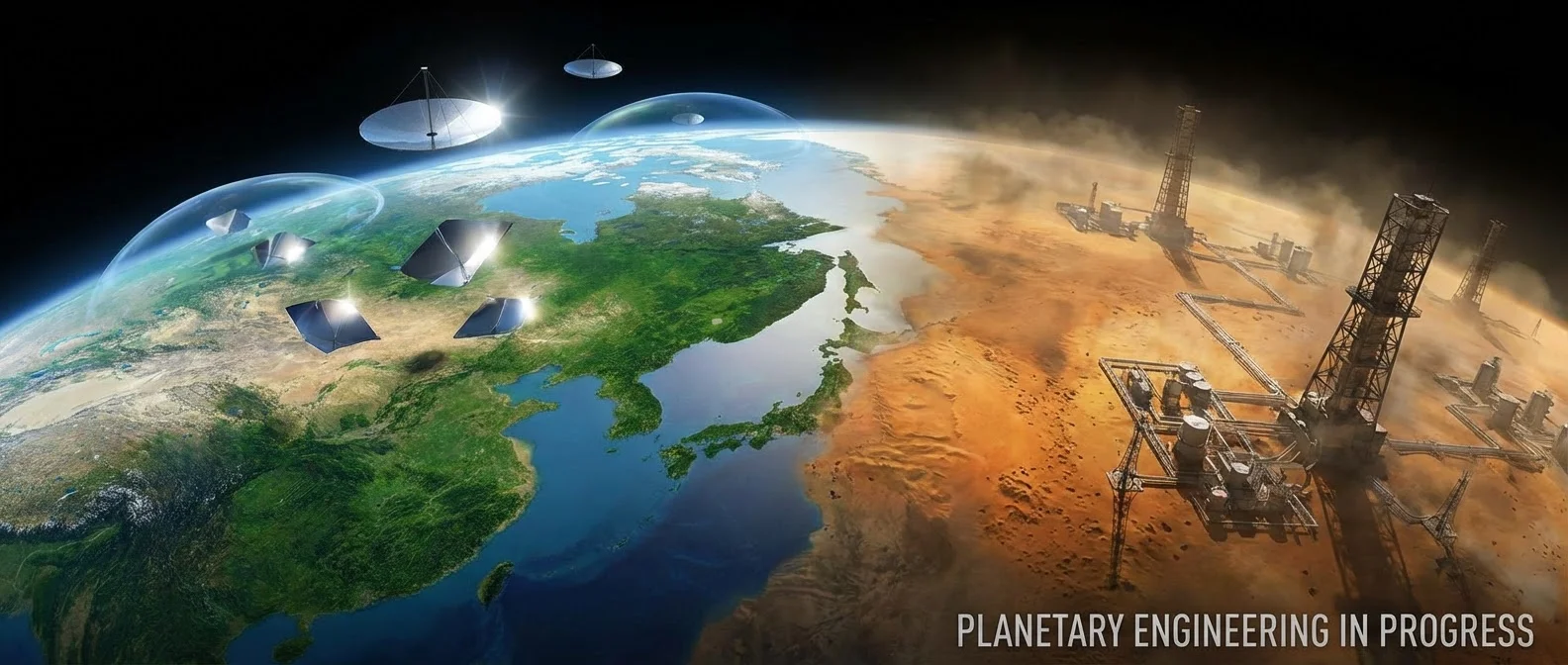
Global temperatures are rising, ice sheets are melting, and extreme weather events are multiplying. While reducing greenhouse gas emissions remains the first line of defense, a growing community of scientists is exploring a radically different approach: climate engineering — deliberate, large-scale interventions in Earth's climate system. From spraying aerosols into the stratosphere to capturing CO₂ directly from the air, these proposals once dismissed as science fiction now attract billions in research funding.
📖 Read more: Direct Air Capture: Machines That Suck CO2
What Is Climate Engineering?
Climate engineering (geoengineering) is defined as deliberate, large-scale intervention in Earth's climate system to counteract human-caused climate change. It's not meant to replace emissions reductions, but to complement them as a potential tool for limiting global warming.
The IPCC (Intergovernmental Panel on Climate Change) and the Royal Society of London distinguish two main categories of methods:
2. Solar Radiation Modification (SRM): Methods that reflect part of sunlight back into space — stratospheric aerosol injection (SAI), marine cloud brightening, space sunshades.
Stratospheric Aerosol Injection (SAI)
The most researched climate engineering method is stratospheric aerosol injection (SAI). Launch microscopic particles of sulfur or calcite to altitudes of 15-25 kilometers, where they reflect a portion of sunlight.
The operating principle mimics a natural phenomenon: major volcanic eruptions. In 1991, the eruption of Mount Pinatubo in the Philippines blasted enormous quantities of sulfur dioxide into the stratosphere, causing a global temperature drop of approximately 0.5°C for nearly three years. Pinatubo demonstrated that atmospheric particles could indeed cool the planet.
Russian climatologist Mikhail Budyko was the first to propose artificial solar radiation management through sulfate aerosols in 1974, in case global warming became a pressing issue. The concept was nicknamed the “Budyko Blanket.”
How Would Delivery Work?
The stratosphere ranges from 11 km at the poles to 17 km at the equator. Proposed delivery methods include: specially modified aircraft (Boeing 747-400, Gulfstream G650), high-altitude balloons, modified artillery, or electromagnetic railguns. A 2018 study found existing aircraft inadequate, requiring purpose-built planes for stratospheric deployment.
📖 Read more: floating-homes-netherlands
Cost and Feasibility
The annual cost of SAI implementation is estimated at $5-10 billion — a fraction compared to the $200 billion to $2 trillion per year that climate damages or emissions reduction cost. Each kilogram of sulfur in the stratosphere offsets the warming effect of hundreds of thousands of kilograms of CO₂. A 2020 study calculated approximately $18 billion per year per degree Celsius of warming avoided.
Removing CO₂ from the Atmosphere (CDR)
While SRM acts as an “umbrella” against the sun, carbon dioxide removal (CDR) attempts to cure the root cause — removing greenhouse gases from the atmosphere.
| CDR Method | How It Works | Potential |
|---|---|---|
| Direct Air Capture (DAC) | Chemical plants filter CO₂ directly from ambient air | High, but expensive |
| Afforestation / Forests | Planting trees that absorb CO₂ through photosynthesis | Medium — depends on permanence |
| BECCS | Biomass + energy + CO₂ capture and storage | High, requires land |
| Ocean Fertilization | Iron in the ocean → phytoplankton bloom → CO₂ capture | Uncertain, ecological risks |
| Ocean Alkalinity Enhancement | Adding alkaline substances → increased CO₂ absorption | Large, early stage |
| Carbon Farming | Agricultural practices that sequester carbon in soil | Low-medium |
The Experiments: From Theory to Practice
Climate engineering isn't just an academic exercise. Multiple experiments have been planned or carried out:
SCoPEx — Harvard Experiment
The Stratospheric Controlled Perturbation Experiment, designed by physicist David Keith and economist Gernot Wagner (2015), aims to launch calcite (CaCO₃) into the stratosphere via balloon — a substance that besides cooling may actually counteract ozone layer destruction. Partly funded by Bill Gates. Sir David King, former chief scientific adviser to the UK government, warned the plans could have “disastrous effects.”
SPICE — Bristol Experiment
The Stratospheric Particle Injection for Climate Engineering program (2012), funded at £2.1 million, planned to test a balloon-and-pipe delivery system for aerosols. It was among the first UK projects aiming at practical SRM testing. The field test was cancelled due to political pressure, but laboratory experiments continued.
📖 Read more: Green vs Blue Hydrogen: The Great Battle
Stardust Solutions — Private Initiative
Founded in 2023-24 as the first for-profit company pursuing commercial SAI deployment, backed by venture capital. The company's launch exposed a regulatory void: no laws prevent private entities from altering Earth's atmosphere
Risks and Objections
Climate engineering is no risk-free solution — and the backlash is fierce:
Hydrological Cycle: Historical sulfate aerosol pollution has already reduced rainfall in certain regions, weakened the South Asian monsoon, and likely contributed to the 1984 Ethiopian famine.
Termination Shock: If SAI is suddenly stopped, temperatures can spike rapidly — worse than before. The cost commitment could last millennia.
Geopolitics: Who decides to “dim” the sun? An SAI program that benefits one country may cause drought in its neighbor.
| Advantages | Disadvantages |
|---|---|
| Low cost ($5-10B/year) | Doesn't address greenhouse gases |
| Rapid action (months) | Risk of ozone depletion |
| Mimics natural process | Hydrological cycle disruption |
| Scalable technology | Termination shock if stopped |
| Can buy time | Geopolitical tensions |
| Reversible (to some degree) | Solar energy efficiency reduced 2-5% |
The Legal Dimension
Governance of climate engineering is perhaps the biggest obstacle. There is still no international framework that explicitly regulates SAI practices:
The Convention on Biological Diversity (2010) created a non-binding framework, requesting environmental assessment before any test. The Vienna Convention for the Protection of the Ozone Layer and the Montreal Protocol ban certain ozone-destroying substances — but sulfate aerosols are not included. The Convention on Long-Range Transboundary Air Pollution (CLRTAP) obliges states to reduce pollutants, but SAI — if it reduces overall pollution — could be exempted.
Stardust Solutions (2023-24), the first for-profit SAI company, highlighted the severity of the gap: without laws, theoretically anyone could start spraying.
📖 Read more: Sponge Cities: Absorbing Floods
Global Impact: A Planet on the Brink
The Mediterranean region is warming 20% faster than the global average. Record temperatures (48°C in Sardinia, devastating wildfires across Southern Europe in 2023) underscore the urgency. Drought threatens agriculture and tourism-dependent economies.
European universities and research institutions are actively participating in climate modeling programs. Countries with high solar irradiance could potentially host DAC plants at lower operating costs, using solar energy to power the CO₂ capture process. Meanwhile, if SAI were deployed globally, solar photovoltaic efficiency could be reduced by 2-5%, creating a dilemma for nations investing heavily in renewable energy.
Small island nations, Arctic communities, and developing countries in the tropics face the most immediate risks from climate change — yet they have the least say in whether geoengineering should proceed. Those least responsible for emissions face the greatest risks from both climate change and proposed fixes.
Climate Engineering Timeline
The Future: Plan B or Inevitable Necessity?
Climate engineering is no panacea. But as temperatures continue to rise and emissions aren't falling fast enough, the conversation is shifting: it's no longer “if” we'll need climate engineering, but “how soon.” The challenge is to develop these technologies responsibly, with international governance and a full understanding of the risks — before necessity forces us to act in haste.