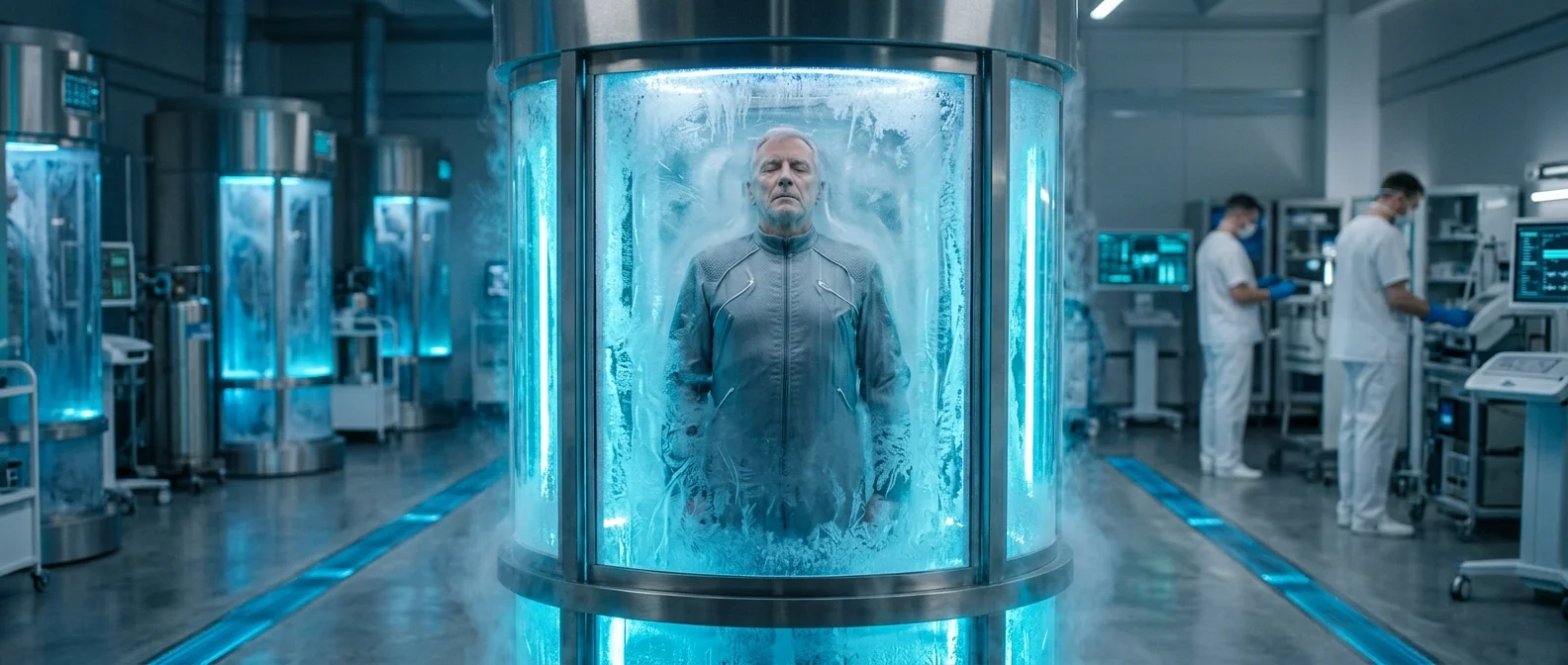
Imagine closing your eyes for the last time — and opening them 200 years later. Cryonics doesn't promise immortality. It promises something more specific: a one-way ticket with no guaranteed return, to a future that might be able to heal you. Over 500 people worldwide have already made that choice.
📖 Read more: Dyson Sphere: Energy from an Entire Star
🧊 What Cryonics Is — And What It Isn't
Cryonics is not freezing. That's probably the single most common misconception. In reality, ice is the worst enemy — crystals pierce cell membranes from the inside. Irreversible damage. The correct technique is called vitrification: the body transitions into a glass-like state, with zero ice formation, at -196°C.
The procedure begins immediately after legal death — not biological death. That distinction is fundamental. The brain doesn't lose its information instantly. If the neural connections encoding memories and personality remain intact, then — in theory — the person hasn't been permanently lost.
The term “cryonics” shouldn't be confused with “cryogenics,” which refers broadly to low-temperature physics. Cryonics is exclusively the practice of preserving humans after legal death, with the goal of future revival.
❄️ The Process Step by Step
What exactly happens when someone dies and has chosen cryopreservation? The answer is a race against time.
Phase 1 — Alert and Stabilization. Immediately after legal death, the rapid-response team (at Alcor it's called DART — Deployment and Recovery Team) begins stabilization. Ice cooling, medications to protect the brain, mechanical blood circulation.
Phase 2 — Vitrification. Blood is gradually replaced with cryoprotectant solutions — substances that function like medical antifreeze. These prevent ice crystal formation. Temperature drops slowly, at a controlled rate.
Phase 3 — Storage. The patient (not “body” — the cryonics community insists on the term “patient”) is placed in a liquid nitrogen vessel called a dewar. At -196°C, all biological activity stops completely. No electricity required — just regular nitrogen replenishment.
🔑 Why vitrification and not freezing?
📖 Read more: Epigenomics: Changing Genes Without Changing DNA
Simple freezing forms ice crystals that pierce cell membranes — irreversible damage. Vitrification converts liquids into a glass-like solid state, preserving molecular structures. A 2016 study showed that a rabbit brain maintained its synapses, cell membranes, and intracellular structures in near-perfect condition after vitrification and rewarming.
🏢 Alcor: Half a Century of Cryonics
In Scottsdale, Arizona sits what many consider cryonics' most important facility. The Alcor Life Extension Foundation was founded in 1972 by Fred and Linda Chamberlain and remains the largest, oldest, and most technologically advanced cryopreservation organization in the world.
Alcor offers two options: whole-body cryopreservation (~$220,000 / ~€200,000) and neuropreservation (head only, ~$80,000 / ~€73,000). The second option rests on the logic that the brain contains everything — memories, personality, identity — and a future body could theoretically be reconstructed.
Fred Chamberlain, the founder, is now cryopreserved in the very facility he created. Linda continues working with the organization. The Patient Care Trust ensures patient care continues indefinitely, regardless of economic or social changes.
🌍 Tomorrow.bio: The European Alternative
Until 2020, if you were European and wanted cryopreservation, the only serious option was Alcor — across the Atlantic. Dr. Emil Kendziorra, a physician and former cancer researcher, together with Fernando Azevedo Pinheiro, founded Tomorrow.bio in Berlin.
The company introduced something new: whole-body field cryoprotection. Instead of transporting the patient to a central facility before starting the procedure, their team performs cryoprotection on-site — drastically reducing the critical delay time.
📖 Read more: Exoskeletons: Superpowers for Everyone
Storage takes place in Switzerland, at the European Biostasis Foundation (EBF) facility. Switzerland offers political stability, a strong rule of law, and geographic security — factors critical for facilities meant to operate for centuries. Membership costs €50/month or €500/year, with a lifetime option at €15,000 (which gets subtracted from the cryopreservation cost later).
In July 2024, Tomorrow.bio expanded to the US (New York, California, Florida), with plans for nationwide coverage. Their equipment is sourced from Germany or built in-house — unusual in this field.
🔬 What Science Says Today
Nobody has “woken up” from cryopreservation yet. That's a fact — and no serious cryonics organization claims otherwise. The question isn't “can it be done today?” but “is there a fundamental reason it can never be done?”
Consider the evidence:
- Sperm, embryos, skin: Routinely cryopreserved and restored for decades.
- Rabbit kidney: Cryopreserved with vitrification and fully functional after rewarming.
- Rabbit brain (2016): After vitrification, synapses, cell membranes, and intracellular structures remained in near-perfect condition.
- C. elegans (roundworm): Cryopreserved and revived — with its memories intact.
"I hope you'll do it [cryonics] the same way I'd hope you'd take a shot with an experimental drug if you were sick and it were the one chance you had. Because it's worth a try."
— Tim Urban, “Why Cryonics Makes Sense”Alcor's theoretical position rests on three assumptions: life can be stopped and restarted, vitrification preserves structural integrity, and future medical technologies (nanotechnology, molecular repair) may enable restoration.
The central idea: death is not an on/off switch but a process. Cryonics intervenes before reaching what's called “information-theoretic death” — the point where the structures encoding a person have been destroyed beyond any possibility of recovery.
📖 Read more: Flying Cars: When Will We Fly?
⚖️ The Hard Questions
Cryonics isn't just a scientific bet. It's philosophical, legal, and social.
Cost and access. At prices ranging from €75,000 to €230,000, cryopreservation isn't an option for most people. Most fund it through life insurance — an annual premium of a few hundred euros can cover the cost. Tomorrow.bio states its goal is “making biostasis accessible to all.” Reality, for now, says otherwise.
Identity. If someone is revived 200 years from now, will they be “the same” person? Supporters say yes — if neural structures are preserved, identity persists. Critics raise a more unsettling question: what does it mean to wake up in a world where everyone you knew is dead?
Legal vacuum. In most countries, cryonics isn't regulated. It's not illegal — but it's not recognized as a medical procedure either. If a company shuts down, there are no guarantees. It has already happened: the Cryonics Society of California collapsed in the 1970s, and multiple bodies decomposed.
Consent. Who decides? What happens when family members disagree? There have been court battles — the most famous involving Ted Williams, the baseball legend, whose children had opposing views on his cryopreservation at Alcor.
🔮 What Comes Next
Cryonics is entering a new phase. Tomorrow.bio uses CT scanners to evaluate cryopreservation quality. Alcor invests in R&D for improved cryoprotectant solutions. New organizations are emerging: Southern Cryonics in Australia, Yinfeng Biological Group in China.
The biggest bet? Nanotechnology. The idea: nanobots that would enter every cell, remove cryoprotectants, repair any damage, and restart biological processes. This technology doesn't exist. But neither did mRNA vaccines in 2000, nor code-writing AI in 2010.
Dr. Kendziorra of Tomorrow.bio puts it honestly: "I don't want anyone to choose cryopreservation if they are not fully aware of the uncertainties involved." Call it what it is: a bet. With enough science to avoid madness, enough uncertainty to avoid guarantees.
If the question is “will it work?”, the honest answer is: we don't know. But 500+ people decided that a “maybe” is worth more than a certain nothing.