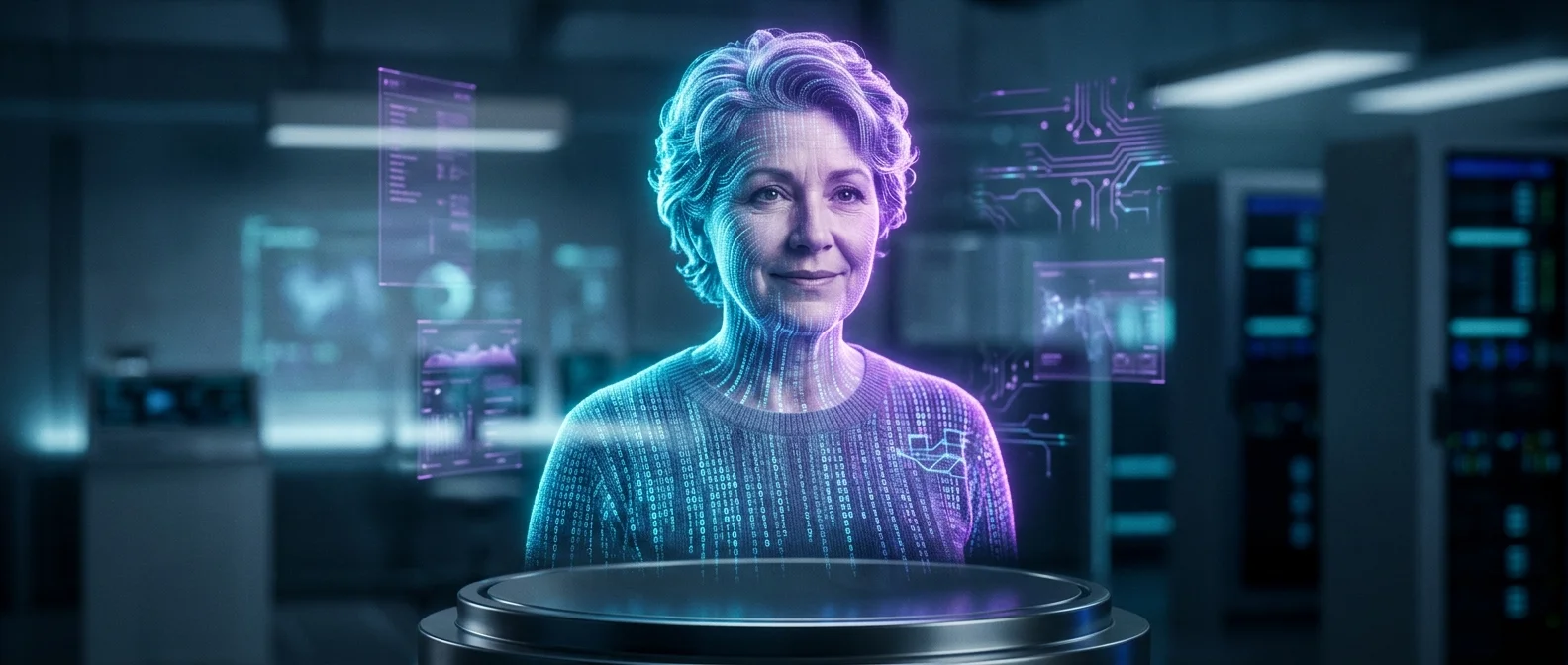
Grandma passed away last November. Today, her granddaughter opens an app on her phone and asks: “Grandma, how did you meet Grandpa?” And she hears her grandmother's voice answer — warmly, with that familiar laugh, with details nobody else would remember. This isn't a Black Mirror script. It's a product you can buy right now.
What Are Digital Clones
A digital clone is an artificial intelligence system that attempts to reproduce the personality, voice, and memories of a real person. It's not a general-purpose chatbot — it's a digital representation trained on the words, stories, and speaking style of a specific individual.
The technology rests on three pillars: voice cloning (a few minutes of recording is enough for accurate reproduction), large language models (LLMs) that absorb a person's way of expression and knowledge, and video/image reproduction using deepfake technology to create visual avatars. Together, these three elements produce what companies in the field call “digital immortality.”
HereAfter AI — Your Stories, Forever
The most approachable player in this space is HereAfter AI. The app works like a digital biographer: it asks you hundreds of questions about your childhood, relationships, experiences, and personality. Every answer is recorded in your own voice, stored and organized automatically.
You can attach photos to each story. Later, your loved ones open the app, ask questions by speaking aloud, and hear answers in your voice — accompanied by photos you selected. No need to scroll through hours of recordings — they simply ask, and the AI finds the right response.
HereAfter is available on iOS and Android, offers a 14-day free trial, and is even sold as a gift: a card for Mother's Day, birthdays, or retirement. The message is clear: start now while you can, because later there are no second chances.
StoryFile — Living History in Museums
StoryFile, founded by Heather Maio-Smith who worked with Steven Spielberg's USC Shoah Foundation, takes a more cinematic approach. Interviews are conducted professionally, in studios with multiple cameras, capturing hundreds of thoughtful responses. StoryFile's AI connects each answer to natural conversational pathways — and the result is remarkable.
At the National WWII Museum in New Orleans, visitors stand before a screen and ask a veteran: “What was D-Day like?” The veteran answers on video, in real time, with his own face and his own voice. The “Voices from the Front” exhibit makes visitors feel as if they're talking to people who lived history — regardless of whether those individuals are still alive.
HoloGlass: Hologram in a Museum
StoryFile partners with Authint AI for HoloGlass — a 3D display that renders digital humans at life-size with cinematic fidelity. You can literally stand in front of a hologram and have a conversation with it.
StoryFile insists on a critical point: "Unlike generative 'ghost' avatars that fabricate synthetic personas, we capture real people answering real questions." This distinction separates authentic preservation from AI fabrication.
The Market of the Digital Dead
China is at the forefront of this market. Dozens of companies offer services creating digital copies of deceased relatives — using photos, WeChat messages, and voice recordings to build chatbots that mimic the dead. The cultural importance of honoring ancestors makes the phenomenon particularly popular there.
In 2020, Korean broadcaster MBC aired a documentary where a mother met her deceased daughter in virtual reality. The video gathered millions of views and sparked a global debate: is this therapy or torture?
On the Character.ai platform, users have created chatbots that mimic the deceased — from celebrities to relatives. The platform has faced criticism for its lack of controls: anyone can create a bot of any person, without consent.
Ethical Dilemmas and Red Lines
The question isn't “can we do this?” — obviously we can. The question is "should we?".
Consent: Did the deceased want to become a chatbot? Most people die without having granted permission for digital reproduction. California passed AB 2602 in 2024, protecting digital likeness rights.
Grief and mental health: Psychologists are divided. Some see therapeutic potential — the ability to hear a loved one's voice again may help process grief. Others warn of grief entrapment: if you can talk to the dead every day, perhaps you never accept the loss.
Identity rights: Can someone create a digital clone of a celebrity without permission? Yes — and it's already happening at scale. The EU AI Act requires labeling of AI-generated content, but enforcement remains murky when it comes to the dead.
Dependency and manipulation: When a company manages the “soul” of your loved one, how easily can it keep you subscribed forever? And what happens if the company shuts down? Do you lose your dad for a second time?
Where This Is Heading
As LLMs and voice/video reproduction advance, digital clones will become increasingly convincing. Predictions point to:
- Real-time video avatars that react in conversation with facial expressions, gestures, and natural pauses
- Digital identity wills that specify what may be done with personal data after death
- VR meetings in digital environments — e.g., a walk in the park with your grandfather
- AI advisors based on the wisdom of a deceased mentor
The New York Times ran an extensive feature in June 2025 titled “AI Avatar, Life, Death” — examining how the technology is changing our relationship with mortality. StoryFile references the article on its homepage.
Death once meant silence. Now your smartphone can resurrect voices from the grave. The first generation of digital ghosts is already here — talking, laughing, remembering. Whether we're ready or not.