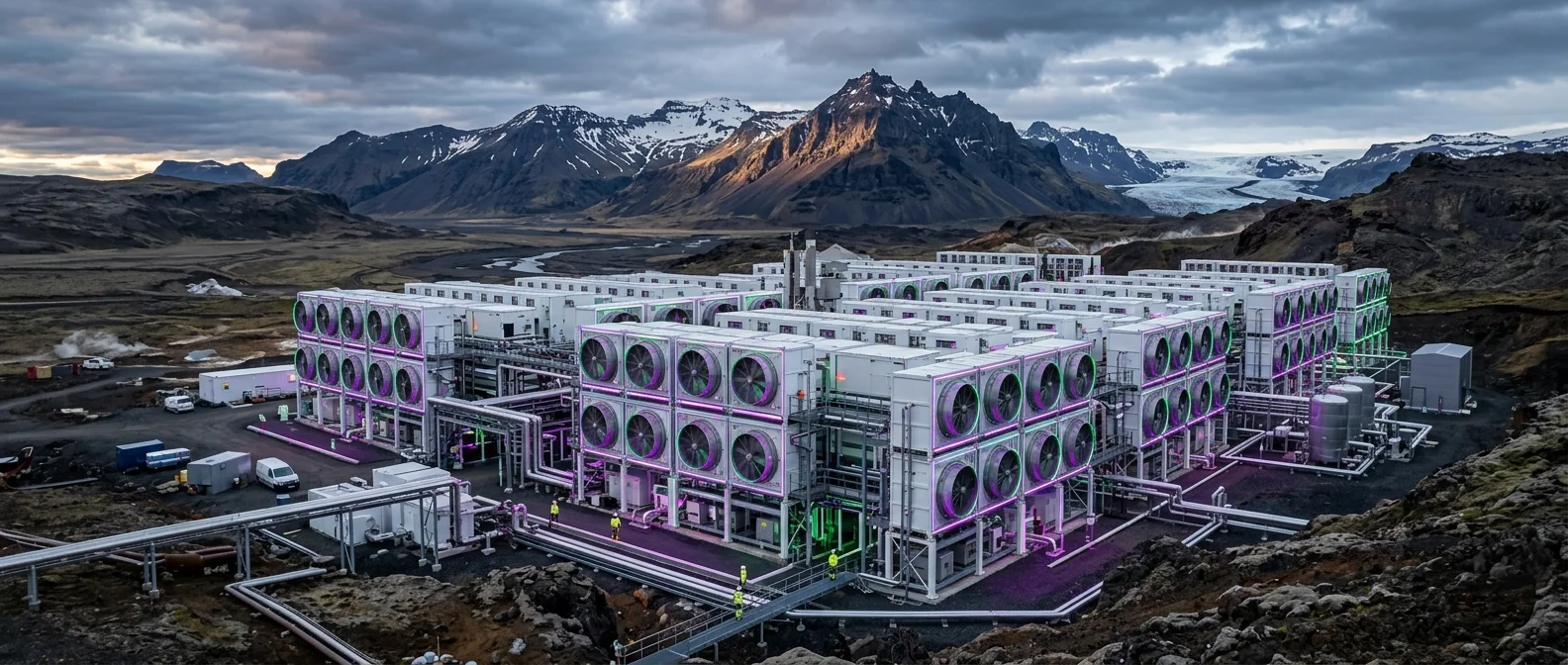
Humanity emits 40+ billion tons of CO₂ every year. Cutting emissions is essential — but it might not be enough. What if we need to suck CO₂ back directly from the air? That's exactly what Direct Air Capture (DAC) technology does — and between 2024-2026, it jumped from experiment to industrial scale.
🌬️ What Is Direct Air Capture
The concept is deceptively simple. Massive fans draw atmospheric air into a processing facility. Chemical reactions capture the CO₂ — which makes up just 0.04% of the air. The pure CO₂ is collected, compressed, and either permanently stored underground or used to produce fuels.
In practice, the physics are brutal. Atmospheric CO₂ concentration is extremely low (~420 ppm). Consider that you need to filter 2,500 tons of air to capture 1 ton of CO₂. That requires enormous energy — and that's where the technology's viability is decided.
🏭 Climeworks: From ETH Zurich to Iceland
Climeworks was founded in 2009 by two ETH Zurich students — Jan Wurzbacher and Christoph Gebald. From that lab emerged the world's largest Direct Air Capture company.
The progression was methodical: grams of CO₂ (2012), kilograms (2014), hundreds of tons with Capricorn in Hinwil, Switzerland (2017), thousands of tons with Orca (~4,000 tons/year) in Hellisheidi, Iceland (2021), and tens of thousands of tons with Mammoth (~36,000 tons/year), also in Iceland (2024).
Why Iceland? Two reasons. First, abundant geothermal energy — Climeworks' technology requires just 100°C, which geothermal provides almost free. Second, basaltic rock. Through the Carbfix process, CO₂ is injected into basaltic groundwater and within ~2 years transforms into mineral — literally becoming stone. Permanent storage on geological timescales.
🔑 How does Climeworks' solid sorbent technology work?
Air is drawn into modular units. A specialized solid material (sorbent) captures CO₂ molecules. Once saturated, it's heated to ~100°C — the CO₂ is released in pure form. The sorbent is reused. The cycle repeats. Climeworks is already developing 3rd-generation technology, under large-scale testing in Basel since 2024.
The company employs 250+ engineers and scientists, has 30+ facilities in operation or development, and landmark customers: Microsoft, JPMorgan Chase, Swiss Re, UBS, Stripe, Shopify, Schneider Electric (31,000-ton agreement), BCG, H&M. In the past year, Climeworks established headquarters in Calgary (Canada), inaugurated a DAC Innovation Centre in Switzerland (2025), and Saudi Arabia's Minister of Energy inaugurated the first DAC unit in Riyadh.
🇺🇸 1PointFive: The World's Largest DAC Plant
If Climeworks is the European pioneer, 1PointFive — a subsidiary of Occidental Petroleum — is aiming for American hyperscale. The company is building STRATOS in Ector County, Texas, what will become the world's largest DAC facility.
The technology differs. 1PointFive uses a liquid solvent instead of a solid sorbent — different chemistry, same goal. The CO₂ is collected, compressed, and stored in deep geological formations underground. The company has secured storage capacity for up to 6 billion tons of CO₂.
Their customers? Microsoft, Amazon, Airbus, British Airways, AT&T, Shopify — companies purchasing Carbon Dioxide Removal (CDR) credits for emissions they can't eliminate. According to IPCC and IEA, the planet needs to remove up to 20 Gt CO₂ annually. 1PointFive is developing projects across Texas (STRATOS, King Ranch) and Louisiana (Allen Parish, Livingston Parish, Chambers County).
💰 The Cost Problem
Let's address the elephant in the room. DAC today costs $250-600 per ton of CO₂. A tree does (very slowly) the same thing for almost free. Why pay?
Three reasons.
Scale. Trees require massive land area. Removing 1 Gt CO₂ through reforestation would require an area the size of India. DAC needs minimal space.
Measurability. You can certify exactly how much CO₂ a DAC plant removed. Climeworks holds independent AAA certification. Trees? They can burn, be cut down, or get diseased.
Permanence. CO₂ turned to stone via Carbfix stays there for millions of years. Geological storage (like 1PointFive's) is considered among the most stable forms of carbon storage.
Costs are already falling. Climeworks targets below $300/ton within the decade, with a long-term goal of $100-150. Think solar panels: from $76/watt (1977) to $0.20/watt today. Technology follows learning curves — each doubling of production drops costs by 15-20%.
⚖️ Criticism and Realism
Criticism of DAC is serious and worth hearing.
Energy paradox. If the energy powering a DAC plant comes from fossil fuels, the net result is negligible or negative. Climeworks solves this with geothermal. 1PointFive relies on natural gas — controversial.
Moral hazard. The existence of CO₂ removal tech could create complacency: “we'll clean it up later.” No serious climate scientist considers DAC a substitute for emission reductions. It's supplementary — for emissions that can't be zeroed out (heavy industry, aviation, shipping).
Scale vs. need. Mammoth removes ~36,000 tons CO₂/year. Humanity emits 40,000,000,000 tons. The gap is staggering — we need capacity millions of times greater.
🔮 What Comes Next
Climeworks is planning megaton-scale plants (millions of tons) for the 2030s. The company is developing projects in Saudi Arabia, Canada, and beyond. 1PointFive is building hubs across Texas and Louisiana, aiming to create an entire CO₂ storage geography along the Gulf of Mexico.
The US government (through DOE) is funding DAC hubs — billions of dollars in federal funding. The EU is preparing similar programs. Saudi Arabia — the world's largest oil exporter — is betting on DAC as a transition strategy.
The real question isn't “does it work?” — it already works. It's “can it scale fast enough?” We don't know yet. But the alternative — not trying — looks considerably worse.
Sources: