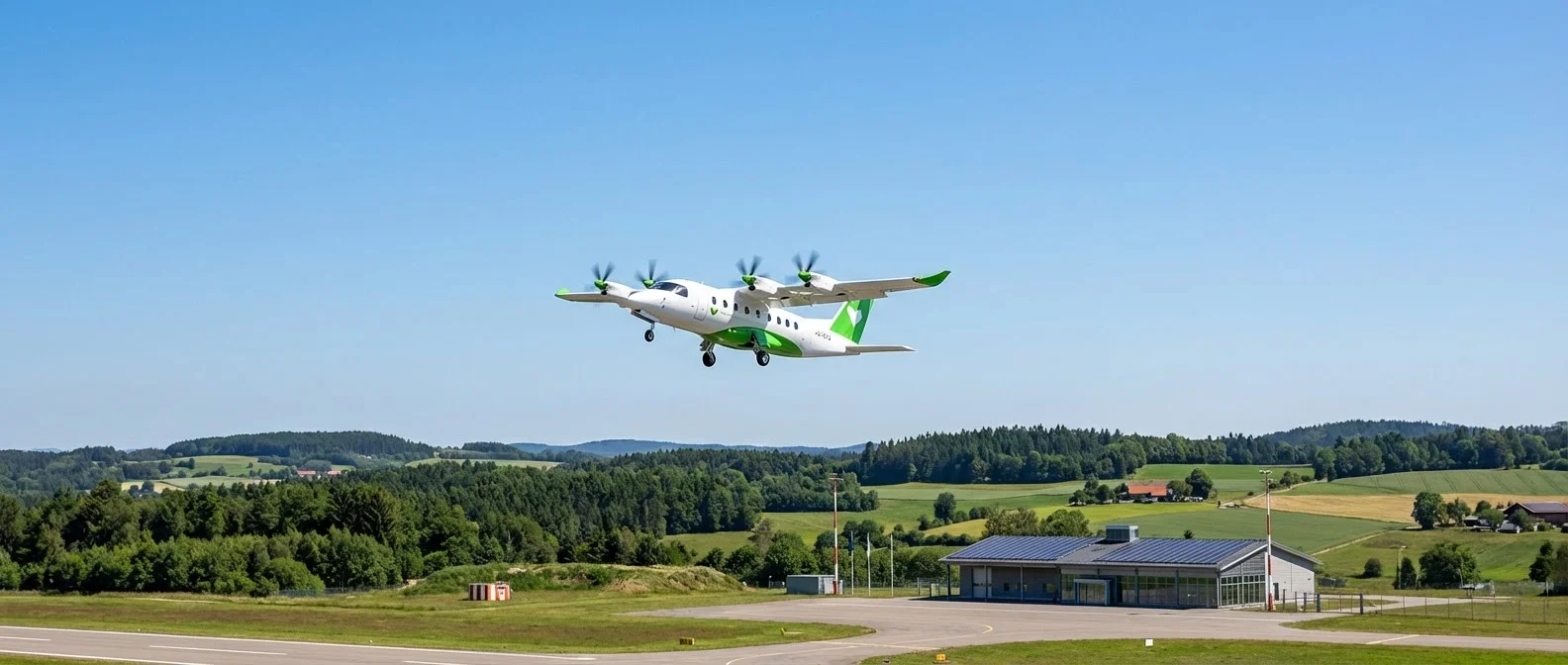
Aviation accounts for 2.4% of global CO₂ emissions — and the figure is rising every year. For the first time in history, electric aircraft are no longer science fiction but reality: in June 2025, BETA Technologies completed the first passenger flight of an electric aircraft in North America, landing the Alia CX300 at JFK Airport. Zero-emission flight is here.
What Are Electric Aircraft?
An electric aircraft runs on electric motors instead of internal combustion or turbine engines. Power can come from batteries, hydrogen fuel cells, or even solar panels. Most current designs use electric motors driving propellers, offering near-zero emissions and significantly lower noise.
The core promise: lower operating costs (electricity is far cheaper than jet fuel), zero local emissions, dramatically less noise, and simpler maintenance with fewer moving parts. Electric motors achieve ~90% efficiency, while a typical jet engine manages only ~50%.
A History Dating Back to the 19th Century
The idea is far from new. On October 8, 1883, Gaston Tissandier flew the first electrically powered airship. A year later, Charles Renard and Arthur Krebs flew “La France” with a more powerful motor. However, heavy lead-acid batteries severely limited speed and range.
The first manned electric airplane — heavier than air — was the Militky MB-E1, which flew on October 21, 1973 from Linz, Austria for 9 minutes, powered by nickel-cadmium batteries. Half a century later, lithium batteries made it practical.
Key modern milestones: in 2016, Solar Impulse 2 completed the first circumnavigation of the Earth using solar power. In June 2020, the Pipistrel Velis Electro became the first type-certified electric aircraft from EASA — a two-seat trainer with a 76 hp motor, 170 km/h cruise speed, and 50-minute endurance. By 2024, 109 units had been delivered.
🔋 Electric Aviation Milestones
- 1883: First electrically powered airship (Tissandier)
- 1973: First manned electric airplane flight (MB-E1, 9 minutes)
- 2016: Solar Impulse 2 — solar-powered circumnavigation
- 2020: Pipistrel Velis Electro — first EASA type certification
- May 2020: MagniX eCaravan — largest electric aircraft to fly (Cessna 208B)
- Dec 2019: Harbour Air — first electric commercial seaplane flight (DHC-2 Beaver)
- Nov 2021: Rolls-Royce Spirit of Innovation — 555.9 km/h speed record
- June 2025: BETA Alia CX300 — first electric passenger flight in North America (JFK)
The Pioneers of Today
Heart Aerospace (ES-30)
Swedish-founded Heart Aerospace, established in 2018 by Anders and Klara Forslund, is developing the ES-30: a 30-seat hybrid-electric regional aircraft. With an all-electric range of 200 km, hybrid range of 400 km, and up to 800 km with reduced passenger load, it targets certification by the late 2020s. The company unveiled the full-scale Heart X1 demonstrator in 2024 and relocated its headquarters to Los Angeles in 2025. With 250 orders and $185 million in funding — backed by Bill Gates (Breakthrough Energy), United Airlines, Air Canada, and Saab — it is the leading contender for electric regional flights.
BETA Technologies (Alia CX300)
Vermont-based BETA Technologies, founded in 2017 by Kyle Clark, made history on June 3, 2025: the Alia CX300 completed the first passenger flight of an electric aircraft in North America, landing at JFK after a 45-minute, 72-nautical-mile flight from East Hampton. The aircraft features four propellers for vertical takeoff (eVTOL) and seats 5 people. The company has raised $1 billion in funding from Qatar Investment Authority, Fidelity, and Amazon.
MagniX & Harbour Air
MagniX develops high-power electric aircraft motors. In May 2020, the eCaravan — an electric 9-passenger Cessna 208B — flew, becoming the largest electric aircraft to take flight. The magni500 motor delivers 750 hp (560 kW) at just 135 kg. Meanwhile, Canadian Harbour Air — North America's largest seaplane airline — completed the first electric commercial seaplane flight in December 2019, flying a DHC-2 Beaver on the Fraser River near Vancouver.
ZeroAvia & Wright Electric
UK-based ZeroAvia takes a different approach: hydrogen fuel cells instead of batteries, supported by £2.7 million from the UK government. Wright Electric, partnering with EasyJet, is working on a 180-seat electric airliner — originally targeting 2027. CEO Jeffrey Engler estimates electric propulsion will reduce energy costs by approximately 30%.
"Aviation will likely be the last transport sector to fully electrify — but the first commercial short-range electric flights will begin before 2030."
The Biggest Challenge: Energy Density
The main obstacle isn't the motor — it's the battery. Jet fuel (kerosene) contains approximately 12,500 Wh/kg, while today's best lithium-ion batteries achieve only 250-300 Wh/kg. This 1:50 ratio means that for equivalent range, a battery would need to be 50 times heavier — impossible for an aircraft.
In practical terms: a small 1,500 kg aircraft with 150 Wh/kg batteries can carry 1 passenger about 80 miles, 2 passengers about 60 miles, or 3 passengers less than 30 miles. For an Airbus A320-class single-aisle airliner, battery density of 2,000 Wh/kg would be needed — roughly 8 times current technology.
There is hope, however: beyond-lithium technologies such as lithium-sulfur (LSB) and lithium-air (LAB) batteries promise significantly higher densities. Meanwhile, hydrogen fuel cells offer higher energy density, though with their own storage complexities.
📊 Energy Density Comparison
- Jet fuel (Jet-A1): ~12,500 Wh/kg
- Li-ion battery (2024): ~250-300 Wh/kg
- Li-sulfur (research): ~500-600 Wh/kg
- Li-air (theoretical): ~1,000-3,500 Wh/kg
- Hydrogen (fuel cell system): ~1,800 Wh/kg
Note: Electric motors utilize ~90% of energy input, while jet engines only ~50%, which partially bridges the gap.
Hybrid Solutions: Bridging the Gap
Given battery limitations, many companies are pursuing hybrid-electric aircraft — the aviation equivalent of hybrid cars. These take off and land electrically (quietly, with zero emissions near cities) but use conventional engines during cruise, achieving longer range.
Heart Aerospace's ES-30 follows exactly this model. Similarly, France's Aura Aero ERA is developing a 19-passenger electric aircraft targeting 2026 certification. The Airbus E-Fan X (now cancelled) explored serial hybrid architecture, while VoltAero Cassio in France pioneers parallel hybrid systems.
By 2018, there were over 30 hybrid aviation projects, and analysts estimated the first short-range hybrid aircraft would enter service around 2032.
Global Impact: Island Nations Lead the Way
Electric aviation is particularly promising for island nations and short-haul routes. Norway has set an ambitious goal of electrifying all domestic flights by 2030. Scandinavian countries, with short inter-city distances and aggressive environmental targets, lead adoption — Heart Aerospace initially targeted Nordic airlines, and SAS, Braathens Regional, and Icelandair all hold letters of intent for the ES-30.
The European Union's European Green Deal includes provisions for sustainable aviation, and the EU's Clean Aviation Joint Undertaking funds research into electric and hybrid propulsion. EASA's type certification of the Velis Electro in 2020 set a regulatory precedent that other regions now follow.
Beyond Europe, New Zealand's Sounds Air has ordered Heart ES-30 aircraft for inter-island routes. In Canada, Harbour Air's electric seaplane project could revolutionize coastal transportation in British Columbia. The FAA has awarded Heart Aerospace a $4.1 million FAST grant to accelerate hybrid engine control systems — signaling serious US regulatory engagement.
The biggest infrastructure challenge remains airport charging: small regional airports need high-power charging stations, requiring either grid upgrades or local renewable energy generation. The SAE International AE-7D committee, formed in 2018, is already developing standards for sub-megawatt and megawatt-level aircraft charging.
When Will We Fly Electric?
The realistic timeline shows gradual adoption:
2025-2028: Certification and deployment of small electric training aircraft (Velis Electro already certified, Diamond eDA40 in process). First trial commercial short-range flights (Harbour Air, Cape Air).
2028-2032: 19-30 seat flights on routes up to 400 km. Heart Aerospace ES-30 and Aura Aero ERA target this window. Scandinavian countries will lead — Norway aims for electric domestic flights by 2030.
2032-2040: Hybrid-electric aircraft of 50-100 seats on regional routes. Island archipelago routes could be electrified during this period.
2040+: If solid-state or lithium-air battery technology matures, medium-range aircraft (1,000+ km) become feasible. For large intercontinental aircraft, hydrogen or sustainable aviation fuels (SAF) will dominate.
"The goal isn't to immediately replace the Boeing 787. The goal is to start with short routes, prove viability, and gradually scale up."
Why It Matters for the Planet
As cars and power grids electrify, aviation risks becoming a larger share of global emissions. According to NOAA, aviation accounts for 3.5% of climate change when NOx and contrails are included. Between 2013 and 2018, aviation emissions rose by 32%.
Electric aviation alone won't solve the problem. But combined with sustainable aviation fuels (SAF), hydrogen, improved aerodynamics, and air traffic management changes, it can help decarbonize a sector many thought impossible to “green.”
When the Alia CX300 landed at JFK in June 2025, it shared the same runway as 747s and A380s — electric aircraft operating alongside the jets they may one day replace.