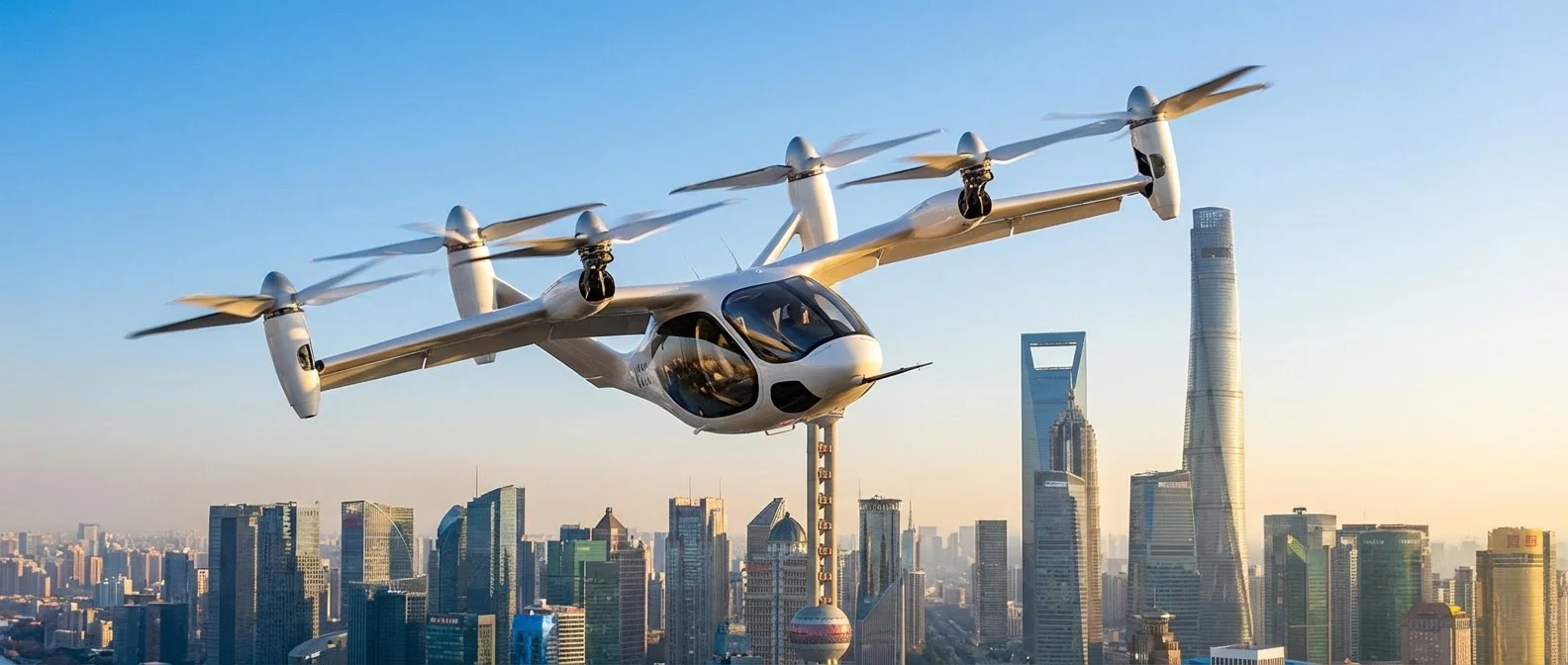
Flying cars are no longer science fiction. Dozens of companies — from startups to Toyota, Airbus, and Boeing — are developing electric vertical takeoff and landing (eVTOL) aircraft designed to carry passengers over traffic. Joby Aviation already delivered its first eVTOL to the US Air Force (September 2023), while the FAA created a dedicated pilot program in September 2025.
What Are eVTOLs?
The term eVTOL stands for Electric Vertical Take-Off and Landing — an electric aircraft that takes off and lands vertically. Unlike traditional helicopters, eVTOLs use multiple electric motors, are nearly silent, produce zero emissions, and can operate autonomously.
The concept began taking shape in 2009 with the NASA Puffin — a single-seat electric VTOL using Distributed Electric Propulsion (DEP). In 2011, three pioneering designs followed: Volocopter VC1 (Germany), AgustaWestland Project Zero (Italy), and Opener BlackFly (USA).
The industry exploded after the Uber Elevate whitepaper (2016), which outlined an on-demand air taxi system. The annual Elevate Summits (2017-2019) transformed the concept from science fiction into a legitimate aerospace sector.
The Major Players
Those That Didn't Make It
Not everyone succeeded. Two of the industry's most prominent names filed for insolvency:
Lilium (Germany)
Despite an innovative jet design with 36 ducted electric fans, the company filed for insolvency. Problem: excessive R&D costs, certification delays, inability to secure further funding.
Volocopter (Germany)
A pioneer in eVTOL multicopters (18 rotors), first crewed flight in South Korea (2021), NYC demo (Nov 2023). Despite all this, filed for insolvency — multiple rotors increased complexity without proportional range benefits.
How Do They Work?
There are four main eVTOL design types:
| Type | Description | Example |
|---|---|---|
| Multicopter | Multiple vertical motors, no wings | Volocopter 2X, Jetson One |
| Tilt-Rotor | Motors rotate: vertical → horizontal | Joby S4, Archer Midnight |
| Lift + Cruise | Separate motors for takeoff and flight | Eve (Embraer), Beta Alia |
| Tilt-Wing | Entire wing pivots with motors | Dufour Aerospace, Airbus Vahana |
Power & Propulsion
Most eVTOLs use lithium batteries (NMC 811 or LFP), but low specific energy remains a challenge — range stays limited to 90-150 miles. Alternatives:
- Hydrogen fuel cells — Joby flew 523 miles (842 km) non-stop on liquid hydrogen (Jun 2024), 3× battery range
- Hybrid — Joby S4-T (Nov 2025): gas-turbine generator + electric motors, for long-range military applications
- Battery + hydrogen — battery for takeoff/landing, fuel cell for cruising: Carnegie Mellon study (2021)
Uses Beyond Air Taxis
eVTOLs aren't just flying taxis:
Deliveries: Wing (Google) already offers drone delivery (up to 100 km, 1.5 kg). Amazon Prime Air and UPS joined too. Wingcopter (Germany) delivered vaccines with UNICEF in Vanuatu (2018).
Agriculture: Guardian Agriculture's SC1 became the first eVTOL approved by the FAA for nationwide operation (2023) — carrying 100+ kg of crop protection products.
Emergency services: Patient, organ, and drug transport between hospitals. Canada's CAAM studied eVTOL EMS benefits (2020). JumpAero develops a single-seat eVTOL for first responders.
Military: USAF Agility Prime program (Apr 2020): $25M funding. Four companies with military airworthiness: Joby, Beta Technologies, Lift Aircraft, Kitty Hawk. First manned eVTOL demo flight at Camp Mabry, Texas (Aug 2020).
Racing: Airspeeder created the eVTOL racing series — the “Formula 1 of the sky” (2021).
Certification & Regulation
The biggest challenge isn't technology — it's certification:
Europe (EASA)
EASA published SC-VTOL-01 in July 2019 — the Special Condition for VTOL aircraft. This was the world's first comprehensive eVTOL certification framework.
United States (FAA)
The FAA uses Part 23 Amendment 64 with special additions. In September 2025, the eVTOL Integration Pilot Program (eIPP) was announced — a 3+ year program with at least 5 pilot projects allowing limited operations before full type certification.
China (CAAC)
EHang's EH216-S became the world's first certified autonomous eVTOL — no pilot, 2 passengers, ~18-mile range.
"The team at Uber Elevate has not only played an important role in our industry, they have also developed a remarkable set of software tools that build on more than a decade of experience enabling on-demand mobility."
When Will We Fly?
Global Impact: Who Flies First?
Urban air mobility won't arrive everywhere at once. Key markets are racing ahead:
- Dubai & Middle East — early adopter, wealthy, small cities perfect for 5-mile hops
- Island nations — Indonesia, Philippines, Greece: hundreds of islands without airports, eVTOLs need just a 20×20m vertiport
- Congested megacities — São Paulo, Lagos, Delhi: ground traffic is so bad that air taxis become cost-competitive
- Military & disaster relief — USAF Agility Prime, rapid deployment to disaster zones
- Tourism — scenic flights, airport transfers, resort connections
- EU Green Deal — funding for green transport infrastructure, vertiports
The Big Challenges
- Batteries — low specific energy, slow charging, replacement costs
- Infrastructure — vertiports, chargers, air traffic management needed
- Cost — initial ticket prices likely $3-5/mile (helicopter-like)
- Noise — though 100× quieter, residents still worry
- Safety — autonomy, redundancy, extreme weather resilience
- Social acceptance — “do I want that flying over my house?”
If in 10 years an eVTOL takes you from downtown to the airport in 10 minutes, that won't be magic — it will be engineering.