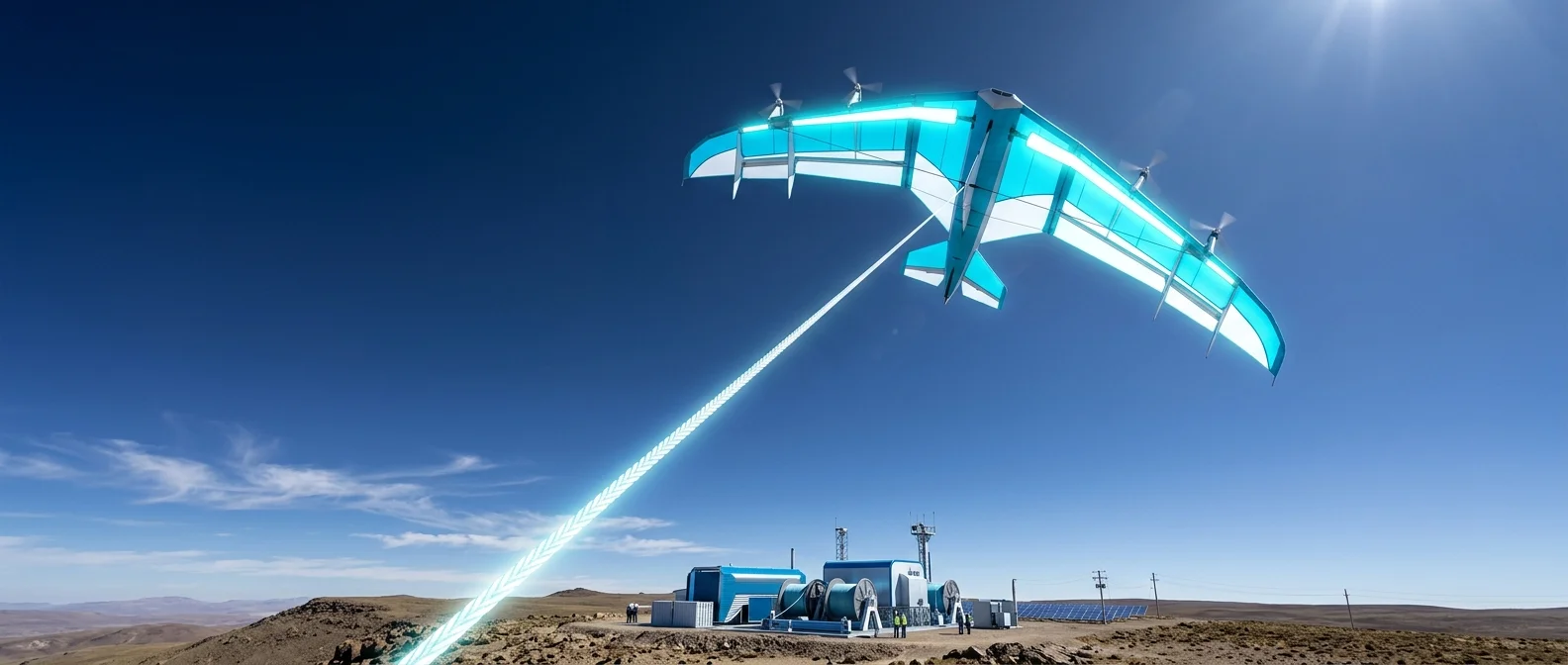
The wind turbines we know reach 150-200 meters tall. Up there, wind blows fairly steady — but at 400 or 500 meters, intensity multiplies and barely stops. The problem? You can't build a tower half a kilometer high. But you can fly a kite.
📖 Read more: Flying Taxis: Vertiports in Cities by 2030
🌬️ Why High Altitudes Change Everything
Above 200 meters, wind blows harder, steadier, and more frequently than near the ground. This isn't theory — it's physics. Friction from buildings, trees, and uneven terrain weakens low-altitude winds. Up high, air moves freely.
The idea behind airborne wind energy (AWE) is straightforward: instead of building a taller tower, send something up that pulls a tether. That tether drives a generator on the ground. No concrete foundation, no steel tower, no massive blades.
⚙️ How a Kite Power System Works
The mechanics are basic. A kite made from high-performance textiles flies in a figure-eight pattern at 200-600 meters altitude. An HMPE tether (ultra-high-molecular-weight polyethylene — the same material used in cranes and elevators) connects the kite to a winch on the ground. As the kite pulls the tether outward, it spins a generator that produces electricity.
When the tether is fully extended, the kite changes its angle, loses pull, and the winch reels it back in using minimal energy. Then the cycle restarts. This is called a pumping cycle — and it runs automatically, around the clock.
Key components of an AWE system:
🪁 Kite: High-durability textiles, aerodynamic profile, air intakes and brakes for control.
📖 Read more: Holograms: From Sci-Fi to Reality
🧠 Control Pod: The “brain” — an autopilot system with sensors managing optimal flight.
🔗 Tether: HMPE rope — used in crane and elevator applications for safety.
🏭 Ground Station: Winch, generator, gearbox, inverter, grid connection module.
📡 Launch Mast: Retractable mast for safe takeoff and landing.
🪁 SkySails: From Hamburg to Taiwan
SkySails Power, based in Hamburg, is the field's pioneer. Founder Stephan Wrage turned his passion for stunt kites into industrial technology. With over 120 employees, 80+ international patents, and 5+ years of proven operation, the company has systems running in the field.
In July 2025, SkySails completed the first kite-based AWE flight in Taiwan — the first such system anywhere in Asia. In partnership with Wistron's subsidiary AiSails, they're targeting the Asia-Pacific market.
Also in July 2025, they unveiled Kyo: the first 450 kW airborne wind turbine. Compact, robust, designed for locations where conventional renewables fall short. First deliveries are expected in the second half of 2028.
📖 Read more: Humanoid Robots in Factories: The H1 Era 2030
"With high-altitude wind energy, we're building a more livable world. The sky is the limit for the global green energy transformation."
— Stephan Wrage, CEO SkySails Power🇳🇱 Kitepower: From TU Delft to Construction Sites
In the Netherlands, Kitepower (a TU Delft spin-off) already has commercial clients. Led by new CEO Dr. Pieter Willems, the company focuses on off-grid applications: construction sites, agriculture, logistics, transportation, and manufacturing.
Construction sites need this most. In the Netherlands, many projects face grid congestion — no available grid connection. Kitepower is running pilot projects with Dura Vermeer, Besix, Mobilis, the Dutch Ministry of Defence, and Rijkswaterstaat (the national water authority).
RWE, among the world's largest energy producers, is already partnering with Kitepower in Ireland and the UK. Peter Lefroy (Head of Offshore Development, RWE Ireland & UK West) put it plainly: "Airborne wind has the potential to play a role in helping to drive down the cost of energy further. It will use winds at higher altitudes which are stronger, steadier, and more constant."
📊 Numbers and Outlook
AWE technology is still early-stage commercially, but the math works. SkySails reports 90% less material input compared to conventional wind turbines. Systems are modular, transportable, and quick to install — even on islands or remote locations.
📖 Read more: Humanoid Robots: Our New Roommates
Why AWE deserves attention:
🔹 No concrete foundation or steel tower required
🔹 Operates at altitudes where winds are several times stronger
🔹 Off-grid capability — ideal for islands, military bases, construction sites
🔹 Potential for future offshore deployment
🔹 Rapid deployment and easy transportability
Google once tried with its Makani project (a rigid-wing kite plane at 300 meters), but shut it down in 2020. Google's failure didn't kill AWE — it validated the simpler approach. SkySails and Kitepower are proving that the simpler approach (soft kite instead of rigid wing) works in practice.
Scale these systems to megawatt capacity, and high-altitude wind could become the cheapest renewable energy in many locations. The kites from childhood playgrounds might end up on the power grid.