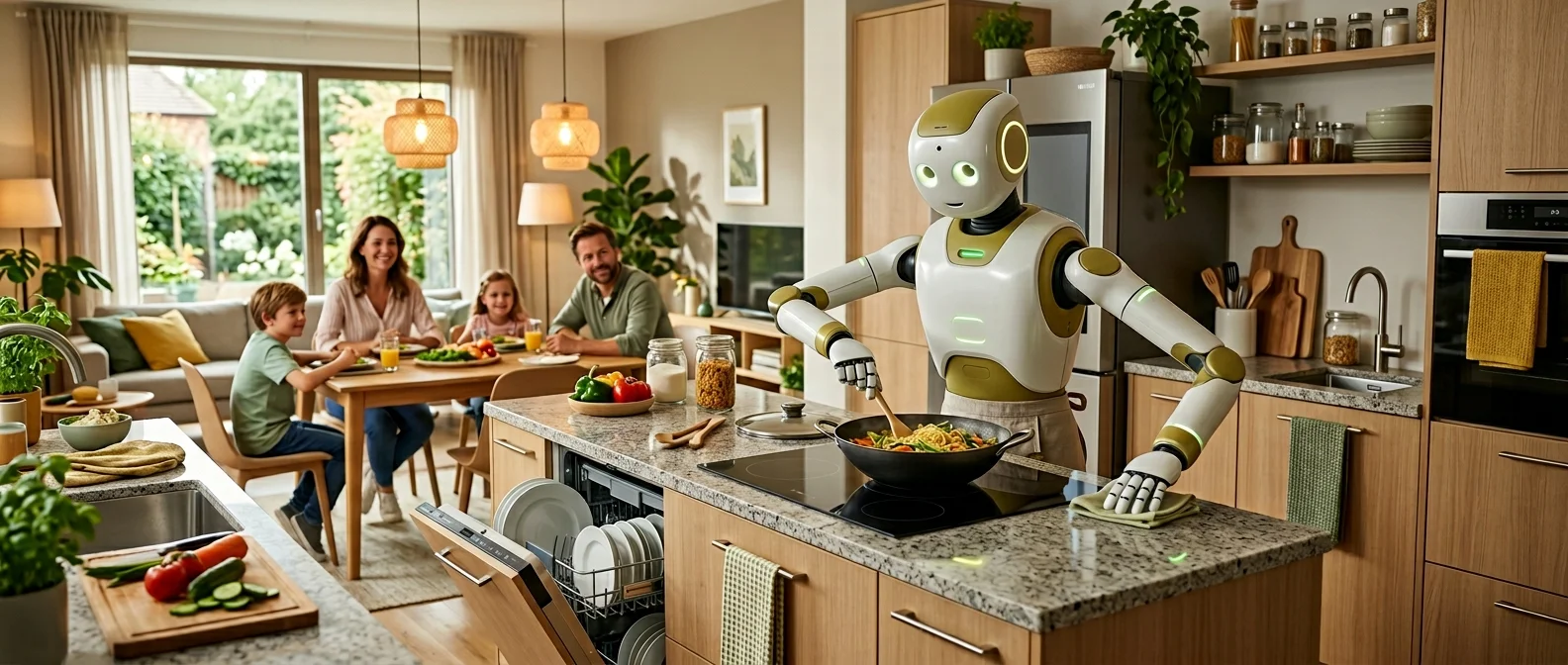
Robots Are Moving In
The Roomba was just the beginning. Today, companies like Samsung, Dyson, and research labs at Stanford are developing machines that go far beyond a single task. We're talking about robots capable of recognizing objects in a room, handling kitchen utensils, opening cabinets, and even serving meals. The domestic service robot market is projected to exceed $30 billion by 2030, according to industry analysts.
Samsung Ballie: Your AI Home Companion
In April 2025, Samsung announced a partnership with Google Cloud to bring Gemini AI to its Ballie robot. Ballie is a spherical AI companion that rolls around your home, recognizes faces, adjusts lighting, greets visitors at the door, manages your schedule reminders, and even projects content onto any wall through its built-in projector.
Thanks to Gemini's multimodal capabilities, Ballie simultaneously processes voice, camera imagery, and sensor data from its environment. You can say “Hey Ballie, how do I look?” while holding up an outfit, and receive real-time styling recommendations. If you mention feeling tired, Ballie uses Google Search grounding to deliver personalized advice on sleep, exercise, or environmental adjustments. The consumer launch is expected in Summer 2025 for the United States and Korea.
How it works: Ballie combines Samsung's proprietary language models with Google Cloud's Gemini capabilities, creating a system that understands text, images, and audio simultaneously for personalized real-time responses.
Mobile ALOHA: It Cooks, Cleans, and Carries
At Stanford University, researchers Zipeng Fu, Tony Z. Zhao, and Chelsea Finn introduced Mobile ALOHA — a low-cost system that combines a mobile base with two robotic arms capable of bimanual object manipulation. Unlike most lab robots that sit fixed beside a table, Mobile ALOHA moves freely through space.
The breakthrough comes from how it learns. Through whole-body teleoperation, a human operator shows the robot how to perform a task. With just 50 demonstrations per task and a co-training technique — combining new data with existing datasets — the team achieved success rate improvements of up to 90%. In practice, the robot can sauté shrimp, open two-door cabinets, store heavy cooking pots, call an elevator, and rinse pans — tasks requiring coordination, strength, and judgment.
The Technologies Behind Home Robots
Three technologies make these home robots possible:
- Large language models and multimodal AI: Foundation models like Gemini give robots the ability to understand natural language, perform visual recognition, and make decisions. The robot doesn't just follow fixed commands — it interprets context.
- Imitation learning: Instead of step-by-step programming, a human demonstrates how a job is done. The robot learns the physics of the real world through observation, making it straightforward to add new skills.
- Sensor integration and IoT: Depth cameras, LiDAR, pressure sensors on fingertips, and smart home platforms like SmartThings allow the robot to perceive its surroundings, navigate, and control other devices in the house.
Who's Building What — A Quick Map
Samsung is far from alone in this race. Dyson has invested over $3 billion in robotic manipulation, aiming for robots that pick up toys, load dishwashers, and organize shelves. Amazon tested Astro, a home surveillance robot with Alexa integration, while Chinese companies like Unitree are introducing humanoid robots priced below $16,000.
Meanwhile, research projects at Google DeepMind (RT-2, ALOHA Unleashed) and MIT are developing vision-language-action (VLA) models that could let robots look at photos of a messy room and autonomously plan a cleaning strategy.
Challenges and Ethical Questions
Several problems remain unsolved:
- Safety: A robot handling knives and hot cookware must fail without causing harm. Current failure rates are not negligible.
- Privacy: Cameras and microphones inside the home raise questions about surveillance, data storage, and third-party access.
- Cost: A multi-task home robot currently costs between $5,000 and $20,000. Prices need to drop below $2,000 for mass adoption.
- Reliability: Every home is different — different floor tiles, different door handles, unexpected stairs. Robots must generalize to environments they've never seen.
The Takeaway
Home robots won't replace humans overnight. More realistically, they'll gradually become part of daily life — first as digital assistants like Ballie, then as object manipulators like Mobile ALOHA, and eventually as autonomous housekeepers running entire households. The biggest obstacles are now trust, cost, and regulation.
Demand, however, keeps growing. Aging populations in Europe and Japan, dual-income households, single-parent families — they all share one need: more time. A robot that mops, cooks, and folds laundry could change how families live.
Key insight: Artificial intelligence is transforming robots from specialized tools into versatile assistants. The question is no longer “if” but “when” they'll become part of every home.