📖 Read more: smart-home-2050
From Myth to Machine: A 2,500-Year Story
The idea of human-shaped machines is not a modern invention. Homer described the “golden maidens” crafted by Hephaestus — automata that could speak and assist the god in his workshop. In the 3rd century BCE, Chinese philosopher Lie Yukou described in the “Liezi” a mechanical robot made of leather and wood that could walk and sing.
In the 13th century, Ismail al-Jazari designed humanoid automata — a waitress robot that served drinks and a hand-washing machine. Leonardo da Vinci (1495) designed a mechanical knight capable of sitting, standing, and moving its arms using a system of pulleys. In Japan, karakuri puppets (17th-19th century) served as entertainment — they danced, beat drums, and served tea.
The Modern Era: From WABOT to Atlas
The real revolution began in 1972 at Waseda University in Japan, with WABOT-1 — the world's first full-scale humanoid robot. It walked at a leisurely pace, spoke simple Japanese commands, measured distances through artificial sensors, and grasped objects with primitive mechanical hands.
🏭 Honda E/P Series → ASIMO (1986-2000)
Honda developed 7 bipedal prototypes (E0-E6) before reaching ASIMO in 2000 — the first robot that could run. Retired in 2022 after 22 years of development, ASIMO paved the way for today's commercial robots.
🤖 Boston Dynamics Atlas (2013-2024-present)
Started as a hydraulic robot for the DARPA Robotics Challenge. In April 2024, the hydraulic version was retired and a brand-new electric version was unveiled — with broader range of motion and precision.
⚡ Tesla Optimus (2022-present)
Height 173cm, weight 57kg, carrying capacity 20kg. Gen 3 hands have 22 degrees of freedom. Elon Musk targets a price of ~$30,000 and mass production by 2026.
🦾 Agility Digit (2020-present)
In June 2024, 5 Digit robots began working in a real GXO Logistics warehouse — a small but historic step for humanoids in industry.
How Does a Humanoid Robot “Think”?
A modern humanoid robot combines three critical elements: sensors, actuators, and artificial intelligence. These systems work together — sensors gather data, AI processes it, actuators execute movement.
📖 Read more: hydrofoil-boats-flying-ferries
Applications: Where Will We Meet Them?
🏥 Medical & Rehabilitation
Humanoid robots are already used in developing prosthetic limbs, patient rehabilitation (WABIAN-2), and as robotic nurses for the elderly. Knowledge flows bidirectionally between robotics and orthopedics.
🏭 Industry & Logistics
Agility's Digit robots work in warehouses. Optimus was designed for “dangerous, repetitive, and boring” tasks at Tesla factories. Figure AI unveiled Figure 03 (September 2025), capable of household chores.
🎭 Entertainment & Sports
In August 2025, Beijing hosted the first World Humanoid Robot Games — 500+ robots from 280 teams competed in soccer, running, and boxing. Unitree organized the first robot boxing match with G1 units, and Disney developed “stuntronics” — robot stunt doubles performing aerial flips in theme parks.
🚀 Space
NASA's Robonaut 2 launched to the ISS in 2011. Valkyrie (R5) was designed for future Moon and Mars missions. Musk announced Optimus robots would be sent to Mars (though plans shifted to the Moon in February 2026).
2025 Records: The Landmark Year
2025 broke every previous record in humanoid robotics:
🤸 First Forward Flip
In February 2025, Engine AI unveiled SE01 — the first humanoid to perform a forward flip. An achievement no one thought possible just a few years ago.
🚶 100km Walk
In November 2025, AgiBot A2 walked 100 kilometers from Suzhou to Shanghai in 3 days, earning a Guinness World Record — proof of marathon-runner endurance.
🏠 Home Robots
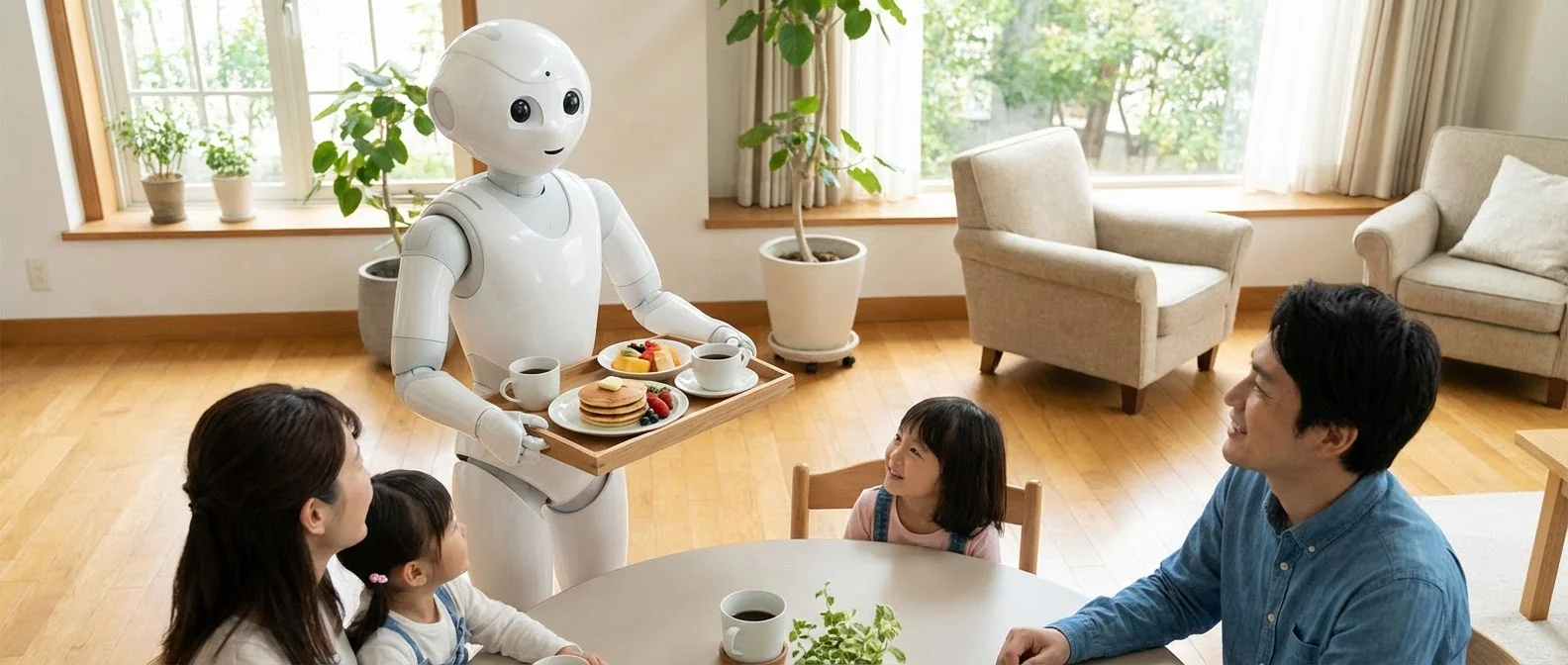
In September 2025, Figure AI unveiled Figure 03 — an autonomous humanoid that does household chores: cooking, cleaning, organizing. Closer than ever to the “robot roommate.”
🇰🇷 K-Humanoid Alliance
South Korea established the K-Humanoid Alliance (April 2025) — a national alliance of companies, researchers, and talent aiming to make the country a global humanoid leader by 2030.
📖 Read more: Hyperloop: Athens-Thessaloniki in 30 Minutes
The Uncanny Valley
One of the most significant obstacles isn't technological — it's psychological. The “Uncanny Valley” theory explains why robots that look “almost” human trigger unease or revulsion. Hanson Robotics' Sophia sparked global interest but also backlash. Engineered Arts' Ameca (2022) achieved more natural facial expressions, reducing this effect.
Roboticists argue that we may not need “hyper-realistic” robots but rather functional designs that inspire trust without faithfully mimicking the human form — a lesson the industry is beginning to internalize.
Criticisms & Concerns
Not everyone is enthusiastic. Rodney Brooks, co-founder of iRobot (Roomba), called Musk's vision of robot assistants “pure fantasy thinking,” emphasizing that robots lag terribly in coordination. DW experts called Optimus a “complete scam” after the 2022 AI Day presentations, while critics at the We, Robot event (October 2024) revealed that many demos used teleoperation rather than autonomy.
The key questions remain:
- Work: Will they replace humans or work alongside them?
- Ethics: Should an “almost human” robot have rights?
- Safety: How do we ensure a powerful robot won't accidentally harm someone?
- Psychology: The risk of excessive emotional dependence on machines
"I think Optimus has the potential to be more significant than the vehicle business over time."
The Forecast: When Will We Share a Home?
With prices dropping (the Unitree G1 costs just $16,000), capabilities exploding (Figure 03 does housework), and giants like Tesla, Samsung/Rainbow Robotics, and Figure AI pouring in billions, humanoid robots are no longer science fiction. They are engineering reality.
The forecast? Warehouse and factory assistants: already here (2024-2025). First-generation home assistants: 2028-2032. Full “roommates” with conversation, cooking, and caregiving abilities: likely after 2035. The question isn't “if” — it's “how we'll live together.”