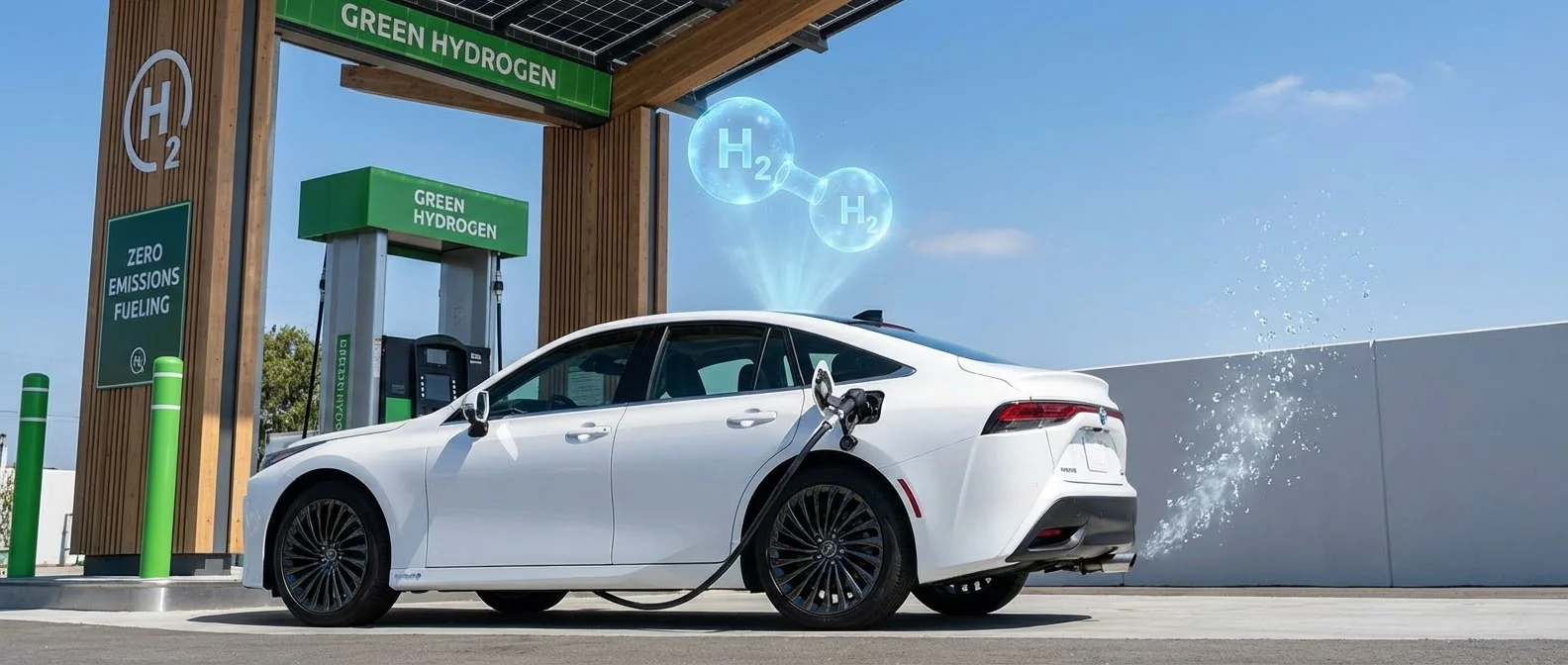
Hydrogen is the most abundant chemical element in the universe — and possibly the key to humanity's decarbonization. In 2021, 94 million tonnes of hydrogen were produced globally, with a market value of $155 billion. Yet over 99% still comes from fossil fuels. The transition to green hydrogen — produced by water electrolysis using renewable energy — could transform the global energy landscape.
📖 Read more: Solar Roads: Roads That Generate Electricity
What Is Hydrogen as an Energy Carrier?
Hydrogen is not an energy source — it's an energy carrier, similar to electricity. It's not mined but produced from other energy sources. The term "hydrogen economy" was coined by John Bockris in 1970, during a talk at General Motors' Technical Center. The idea was to use hydrogen, powered by nuclear and solar energy, to address fossil fuel depletion and pollution.
The Colors of Hydrogen
The industry uses a color-coding system to distinguish different hydrogen production methods. Each “color” reflects the environmental impact and energy source used.
| Type | Production Method | Cost ($/kg) | CO₂ Emissions |
|---|---|---|---|
| ⬜ Grey | Steam methane reforming (SMR) | 1.0 – 2.5 | 6.6-9.3 tonnes/tonne H₂ |
| 🔵 Blue | SMR + Carbon capture (CCS) | 1.5 – 3.0 | Reduced (~60%) |
| 🟢 Green | Water electrolysis + Renewables | 3.0 – 6.0 | Near zero |
| 🟡 Yellow | Electrolysis + Nuclear energy | 2.5 – 5.0 | Very low |
| ⚪ White | Natural hydrogen (underground) | Under research | Zero |
How Does Electrolysis Work?
Electrolysis is the process of splitting water (H₂O) into hydrogen (H₂) and oxygen (O₂) using electricity. Efficiency reaches up to 80%, requiring approximately 9 liters of water to produce one kilogram of hydrogen. By December 2023, manufacturers were expanding electrolyzer production capacity by 35% to meet the needs of over 1,400 announced projects.
🔋 Alkaline Electrolyzers (AE)
A mature and cost-effective technology for large-scale, steady production. They operate at 70-90°C using a potassium hydroxide electrolyte. Less suited for intermittent renewable sources.
⚡ PEM Electrolyzers
Proton Exchange Membrane — compact design, high responsiveness at 50-80°C. Ideal for coupling with wind/solar energy. They use platinum and iridium, increasing costs.
🔥 SOEC (Solid Oxide)
Operate at high temperatures (500-1000°C) with exceptional efficiency. Suitable for integration with industrial heat sources. Challenge: high material stress and slow dynamic response.
🌱 AEM Electrolyzers
Anion Exchange Membrane — a new, promising technology combining AE affordability with PEM flexibility. Uses non-noble metals, significantly reducing cost.
The Cost: The Big Barrier
The key price point is $2/kg — where green hydrogen becomes competitive against grey. According to Goldman Sachs analysis, this could be achieved globally by 2030, especially with a carbon tax. Electrolyzer costs dropped by 60% between 2010 and 2022, though they rose 50% between 2021 and 2024. The US DOE's Hydrogen Hotshot target is $1/kg by 2031.
📉 Green Hydrogen Cost Forecast
According to the International Energy Agency (IEA), green hydrogen production costs were $4-9/kg in 2021 and are expected to fall below $1.5/kg by 2030 in regions with good solar conditions, and below $1/kg by 2050. IRENA projects costs of $1.1-3.4/kg by 2050. Subsidies play a critical role: the US offers a $3/kg tax credit through the Inflation Reduction Act, while the EU and Japan have committed tens of billions.
Where Is It Used Today?
Nearly all hydrogen produced (94 Mt in 2021) is used in oil refining (40 Mt) and industry (54 Mt). Industrially, the primary uses are ammonia production for fertilizers (34 Mt), methanol (15 Mt), and direct reduced iron manufacturing (5 Mt). CO₂ emissions from this production reached 915 million tonnes — 2.5% of global energy-related emissions.
Hydrogen in Transportation
🚛 Heavy Trucks
The IEA projects hydrogen will cover ~30% of heavy truck energy demand by 2050, mainly for long-distance freight. Hyundai is already testing fuel cell trucks with 700 km range and 12-minute refueling.
🚢 Shipping
Green ammonia and methanol — hydrogen derivatives — are emerging as the most promising maritime fuels. Maersk already uses green methanol ships. By 2050, 20-30% of transport energy could be hydrogen-powered.
✈️ Aviation
Airbus is developing hydrogen aircraft for medium-range flights (ZEROe concept). Hydrogen as aviation fuel is early-stage but considered critical for long-haul zero-emission flight.
🚌 Buses & Trains
Hydrogen buses operate in 8+ European cities (HyFLEET:CUTE program). Alstom launched the first hydrogen trains in Germany. Iceland operated a pilot fleet in Reykjavik.
Hydrogen in Industry
Heavy industry is perhaps the most critical sector for hydrogen. Steel, cement, glass, and chemical production requires extremely high temperatures that cannot easily be electrified. Hydrogen can replace carbon in steelmaking — SSAB in Sweden already produces “green steel” using hydrogen instead of coke. Meanwhile, green ammonia for fertilizers and green methanol production opens massive markets.
🏭 Green Steel: The Revolution
Traditional steelmaking uses coke (from coal) as a reducing agent. Hydrogen can replace this process through Direct Reduced Iron (DRI), eliminating CO₂ emissions. H2 Green Steel (Sweden) is building one of the world's largest electrolysis plants (740 MW) in partnership with Thyssenkrupp Nucera, targeting green steel production by 2026.
Energy Storage
One of hydrogen's greatest advantages is its capacity for long-duration energy storage. When solar and wind production exceeds demand, surplus energy can be converted to hydrogen via electrolysis and stored for months. This solves the intermittency problem of renewables — especially during low-production seasons — in ways batteries cannot.
National Hydrogen Strategies
Since 2017, 60+ countries have published national hydrogen strategies. These guide public and private investment in critical areas: production, transport, storage, and end-use.
🇯🇵 Japan
First country with a hydrogen strategy (2017), aiming to become a “hydrogen society.” Has 135+ refueling stations, plans 1,000 by decade's end. Committed $21 billion in subsidies (2023).
🇪🇺 European Union
2021 strategy for large-scale infrastructure development. The European Green Hydrogen Hub targets a €100B/year economy. 6 countries seek legislative backing. Germany: €9B for 5 GW electrolyzers by 2030.
🇺🇸 United States
$9.5B via Infrastructure Act, $3/kg tax credit (Inflation Reduction Act). Hydrogen Hotshot target: $1/kg by 2031. Texas: largest domestic producer with extensive pipeline network.
🇮🇳 India & 🇨🇳 China
India: target 5 Mt green H₂ by 2030, Adani Group $70B investment. China: market leader with 33 Mt/year, shifting to green. Sinopec targets 120,000 tonnes of green H₂.
Major Global Projects
🏭 Fukushima Hydrogen Energy Research Field (Japan)
Inaugurated in March 2020, it is one of the world's largest hydrogen production facilities. It uses massive solar arrays for water electrolysis. Located in the same region as the former nuclear plant — symbolizing the transition from nuclear to green energy.
🏜️ NEOM — Saudi Arabia
As part of the NEOM mega-project, Saudi Arabia plans to produce 1.2 million tonnes of green ammonia annually, with production starting in 2025. Project value: $5 billion. It represents one of the largest green energy investments in the Middle East.
🌊 Oman — $30 Billion Hydrogen Hub
A consortium of companies announced a $30 billion project in Oman, which by 2038 will be powered by 25 GW of wind and solar energy. It will become one of the world's largest hydrogen facilities.
"The hydrogen economy isn't just about cars — it's about restructuring our entire energy system. Hydrogen in factories, ships, energy storage — that's where the real revolution lies."
Infrastructure & Challenges
Transitioning to the hydrogen economy requires massive infrastructure investment: pipelines, refueling stations, storage tanks, and electrolysis units. Hydrogen, as the smallest molecule, easily escapes containers, causes steel embrittlement in pipelines, and is highly explosive.
🔧 Transport
Pipelines are the cheapest long-distance transport method but must be designed for embrittlement and leaks. Alternatives: compressed H₂ tube trailers, liquid H₂ tankers.
🏗️ Storage
High-pressure storage (350-700 bar), liquid form (-253°C), or as ammonia/methanol. Each method has trade-offs: liquid ammonia transports easily, but conversion loses energy.
⛽ Refueling Stations
Globally, Japan leads with 135+ stations, followed by Germany and the US (mainly California). South Korea is building 188 km of underground pipelines in Ulsan.
⚠️ Safety
Highly explosive when mixed with air (4-75%). Invisible flame. Global warming potential (GWP100) ~11.6. Requires strict detection and handling protocols.
Hydrogen Timeline
Global Perspective
The Future of Hydrogen
The IEA forecasts production of 37 million tonnes of low-carbon hydrogen by 2030. By 2050, hydrogen is expected to replace fossil fuels in sectors that cannot be electrified: steelmaking, chemical industry, shipping, aviation. New technologies — such as the discovery of natural hydrogen underground, bio-electrolysis with biochar (6x more efficient), and H₂ production from scrap iron — promise to fundamentally change production methods. The hydrogen economy is no longer science fiction — it's an industrial reality in rapid evolution.