📖 Read more: Space Elevator: From Dream to Plan
The Problem: Why TCP/IP Falls Apart
Every time you load a webpage, data travels through TCP/IP — a protocol built on one fundamental assumption: that sender and receiver are connected simultaneously. On Earth, that works fine. In space, it doesn't.
A signal from Mars takes 4 to 24 minutes to reach Earth, depending on orbital positions. That means a basic TCP handshake — the standard connection procedure — would require at least three signal exchanges. We're talking over an hour just to initiate a data transfer. And if a packet gets lost? Start over.
Delay isn't the only problem. A planet can hide behind the Sun for weeks, cutting all contact. Satellites orbit out of view every 90 minutes. Atmosphere, solar radiation, physical obstacles — everything conspires against a stable connection.
DTN: An Internet Without Permanent Links
NASA's solution is called Delay/Disruption Tolerant Networking (DTN) — a suite of protocols designed specifically for environments where disconnections are the norm, not the exception.
DTN operates on a "store-and-forward" principle: each network node stores data locally and forwards it as soon as the next node becomes available. Think of it like email — the message sits in the outbox until a connection appears. Reliable delivery is guaranteed through automatic retransmission mechanisms, no real-time end-to-end link needed.
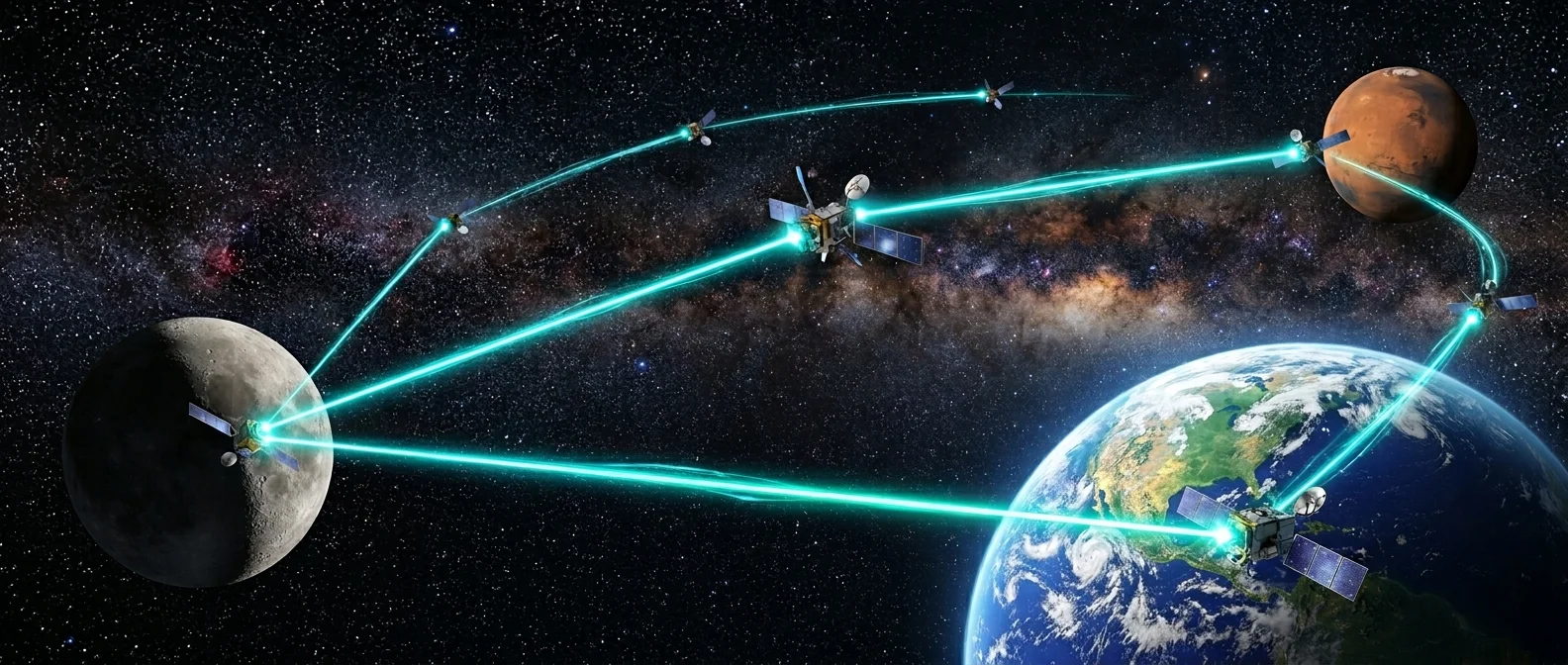
How it works in practice: Mars sends data to an orbiting relay satellite. That satellite stores it until it can “see” a node closer to Earth. That node forwards it to the next one, and so on, until the data reaches a ground antenna on Earth — minutes, hours, or days later, but reliably.
The DTN suite also includes security capabilities. Bundle Protocol Security enables integrity checks, authentication, and encryption even on links that previously lacked them. In a network spanning millions of kilometers, security can't be optional.
It Already Works — And Remarkably Well
DTN isn't theoretical. It runs on the International Space Station, on NASA's PACE mission, and was tested on an Antarctica-to-ISS connection.
In November 2017, NASA engineers at McMurdo Station in Antarctica used DTN to send a selfie to the ISS. The image traveled through the McMurdo ground station, hopped to a TDRS relay satellite, down to the White Sands Complex, over to Marshall Space Flight Center, and back up through another TDRS to the ISS. Each node stored and forwarded — exactly as designed.
Since 2024, NASA's PACE mission (Plankton, Aerosol, Cloud, ocean Ecosystem) became the first operational Class-B NASA mission to use DTN. Over 34 million bundles have been transmitted with a 100% success rate. The mission downlinks up to 3.5 terabytes of science data daily through 12-15 transmissions across 4 ground stations (Alaska, Virginia, Chile, Norway).
Even more impressive: in 2024, NASA sent over 500 pet photos to the ISS via laser links, using the LCRD relay in geosynchronous orbit and High-Rate DTN (HDTN). HDTN proved four times faster than earlier DTN implementations.
📖 Read more: Starship Point-to-Point: London to Sydney in 1 Hour
Optical Communications: Lasers Instead of Radio
DTN solves the protocol problem. But what about speed? That's where optical communication comes in — lasers instead of radio waves.
NASA's Deep Space Optical Communications (DSOC) experiment, launched aboard the Psyche mission in October 2023, proved that data encoded in near-infrared laser signals can be reliably transmitted and decoded after traveling millions of miles — at distances comparable to Mars.
On December 11, 2023, DSOC streamed the cat video — 15 seconds of ultra-HD footage — from 31 million kilometers away (about 80 times the Earth-Moon distance). The signal took 101 seconds to arrive. Reception happened at the 200-inch Hale Telescope at Caltech's Palomar Observatory in San Diego County.
By December 2024, the experiment broke distance records: Psyche data was received from 307 million miles — farther than the average Earth-Mars distance. For comparison, the Magellan mission to Venus (1990-1994) downlinked a total of 1.2 terabits across its entire mission. DSOC transmitted 1.3 terabits in a single night.
What the Interplanetary Internet Will Look Like
NASA describes DTN as a “foundational capability for creating the Solar System Internet.” What would that actually look like?
Picture layers of nodes. On Earth, the Deep Space Network (DSN) — with antennas at Goldstone (California), Madrid, and Canberra — serves as the base. Around the Moon, the LunaNet program will place communication and navigation nodes around the lunar surface. Between Earth and Moon, relay satellites (like the TDRS fleet already in service) will provide coverage.
For Mars, the architecture calls for DTN-enabled satellites in areosynchronous orbit, collecting data from rovers, habitat modules, and surface instruments. Data would hop through relay nodes, then reach Earth via laser links or radio frequency channels.
"Future space missions will require astronauts to send high-resolution images and instrument data from the Moon and Mars back to Earth. Bolstering our capabilities of traditional radio frequency communications with the power and benefits of optical communications will allow NASA to meet these new requirements."
— Kevin Coggins, NASA SCaN ProgramAn interesting experiment is already underway at Goldstone: a radio frequency antenna was recently retrofitted with seven optical reception mirrors, creating a “hybrid” RF-optical antenna that simultaneously receives radio signals and laser transmissions from Psyche. The transition doesn't require abandoning existing infrastructure — just upgrading it.
What This Means Going Forward
If NASA sends humans to Mars — something planned for the 2030s — they won't survive on occasional “hello” messages to Earth. They'll need high-definition video for telemedicine, massive scientific data transfers, and some form of web experience — even with minutes of delay.
DTN isn't exclusively for space. NASA is exploring terrestrial applications: communications during natural disasters (when networks fail), remote areas without infrastructure, and unstable IoT networks. Engineering for Mars solves problems on Earth too.
Nobody will be streaming YouTube in real time on Mars — physics won't allow it. But uploading data, sending emails, updating medical device firmware, sharing photos from home? That will be possible soon. The interplanetary internet won't look like what we know. It'll be something new — designed for a world where connection is never guaranteed.