When Cells Become Processors
A teaspoon of bacteria contains more circuits and computing power than a supercomputer. This mind-bending reality reveals something deeper: life computes by its very nature. From individual cells responding to chemical signals to complex organisms navigating their environment, information processing sits at the heart of every living system.
After decades of trying, scientists are finally learning to train cells, molecules, and even entire organisms to perform computational tasks for our purposes. This isn't about replacing traditional computers — it's a radically different approach that could help us tackle problems in domains that were simply unreachable before.
📖 Read more: Neural Computers: Biological Brains on Chip
📖 Read more: Living Brain Computers: Real Neurons Power Next-Gen AI
From Silicon to Living Circuits
For decades, computing has been dominated by silicon chips. These consist of billions of microscopic switches called transistors that encode data in bits, or binary digits. If a switch is open and allows electrical current to flow, that represents a 1. If it's closed, that's a 0.
Biological computers work completely differently. Instead of transistors, they use living cells, DNA molecules, or even entire organisms. These systems process information through biochemical reactions, using the same mechanisms that nature has perfected over billions of years.
Traditional vs Biological Computers
| Feature | Traditional | Biological |
|---|---|---|
| Basic element | Transistor | Cell/Molecule |
| Energy | Electrical | Biochemical |
| Processing | Binary | Analog/Parallel |
| Consumption | High | Extremely low |
The Molecular Computing Revolution
Bioengineers are starting to understand the wet and soft components that nature provides. As they become familiar with these, they're beginning to understand where biological computers might ultimately be useful — from smart materials and accounting solutions to intelligent machines powered by microscopic amounts of energy.
As Angel Goñi-Moreno from the Technical University of Madrid explains, "biocomputing doesn't compete with conventional computers. It's a radically different perspective that could help us tackle problems in domains that were simply unreachable before."
Neurons as Processors
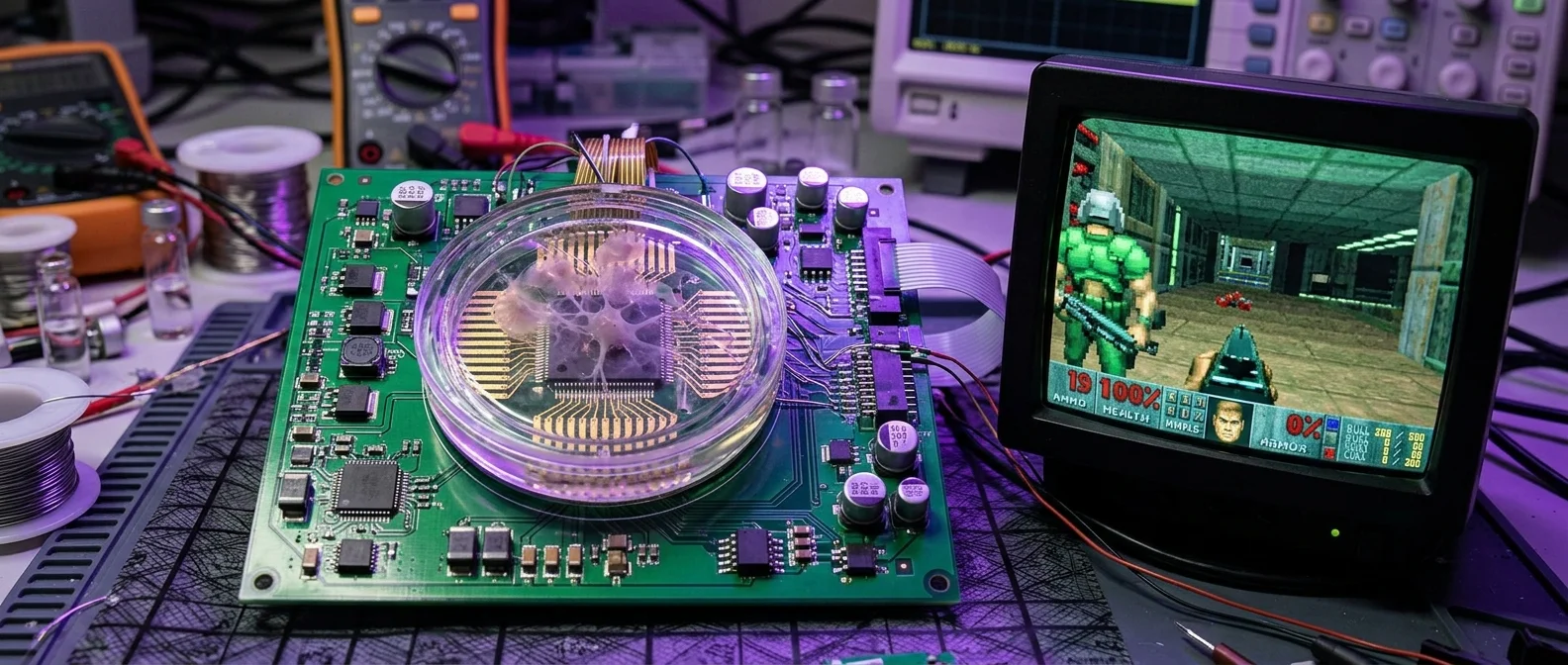
One of the most exciting developments is using human brain cells for computational tasks. Researchers have managed to train brain cells on chips to play the game Doom within a week. This isn't science fiction — it's reality that showcases the unlimited potential of biological computers.
Brain cells have an inherent information processing capability that far exceeds traditional processors. They can process thousands of signals simultaneously, learn from experience, and adapt to new conditions in ways that today's computers simply cannot replicate.
Neural Computer Advantages
- Parallel processing: Thousands of signals simultaneously
- Adaptability: Learning and evolution in real-time
- Energy efficiency: Millions of times lower consumption
- Self-repair: Regeneration and restoration capabilities
📖 Read more: Mini Brains on Chip: Solving Engineering Problems
Real-World Applications
The applications of biological computers seem unusual and eclectic, and that's exactly the point. This isn't about replacing your smartphone or laptop, but solving problems that traditional computers can't handle effectively.
In the field of artificial intelligence, digital computers struggle to mimic the complex processes of the human brain. The latest hardware is often too expensive and inefficient for use in this domain. Biological computers offer an alternative solution that could revolutionize AI.
Smart Materials
Materials that respond and adapt to their environment using biological computers
Medical Applications
Systems that can detect and treat diseases at the cellular level
Environmental Control
Biosystems that monitor and restore environmental damage
Accounting Solutions
Management systems that optimize resources with biological algorithms
From Ancient Times to the Future
The idea of analog computers isn't new. The Antikythera mechanism, an astonishingly sophisticated 2000-year-old computer, was discovered in an ancient Greek shipwreck in 1901. About the size of a shoebox and equipped with thick bronze gears, it was built to map the trajectories of celestial bodies.
Today, as digital computers reach their limits, researchers at the cutting edge of computer development are looking toward analog techniques that have more in common with the Antikythera mechanism than with today's conventional computers. To save the future of computing, we might need a blast from the past.
"Much of the mathematics used at the frontiers of modern science translates poorly to digital technology, where certain equations are difficult to solve."
— New ScientistSustainability and Energy Efficiency
One of the biggest advantages of biological computers is their exceptional energy efficiency. While modern data centers consume massive amounts of energy and contribute significantly to carbon emissions, biological computers operate on microscopic amounts of energy.
Living cells have evolved to be incredibly efficient. They can perform complex computational tasks using only the chemical energy they produce from simple nutrients. This makes them ideal for applications where energy consumption is critical.
Advantages
- Exceptional energy efficiency
- Self-repair and regeneration
- Parallel processing
- Adaptability
- Biocompatibility
Challenges
- Slow processing speed
- Difficulty in control
- Limited lifespan
- Environmental sensitivity
- Design complexity
Challenges and Limitations
Despite their exciting potential, biological computers face significant challenges. Processing speed is considerably slower than traditional computers. While a modern processor can execute billions of operations per second, biological processes operate on timescales of seconds or even minutes.
Control of biological systems is extremely difficult. Living cells have their own "will" and may not always behave as expected. This makes programming and managing biological computers a complex challenge that requires new approaches and tools.
The Future of Computing
Biological computers won't replace traditional computers, but will complement them in specialized applications. As the technology evolves, we'll see hybrid systems that combine the best of both worlds — the speed and precision of digital computers with the adaptability and energy efficiency of biological systems.
Sources: