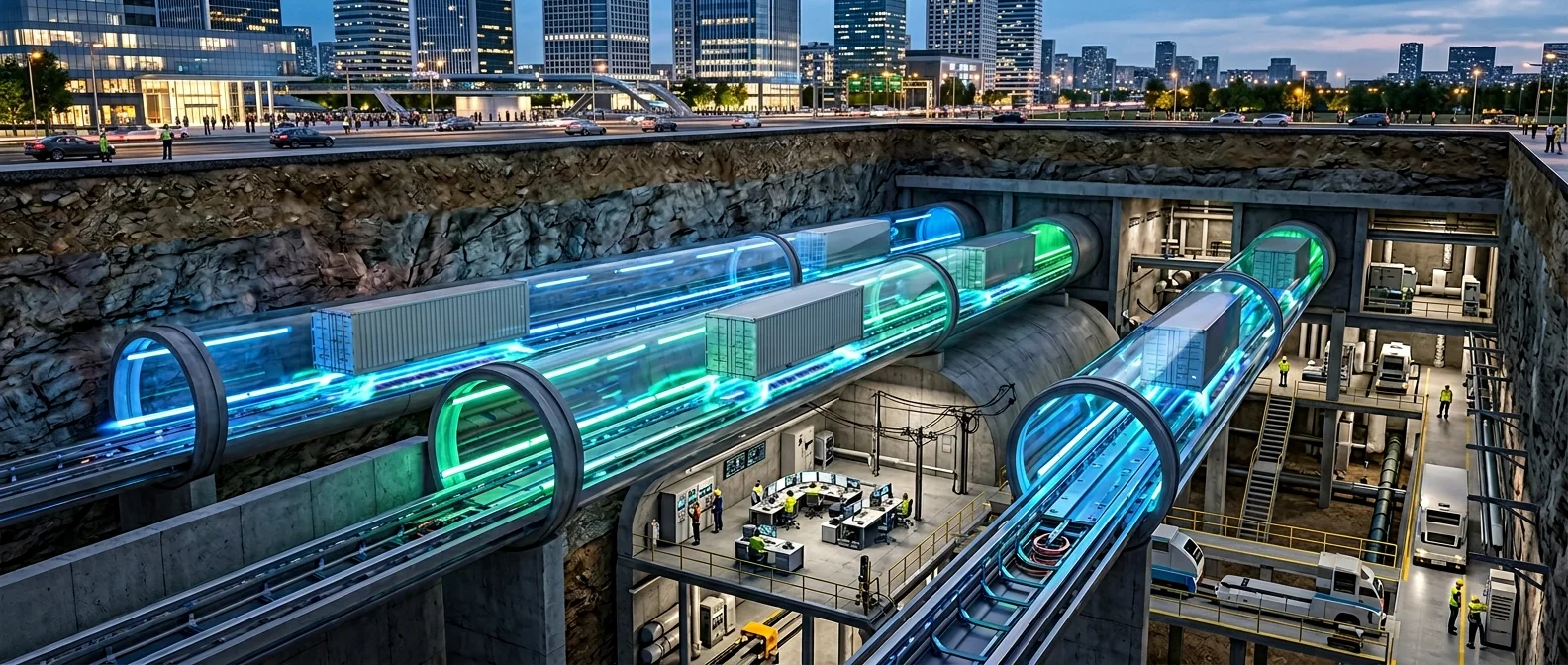
Every day, millions of parcels move through trucks on urban networks already choking with traffic. What if deliveries happened underground, inside pipes, with capsules propelled by linear magnetic motors? Startups in the UK, Germany, and Switzerland are building these systems now. The first tests are done.
📖 Read more: Maglev 600km/h: The Flying Trains of China
The Idea: Pipes Instead of Roads
The basic concept is straightforward: instead of loading a truck for one delivery run, individual parcels are placed in capsules that travel through pipes. The pipes can be underground, above ground, or even suspended — running alongside existing roads and railway lines. Movement happens via linear electromagnetic motors — the same technology used in roller coasters and maglev trains.
The technology isn't new. The concept of transporting goods through tubes dates back to the 19th century: pneumatic tubes in London carried telegrams from 1853, while the Paris network reached 467 kilometers. Today's systems can move thousands of parcels per hour, fully automated, without fuel.
Magway: The British Vision
Magway was founded in 2017 in London by Rupert Cruise, an engineer who had worked on Elon Musk's Hyperloop, and Phill Davies. The idea was simpler than Hyperloop: you don't transport people at supersonic speeds, you don't need a vacuum — you simply send parcels through pipes, steadily and automatically.
The system uses linear synchronous magnetic motors to propel capsules through 90-centimeter diameter HDPE pipes. Each capsule travels at 50 km/h — slow by highway standards, but fast enough for capsules separated by milliseconds. The capsule size is designed to match the standard totes used in automated warehouses by Ocado and Amazon, enabling direct compatibility.
Magway Funding: £650,000 from Innovate UK (2018), £1.58 million via crowdfunding (2019), £1.9 million from the UK Government's Driving the Electric Revolution programme (2020). Partners: Ocado Innovation, Force Engineering, Transport Research Laboratory.
In September 2020, Magway completed the first full loop of test track in a warehouse in Wembley. The scale: 850 kilometers of pipes through decommissioned London gas pipelines, delivering over 600 million parcels annually. Modelling showed that 94% of London's daytime population would be within a 15-minute walk or cycle of a Magway node.
CargoCap: German Precision
In Germany, CargoCap started as a research project at Ruhr University Bochum. The system uses autonomous electric capsules moving through underground pipelines approximately 2 meters in diameter. Each capsule fits two europalettes and travels at speeds up to 80 km/h, using electromagnetic linear motors. The vision is connecting industrial zones, airports, and distribution centres in the Ruhr region.
CargoCap's approach differs from Magway's. While Magway targets small e-commerce parcels, CargoCap was designed for heavier commercial cargo — industrial materials, spare parts, food. The capsules are autonomous, with their own navigation and continuous-operation sensors — the system runs 24/7 without drivers.
Cargo Sous Terrain: The Swiss Proposal
Switzerland, always a pioneer in infrastructure, is advancing with Cargo Sous Terrain (CST). The project envisions an underground network connecting major cities (Zürich, Bern, Basel, Luzern) with autonomous vehicles in 3-lane tunnels. The first phase is the Zürich-Härkingen line (approximately 70 km), with the project receiving legislative approval in 2022. CST doesn't use maglev but electric vehicles on rails — proof that nations are investing in underground freight networks.
📖 Read more: Underwater Tunnels: Roads on the Seabed
Why Magnetic Levitation for Cargo?
Using linear magnetic motors for freight transport offers specific advantages:
- Zero emissions: fully electric, no fuel needed
- Weather-independent: snow, rain, traffic congestion don't exist underground
- 24/7 operation: no drivers, no shifts, no traffic hours
- Minimal maintenance: no moving parts on the guideway means minimal wear
- Security: closed system, protection from theft and vandalism
Critical factor: In 2023, 30% of trucks in London carried e-commerce parcels. If those parcels moved underground, millions of tonnes of CO₂ would disappear, road space would be freed, and road damage would decrease dramatically.
Challenges and Obstacles
Naturally, there are serious challenges. Infrastructure cost is enormous — building underground pipes in an urban environment requires significant investment. Magway addresses this by repurposing decommissioned gas pipelines, but the problem remains for new lines.
Additionally, the “last kilometre” remains a challenge. Parcels arrive at a node, but must be delivered to your door. This requires combining with other solutions — delivery robots, drones, or electric vans for the journey from node to home. And of course, regulatory approval for new underground construction is time-consuming — even in Switzerland, CST needed over a decade to reach the construction stage.
Nevomo: The Hybrid Model
Polish Nevomo (MagRail) follows a different strategy: it modifies existing railway lines into hybrid maglev, avoiding the enormous cost of new infrastructure. Testing on a 700-meter track started in 2023. While it primarily focuses on passenger transport, the technology is equally applicable for freight on existing lines during low-traffic hours.
The Future of Underground Transport
The e-commerce explosion has made the problem urgent. In cities like London, Paris, and Zürich, thousands of delivery trucks add congestion and pollution to already saturated networks. Magnetic cargo systems offer a radical alternative: moving parcels below the city, leaving roads for people.
In a world that orders more and more online, magnetic levitation cargo pipes might be tomorrow's infrastructure. Not because they're impressive, but because they solve a real problem: we need to stop filling roads with trucks to deliver a single box.