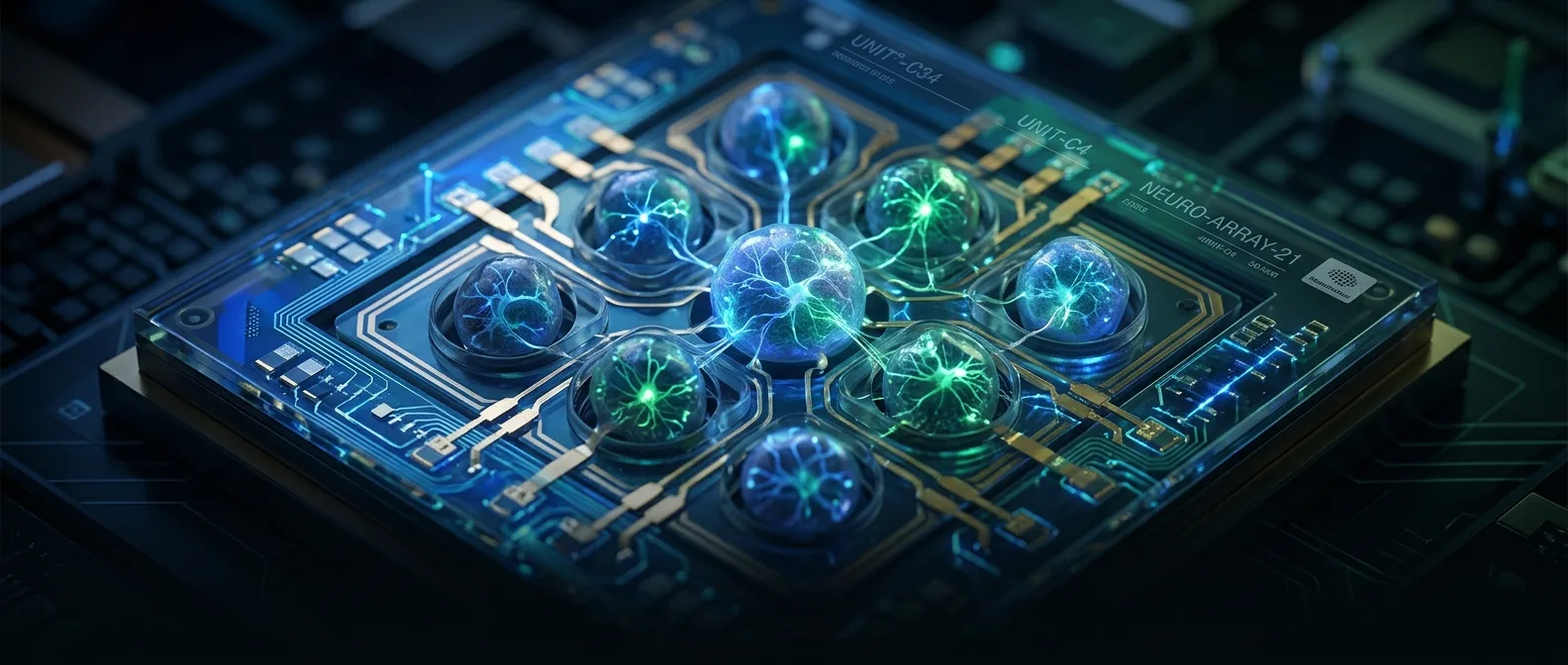
🧬 What the Hell Are Brain Organoids?
Let's start with the basics. Brain organoids aren't some sci-fi nightmare scenario. They're three-dimensional brain structures grown in labs from stem cells.
Picture skin cells rewinding to their stem cell state. Then, with the right cocktail of nutrients, they self-organize into neurons, networks, something that resembles chunks of brain tissue. Not a full brain — more like a "demo version."
Quick comparison: If the human brain is Windows 11, brain organoids are roughly MS-DOS. They work, but with basic functionality.
The fascinating part? These "brains in a dish" generate electrical activity. Pulses, waves, signals. Like microscopic laboratories mimicking how real brains operate.
From Sci-Fi to Lab Bench
Organoid technology isn't brand new. In 2013, scientists first created three-dimensional brain structures resembling premature infant brains. Now, in 2026, they've reached complexity levels that mirror the neural wiring of kindergarten-age children.
The more sophisticated they become, the more researchers wonder: "Can they learn?"
⚡ The Experiment That Changed Everything
In the latest experiment from Ash Robbins' team at UC Santa Cruz, scientists challenged mini-brains with the classic "cartpole problem." The game is simple: keep a stick upright on a moving cart.
Sounds easy? Try balancing a ruler on your palm while walking. Your eyes constantly track. Your hand makes micro-adjustments. Your brain has one goal: keep the ruler vertical.
Researchers placed organoids on chips that record their electrical pulses and communicate with computers. Every time the digital stick fell, they gave the mini-brains an electrical pulse — like saying "wrong, try again."
The Magic of Reinforcement Learning
Here's the trick. When we learn something new, our brains release dopamine when we succeed. But cortical organoids lack dopamine neurons. How can they learn?
The team discovered electrical signals suffice. Organoids released other chemicals that strengthen neural connections. When researchers blocked this process, learning stopped.
"You can think of it as an artificial trainer saying 'you're doing it wrong, change your approach a bit'"
— Ash Robbins, UC Santa Cruz
The learning didn't last forever, though. After 45 minutes without stimulation, organoids forgot everything. Like having only "short-term memory" without infrastructure for long-term storage.
🔬 Brainoware: Next-Gen Biological Computing
UC Santa Cruz isn't alone in this space. Another research team developed "Brainoware" — a system using brain organoids for speech recognition and nonlinear equation prediction.
Brainoware operates like reservoir computing. Imagine a digital pulse sent to the organoid, bouncing through the neural network like a stone in a pond. The resulting waves contain information.
Early Results
The research team showed their system can:
- Recognize speech: Distinguish between different phonetic elements
- Predict chaos: Solve nonlinear equations describing chaotic systems
- Adapt: Modify neural connections based on training data
All with far less energy than conventional processors. Human brains consume roughly 20 watts — like an LED bulb. AI GPUs can hit 400-500 watts.
Energy Efficiency
Biological processors could consume fractions of the energy required by today's AI chips.
Parallel Processing
Neurons process information simultaneously, not serially like traditional processors.
Self-Repair
Biological networks can repair damage and reorganize their connections.
💼 The Market Wakes Up
Companies aren't watching from the sidelines. Swiss company FinalSpark already offers remote access to their neural organoids. Australian startup Cortical Labs is preparing the "CL1" — a desktop biocomputer for offices.
And no, it's not just pharmaceutical companies. AI firms are exploring organoids as alternative computing systems.
Bold Predictions
A UC San Diego team proposes using organoid-based systems to predict oil spill trajectories in the Amazon by 2028. I imagine those board meetings: "Well, let's ask the mini-brain about the spill."
But let's not get ahead of ourselves. So far, these systems can play Pong and do basic speech recognition. We're not talking consciousness or higher intelligence.
🤔 The Dark Side of the Story
As impressive as this sounds, there are questions we can't ignore.
Ethical Dilemmas
What happens when brain organoids become more complex? How will we know when they need ethical protection? If a mini-brain can learn, can it suffer?
Organoid researchers have called for urgent updates to bioethics guidelines. Technology is advancing faster than legislation.
Technical Limitations
Not everything is rosy on the technical side:
- Short-term memory: As we saw, learning fades in 45 minutes
- Limited complexity: They can't handle complex tasks
- Uncertain reliability: Biological systems are more vulnerable than electronic ones
And of course, it remains unclear whether this technology can ever compete with traditional chips in speed and reliability.
🎯 Frequently Asked Questions
Are brain organoids conscious?
No. Scientists agree that current organoids show no consciousness or anything close to it. They're more like simple reflexes than actual thinking.
How close are we to practical applications?
First systems already exist for research purposes. For commercial applications competing with traditional chips, we probably need several more years.
Could this technology replace traditional computers?
Probably not entirely. We're more likely to see hybrid systems where biological and digital processors work together, each doing what they do best.
In the end, we're in the early stages of technology that could change how we think about computing. Mini-brains won't replace your laptop tomorrow, but they might open paths to computational systems that are more efficient, adaptable, and — who knows — more "alive" than we imagined. Just as we wonder when AI will become smarter than us, maybe the answer isn't in software, but in giving machines a piece of our own brain.