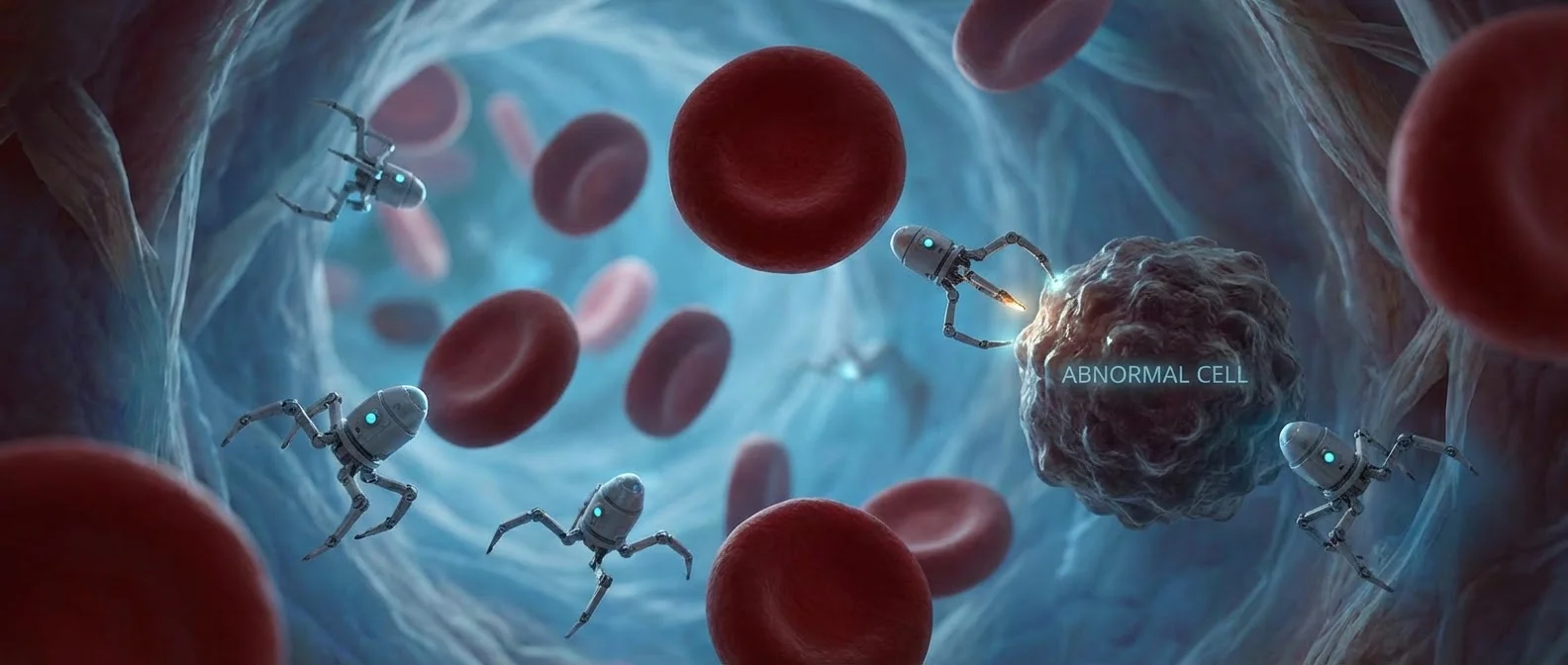
Imagine microscopic robots — smaller than a red blood cell — circulating through your bloodstream, detecting cancer cells, delivering drugs precisely where needed, and repairing damaged tissues. What sounds like science fiction is slowly becoming reality through nanorobotics.
📖 Read more: Telemedicine 2040: The Doctor-Hologram
🔬 What Are Nanorobots?
Nanorobots (or nanobots) are machines at the nanometer scale — one millionth of a millimeter. Their components are built from molecular or nanometric elements, ranging from 0.1 to 10 micrometers in size. At this scale, a single red blood cell (~7 μm) is a “giant” by comparison.
The idea isn't new. Richard Feynman, in his legendary 1959 lecture “There's Plenty of Room at the Bottom,” envisioned machines so small you could literally “swallow the surgeon.” His student Albert Hibbs originally suggested medical applications for these theoretical micro-machines.
📖 Read more: Bionic Eyes: How We'll See in the Future
⚙️ How Are They Built?
Manufacturing machines at the molecular scale is one of the greatest technological challenges. Multiple approaches are being developed in parallel:
🧬 DNA Machines (Nubots)
Molecular machines built from DNA. DNA structure can assemble 2D and 3D nanomechanical devices. Biological circuit gates made from DNA have been engineered for targeted in-vitro drug delivery.
🧲 Magnetic Helical
Silica particles with magnetic coating, controlled via rotating magnetic fields (Helmholtz coils). They can already move through human blood and navigate inside cancer cells.
🦠 Biohybrids
Combining biological and synthetic elements. Bacteria like E. coli and Salmonella typhimurium are used for flagellar propulsion, controlled by electromagnetic fields.
💻 Biochips
Nanoelectronics + photolithography + biomaterials. This semiconductor industry method (in use since 2008) enables teleoperation and advanced medical instrumentation capabilities.
📖 Read more: Implantable Health Chips: The Doctor Inside You
🖨️ Nano 3D Printing
A focused laser hardens liquid resin into lines just a few hundred nanometers wide. Structures smaller than a grain of sand are built with moving parts under 100 nm.
💎 Diamondoid Assembly
The Nanofactory Collaboration (Robert Freitas & Ralph Merkle) is developing positional diamond mechanosynthesis, aiming for a nanofactory capable of building medical nanorobots.
🎯 Medical Applications
Nanomedicine represents the most promising application field. Nanorobots could revolutionize how we treat serious diseases.
📖 Read more: Robot Cruise Ships: No Crew 2040
| Application | How It Works | Stage |
|---|---|---|
| Targeted Drug Delivery | Nanoparticles with RNA strands find and attach to cancer cells, releasing chemotherapy precisely there (Harvard/MIT) | Lab-scale |
| Cancer Cell Destruction | Magnetic nanorobots enter tumors, detect sialic acid in the microenvironment, and release therapy | In vitro |
| Tissue Repair | Nanorobots “hitchhike” on white blood cells, reach wound sites via transmigration, accelerate recovery | Theoretical |
| Antimicrobial Action | Magnetic nanorobots fight resistant bacteria — even deep inside teeth (dentistry) | Prototype |
| Diabetes Monitoring | Nanosensors measure glucose in real-time within the bloodstream | Research |
| Assisted Fertilization | Helical nanomotor transports sperm cell with motility issues to the egg (2015) | Prototype |
🏆 Key Milestones
⚡ Technical Challenges
🔧 Nanoscale Adhesion
At nanoscale dimensions, high surface energy causes parts to “stick” together. Adhesion and static friction can exceed material strength — breaking them before any movement occurs. Designing movable structures with minimal contact area is critical.
📖 Read more: Robotic Insects: Technology Mimicking Nature
🛞 Propulsion & Navigation
Nanorobots operate in low Reynolds number environments — inertia is negligible and viscosity dominates. Like swimming through honey. The helical shape (inspired by bacterial flagella) converts rotation into propulsion via external magnetic fields.
⚕️ Biocompatibility & Regulation
Nanorobots must be non-self-replicating (avoiding “grey goo” scenarios), biocompatible, and biodegradable. In the US, the FDA regulates nanotechnology based on size. Despite $2 billion in grants, drug-delivery nanorobots “have a long way to go before commercialization.”
🌐 Global Impact: The International Race
Major corporations like General Electric, Hewlett-Packard, Northrop Grumman, and Siemens are investing in nanorobotics. Universities worldwide have received over $2 billion in government grants for medical nanodevice research. Bankers are strategically investing to acquire rights and royalties on future nanorobot commercialization. The race parallels the space race and nuclear arms race in its intensity. Researchers across the US, Europe, Japan, and China are competing to bring the first therapeutic nanorobots to market.
🔭 What Does the Future Hold?
Nanomedicine is in its early stages, but the pace of development is accelerating. Researchers at Harvard and MIT have already attached RNA strands (~10 nm) to nanoparticles loaded with chemotherapy drugs — these strands “recognize” cancer cells, attach to them, and release the drug only there. Such targeted delivery could eliminate the side effects of chemotherapy.
New applications emerge each year — MRI-guided nanocapsules, bacterial microrobots targeting tumors, nanomotors detecting chemical changes in the tumor microenvironment. By the 2040-2050 decade, injecting nanorobots into the bloodstream could become as routine as a blood test. Feynman's surgeon may finally be “swallowed” by the patient.