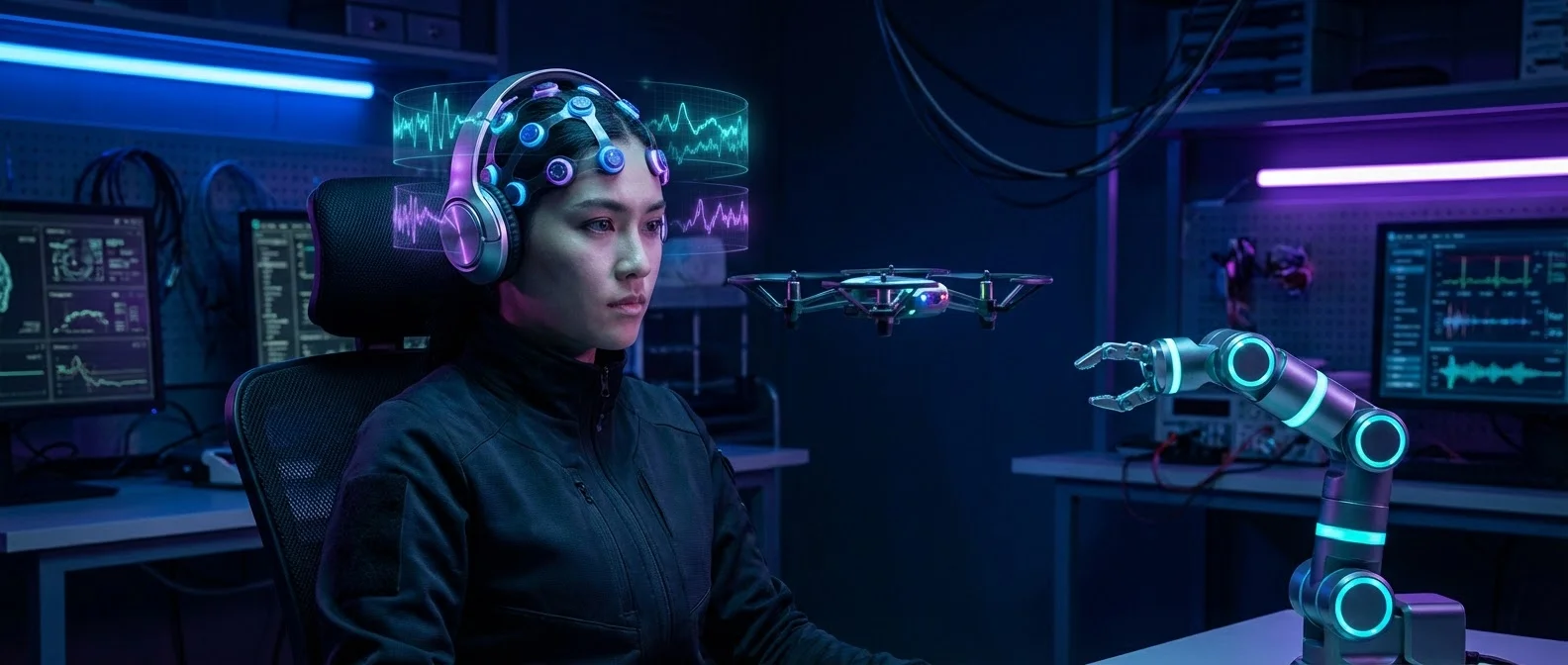
Imagine controlling your computer, a drone, or a robotic arm with nothing but your thoughts. No keyboard, no mouse, no voice commands — just think, and the device obeys. This is no longer science fiction. Brain-Computer Interfaces (BCIs) translate the brain's electrical signals into digital commands, creating direct pathways for paralyzed patients to control prosthetics and type messages.
📖 Read more: SMR: Mini Nuclear Reactors in Cities
What Is a Brain-Computer Interface?
A Brain-Computer Interface (BCI) is a system that creates a direct link between brain activity and an external computer or device. The brain generates electrical signals every time we think, move, or even dream. A BCI “listens” to these signals, decodes them through machine learning algorithms, and converts them into commands — such as moving a cursor, typing words, or operating a robotic arm.
The term “Brain-Computer Interface” was scientifically established in 1973 by Jacques Vidal at UCLA, who proposed using EEG signals to control external objects. But the idea started much earlier: German psychiatrist Hans Berger recorded the first human electroencephalogram (EEG) in 1924, discovering alpha waves — the foundation upon which all neurotechnology was built.
Three Categories of Neural Interfaces
Neural interfaces are divided into three major categories based on the degree of surgical intervention required:
| Category | Method | Advantages | Disadvantages |
|---|---|---|---|
| Non-Invasive | EEG, fMRI, MEG — sensors on the scalp | Safe, affordable, easy to apply | Low signal resolution |
| Partially Invasive | ECoG, Stentrode — electrodes on brain surface | Better signal without deep implantation | Surgery, but lower risk |
| Fully Invasive | Neuralink, BrainGate — electrodes inside the brain | High precision, thousands of channels | Brain surgery, inflammation risks |
The History: From Berger to BrainGate
📖 Read more: Solid-State Batteries: The Revolution
Mind Reading: How Close Are We?
One of the most fascinating fields is thought decoding (brain reading). This isn't just telekinesis — we're talking about reading images, words, and even intentions directly from the brain:
🖼️ Image Reading
In 2008, researchers at ATR Laboratory in Kyoto reconstructed images from brain signals at 10×10 pixel resolution. In 2011, a UC Berkeley team used fMRI to reconstruct videos watched by volunteers. In 2023, Stable Diffusion combined with fMRI achieved remarkable image reconstruction, and in 2024 researchers reconstructed imagined images — pictures a person was thinking about without any visual stimulus.
🗣️ Speech Decoding
In 2019, UCSF managed to synthesize speech from brain activity. In 2021, the same team helped a patient who hadn't spoken in 15 years to “speak” through a neuroprosthesis. In 2023, two teams (Stanford & UCSF) achieved speech decoding at 62-78 words/minute — a record approaching natural speech rate (~150 words/minute).
🧠 Intention Detection
In 2008, researchers predicted with 60% accuracy whether a person would press a button with their left or right hand — up to 10 seconds before the subject decided! This discovery challenges our understanding of when decisions actually form in consciousness.
Current Applications
Neural interfaces aren't just in laboratories. They're already transforming lives:
| Application | Description | Status |
|---|---|---|
| Wheelchair Control | EEG-based BCI for autonomous wheelchair movement | Clinical trials |
| Robotic Arm | BrainGate: tetraplegics control a robotic hand with thought | Research-proven |
| Speech for Paralyzed | UCSF neuroprosthesis: converts thoughts into words on screen | Clinical trials '23-'25 |
| Gaming & VR | Emotiv EPOC, NextMind: EEG headsets for gaming and AR/VR control | Commercially available |
| Paraplegic Walking | BCI-robotic gait orthosis for restoring ambulation | Research stage |
| Lie Detection | fMRI brain reading, “brain fingerprinting” via P300 signals — 85% accuracy | Controversial |
Brain-to-Brain: Telepathy Through Technology
One of the most impressive developments is direct brain-to-brain communication. You no longer need to speak or write — thought is transmitted digitally.
In 2002, Kevin Warwick implanted 100 electrodes in his nervous system and managed to send signals to his wife — the first electronic communication between two human nervous systems. In 2013, researchers at Duke University connected the brains of two rats, allowing them to share information. And in 2014, an international team transmitted the words “hola” and “ciao” non-invasively between humans in India and France — the first brain-to-brain human communication.
📖 Read more: Space Junk Crisis: 36,000+ Objects Threaten Earth's Orbit
Ethical Questions & Neuro-Rights
Reading thoughts creates new legal and privacy dilemmas:
🔐 Neural Privacy
If a BCI can decode thoughts, who guarantees that “inner thoughts” won't be accidentally broadcast instead of conscious speech? Neuroethicist Julian Savulescu emphasizes that neural data is not fundamentally different from other types of evidence — but many disagree. Chile passed a neuro-rights law in 2021, becoming the first country in the world to do so.
⚖️ Judicial Use
In India in 2008, a woman was convicted of murder based on EEG “brain fingerprinting” — an extremely controversial decision. Legal scholars in the US believe involuntary brain reading violates the Fifth Amendment (the right against self-incrimination).
🛡️ Brain Cybersecurity
The research “Brain-Computer Interfacing Technology and the Ethics of Neurosecurity” (2016) warns that BCIs could become hacking targets. Imagine someone “breaking into” your neural interface — the term “brain hacking” is no longer fiction.
The Future: Neural Dust & Synthetic Telepathy
The next generation of BCIs will be even smaller and less invasive. “Neural Dust” technology — microscopic wireless sensors the size of a grain of sand — promises thousands of recording points without wires or batteries, powered by ultrasonic energy.
Researchers envision a future where thought alone is enough to write an email, drive a car, or communicate with someone on the other side of the world. “Synthetic telepathy” — non-invasive brain-to-brain communication in real time — could become reality by 2040-2050, according to many researchers. The question is no longer “if” but “when” — and “under what rules.”