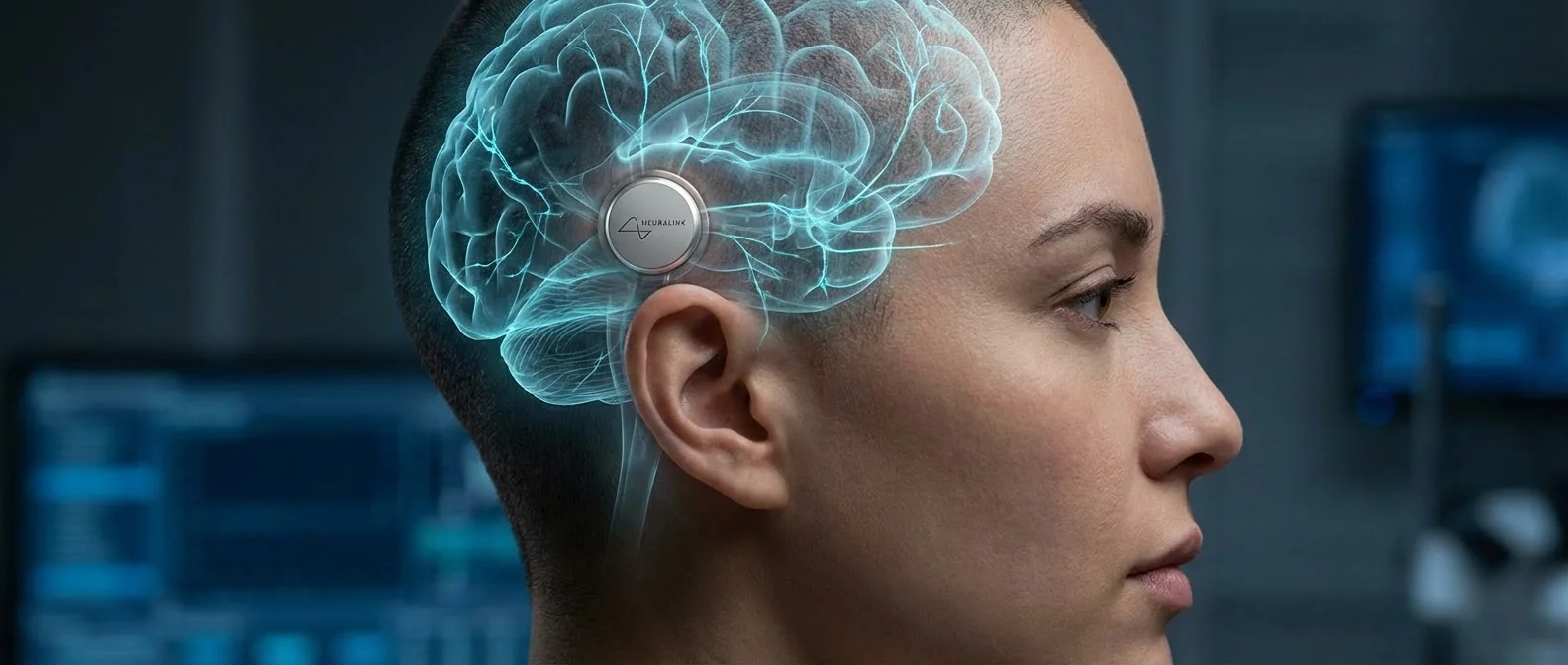
Imagine controlling your computer with nothing but thought. Typing messages, playing games, designing 3D objects — without moving a single finger. This is no longer science fiction. This is Neuralink technology.
📖 Read more: Mars Colony: When Will We Live on the Red Planet?
🧠 What Is a Brain-Computer Interface?
A Brain-Computer Interface (BCI) is a direct communication link between the brain's electrical activity and an external device — typically a computer or robotic limb. The term was first coined in 1973 by Jacques Vidal at UCLA, under a DARPA-funded research program.
The foundation was laid decades earlier. In 1924, German psychiatrist Hans Berger recorded human brain electrical activity for the first time using electroencephalography (EEG), discovering alpha waves (8–13 Hz).
⏳ Historical Timeline: From EEG to Neuralink
⚙️ Neuralink's Technology
🧵 Nano-Threads (Probes)
Made of polyimide (biocompatible material) with gold/platinum conductor. Just 4–6 μm thick — thinner than a human hair. Each thread carries 32 independent electrodes.
🤖 Surgical Robot
Tungsten-rhenium needle just 25 μm wide. Inserts up to 6 threads (192 electrodes) per minute. Avoids blood vessels in real-time through an optical imaging system.
💾 ASIC Chip (N1)
1,536 recording channels, 256 amplifiers per chip, on-chip digitization (ADC). Wireless data transmission. Chip size: 23mm, fully implantable beneath the skull.
📡 Wireless Communication
No cable needed — data is transmitted wirelessly to an external device. Rechargeable lithium battery. Sampling rate of 300 Hz to 5 kHz for neural signal capture.
📖 Read more: Synthetic Biology: Creating New Life
🧬 Biocompatibility
Flexible electrodes reduce scar tissue formation. The ultra-thin, tissue-like design minimizes the brain's foreign-body reaction, matching the Young's modulus of brain tissue.
🔋 Telepathy & Blindsight
Telepathy: controls computers by thought (in trials). Blindsight: vision restoration — FDA breakthrough device designation (September 2024).
👤 The First Patients
Noland Arbaugh (Patient #1)
29 years old, quadriplegic after a diving accident (C4–C5). Implanted January 29, 2024. Controls cursor, plays online chess, listens to music. “The device gave my life back.” Initially 85% of threads retracted — fixed via software update.
"Alex" (Patient #2)
August 2024. Creates 3D designs in Autodesk Fusion, plays Counter-Strike 2 at a high level. Improved placement technique — no thread retraction occurred.
Paul (First UK Patient)
October 2025 at UCL. Just hours after surgery, he controlled a computer using only his thoughts. First patient outside the United States.
Trials in Canada
November 2024: Health Canada approval. August 2025: two patients at Toronto University Health Network — first surgical procedures outside the US.
🏢 Competition: Who Else Is Building BCIs?
| Company | Technology | Status |
|---|---|---|
| Neuralink | Invasive, 3,072 electrodes, wireless chip | 12 patients (2025) |
| Synchron (Stentrode) | Endovascular — inserted via blood vessel, no craniotomy | 4 patients with no serious adverse events |
| BrainGate | Utah Array 96 electrodes — pioneering academic platform | Multi-year clinical trials |
| Precision Neuroscience | Surface electrodes (no brain penetration) | Founded by ex-Neuralink co-founder |
| Paradromics | Connexus BCI — high-density electrode arrays | DARPA funded ($65M) |
📖 Read more: Techno-Feudalism: When Big Tech Rules
⚠️ Ethical Concerns & Risks
🔒 Neural Data Privacy
A BCI “reads” your thoughts. Who has access to neural data? Could someone hack it? Bioethicists warn of hacking risks, privacy loss, and potential misuse of neural data. There is no established regulatory framework for “neuro-rights” yet.
🐒 Animal Testing
2017–2022: at least 1,500 animals (monkeys, pigs, sheep) used in Neuralink experiments. The PCRM filed complaints reporting euthanasia of monkeys, brain swelling, partial paralysis, and chronic infections. The company denies abuse, but controversies remain with ongoing USDA and SEC investigations.
⚖️ Consent & Long-Term Support
What happens if the company shuts down? The patient is left with an unsupported implant. Obtaining informed consent from someone with paralysis raises particular ethical questions. Some bioethicists worry about personality changes that deep brain stimulation may cause.
🌐 Global Impact: The International Race
The race to develop BCIs spans the globe. In the US, DARPA has funded BCI research for decades, including $65 million to Paradromics alone. The EU's Horizon 2020 and Horizon Europe frameworks have supported extensive BCI research since 2013. China, Japan, and South Korea are investing heavily in neurotechnology. Major universities — Brown, Stanford, Pittsburgh, UCL — continue to drive academic breakthroughs. The question is no longer whether BCIs will work, but which regulatory and ethical frameworks will govern their use.
🔮 What Lies Ahead?
BCI technology is at the stage the internet was in the mid-'90s — early, but with enormous potential. BCIs are already decoding speech at 62–78 words per minute (2023), controlling robotic limbs with many degrees of freedom, and enabling quadriplegics to “speak” again after 15 years of silence.
Neuralink is expected to apply for commercial approval within the next 2–3 years. Blindsight aims to restore vision. Brain-to-brain communication (already tested between humans in 2014 with “hola” and “ciao” transmitted between India and France) could become reality in the coming decades.
The question is no longer whether we'll control machines with thought, but who will set the limits of that power.