📖 Read more: Telepathy: Brain-to-Brain Without Words
What Neuro-Marketing Actually Is
The term was coined in 2002 by professor Ale Smidts during his inaugural address at the Rotterdam School of Management. His proposition was simple but bold: instead of asking consumers what they want, look directly inside their brains.
In practice, neuro-marketing blends neuroscience, psychology and marketing into a framework that measures physiological signals — brain activity, eye movement, heart rate, skin conductance — while a consumer watches an ad, handles packaging or navigates an online store. The goal is ruthlessly practical: predict which campaigns will sell before spending millions on airtime, cutting through the gap between what people say and what they actually buy.
The Tools That Read Your Mind
There is no single machine. The industry draws from an entire arsenal of technologies, each with distinct tradeoffs.
Functional magnetic resonance imaging (fMRI) tracks blood-flow changes inside the brain, revealing which regions activate when someone views a product. Spatial resolution reaches millimeters. The drawback? A scanner costs around five million dollars, and the subject must lie motionless inside a tunnel. Not exactly a shopping mall simulation.
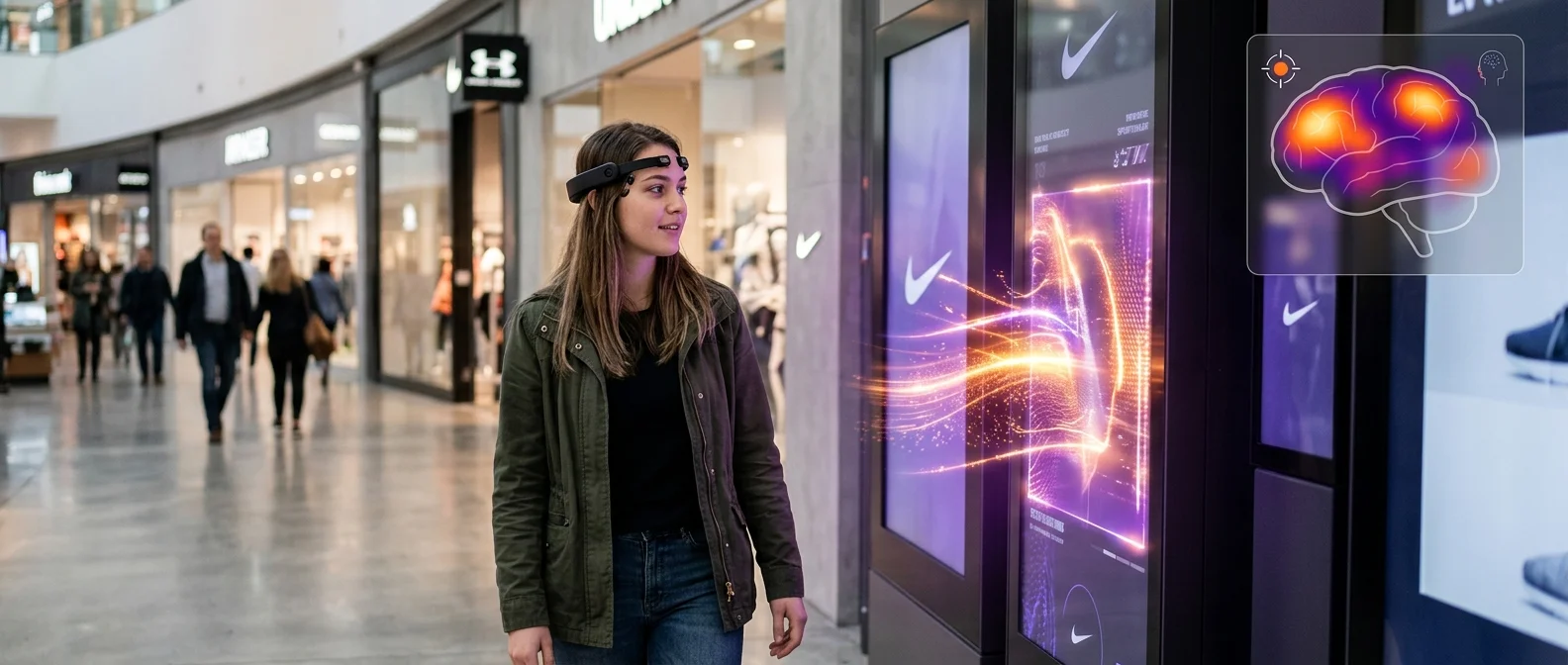
Electroencephalography (EEG) is far more accessible — a system runs about $20,000. Electrodes placed on the scalp record electrical signals in real time, capturing reactions within milliseconds of a stimulus. Spatial precision, however, falls well short of fMRI.
Alongside these, eye tracking records exactly where someone looks, for how long, and how their pupils dilate — a marker of emotional arousal. Facial coding detects micro-changes in facial muscles. And biometrics — heart rate, galvanic skin response, respiration — provide real-time physiological feedback that words often hide.
📖 Read more: Cryonics: Will We Wake Up in the Future?
Five Experiments That Changed the Game
Coca-Cola vs Pepsi (2004): Researchers at Emory University placed volunteers inside an fMRI scanner and served both drinks. Blind-tasted, the neural responses were nearly identical. But the moment participants learned which was which, Coca-Cola fans showed a surge in the prefrontal cortex, hippocampus and memory regions. Brand trumped taste. It was the first neurological proof of that phenomenon.
Wine and price (INSEAD): Neuroeconomist Hilke Plassmann demonstrated that the same wine tastes better when you believe it costs more. Under fMRI, the brain's pleasure center fired more intensely for the expensive label — though not a single drop changed in the glass.
NCI: Predicting real behavior through fMRI
The U.S. National Cancer Institute hooked 31 heavy smokers to fMRI, asked them to rank three anti-smoking campaigns, and then tracked calls to the 1-800-QUIT-NOW hotline after each campaign aired nationally. The campaign that activated the medial prefrontal cortex most generated the most calls — even though it was not the self-reported favorite.
Frito-Lay & Cheetos (2008): A commercial showed a woman stuffing orange Cheetos into a dryer full of white clothes. In traditional focus groups, viewers rejected it — no one wanted to appear mean-spirited. EEG revealed what focus groups missed: viewers' brains lit up with satisfaction. Frito-Lay CMO Ann Mukherjee declared that brain imaging could be more accurate than focus groups.
Hyundai (2011): Thirty volunteers wore EEG caps and stared at every design detail of a silver prototype — bumper, windshield, wheels — for a full hour. Hyundai used the resulting brain-activity data to adjust the exterior design before production.
📖 Read more: Vacuum Trains: Hypersonic Trains in a Tube
Who Pays to Scan Your Brain
The client list extends far beyond food companies. Nielsen runs an entire Consumer Neuroscience division (formerly NeuroFocus). NBC and TimeWarner use EEG to evaluate TV commercials before they air. Microsoft deploys EEG to measure engagement in Xbox games. Google, Facebook and Amazon maintain internal consumer-neuroscience labs, though they rarely publish data.
In the 2017 Advertising Research Foundation study, researchers from Temple University and NYU compared neurometric methods with traditional focus groups on real campaigns. fMRI achieved the largest improvement in predicting effectiveness. Moran Cerf, a neuroscientist at Northwestern, noted that EEG data from just 16 movie-trailer viewers predicted box-office revenue more accurately than any survey.
The Dark Side: Ethics and Manipulation
In 2012, Facebook ran an experiment on 700,000 users without their knowledge: it modified their news-feed algorithm to show more positive or negative content, then measured how this affected their posts. The paper, published in PNAS, ignited fierce backlash.
📖 Read more: Vertical Farms: How They'll Feed Cities by 2040
The real ethical minefield lies elsewhere. A 2015 study showed that exposure to anti-smoking messages during sleep reduced cigarette purchases — though subjects remembered nothing upon waking. Elsewhere, researchers found that administering testosterone to men increased preference for luxury brands. And transcranial magnetic stimulation (TMS) can theoretically suppress rational price evaluation.
According to Michael Platt at Wharton, the ethical boundary depends on intent. Optimizing packaging to reduce single-use plastics is a positive application. Maximizing the time a fifteen-year-old spends on an app is something else entirely. The line between persuasion and manipulation shifts with each new discovery.
Emotional AI: The Next Chapter
The neuro-marketing market is growing at 15.6 percent annually. The real transformation won't come from million-dollar fMRI scanners. It will arrive through portable EEG headbands costing a few hundred dollars, cameras that read micro-expressions in real time, and Emotional AI algorithms that fuse biometric data with machine learning.
Uma Karmarkar at UCSD predicts that smartphones will eventually estimate emotional states through voice analysis and smartwatch data. Brian Knutson at Stanford, one of the pioneers of neuroeconomics, argues that activity in the nucleus accumbens can predict whether someone will buy a product before they consciously decide. Campbell's Soup redesigned its packaging after two years of neurometric studies. Gerber and Frito-Lay followed.
The new wave of tools is making such studies accessible not only to multinationals but to mid-size companies. And while consumers search for ways to protect their privacy, the industry searches for quieter routes into their heads. Every video that holds you three seconds longer, every button that feels more inviting than it should, every email subject line that seems to know exactly what you are thinking — somewhere behind them, an EEG headband measured someone very much like you.