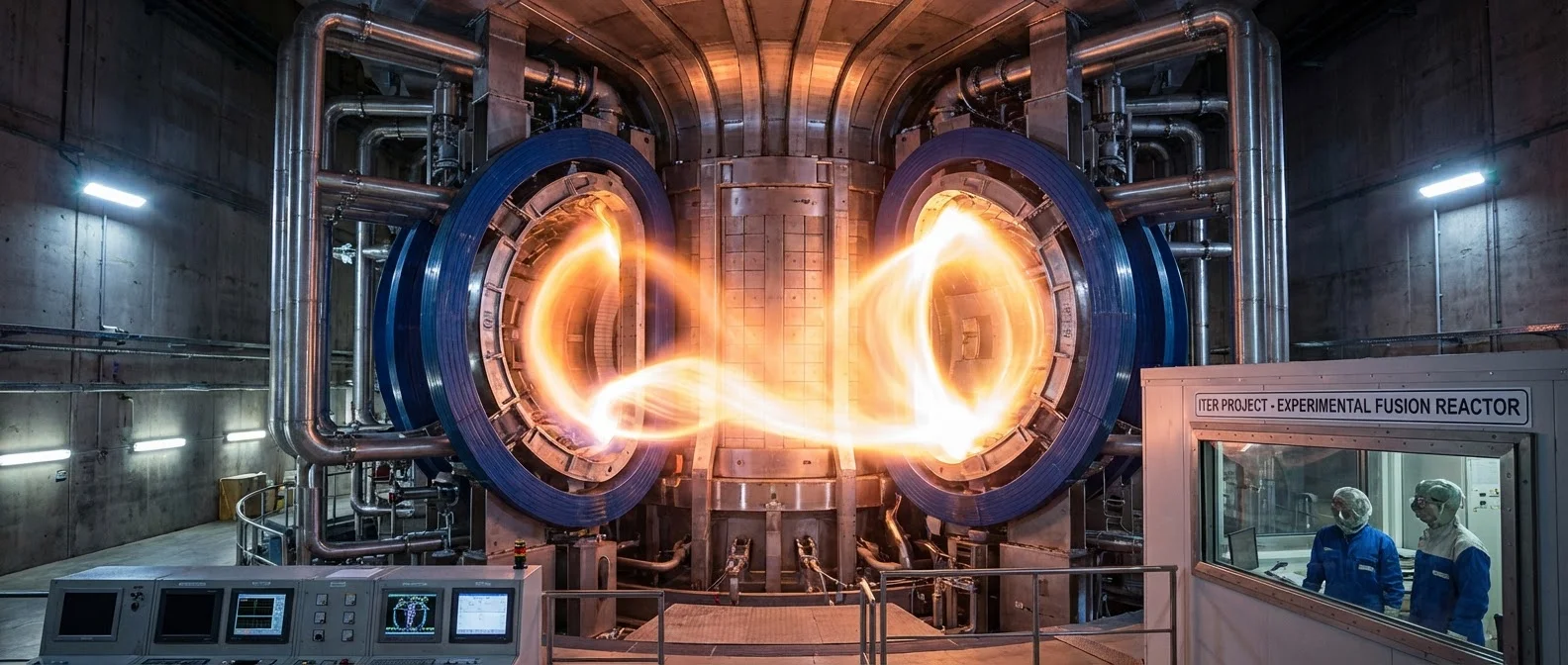
Every second, the Sun converts 600 million tons of hydrogen into helium, releasing energy equivalent to billions of nuclear bombs. For decades, scientists have been trying to replicate this process on Earth — nuclear fusion. In December 2022, NIF achieved fusion energy gain for the first time. Today, dozens of companies and government programs are racing in a competition that could reshape the planet's energy landscape.
📖 Read more: Solar Satellites: Energy from Space
What Is Nuclear Fusion?
Nuclear fusion is the process by which two light atomic nuclei merge to form a heavier nucleus, releasing enormous amounts of energy. It is the opposite of fission, used in today's nuclear power plants.
The most promising reaction is D-T (deuterium-tritium): two hydrogen isotopes fuse and produce helium-4 and a neutron, with 17.6 MeV of energy. Deuterium is abundant in seawater, while tritium can be produced from lithium via “breeding blankets” surrounding the reactor.
"Fusion offers advantages compared with fission. It produces minimal high-level radioactive waste, involves lower inherent safety risks, and is not subject to catastrophic meltdown."
— Wikipedia, Nuclear FusionHow It Works: Two Main Methods
Magnetic Confinement (MCF)
Powerful magnetic fields “trap” plasma in a ring shape (torus). The tokamak is the most developed approach — over 226 experimental devices worldwide. Alternatives include the stellarator (Wendelstein 7-X) and spherical tokamak.
Inertial Confinement (ICF)
Powerful lasers target a tiny fuel capsule, compressing it to 100 times the density of lead. The reaction completes in microseconds. NIF uses 192 lasers with this method.
Historical Milestones
📖 Read more: Deep Geothermal: Energy from Earth's Core
Major Fusion Projects
| Project | Type | Location | Status |
|---|---|---|---|
| ITER | Tokamak | France | Under construction — 35 nations |
| NIF | Laser ICF | USA (LLNL) | Operational — 192 lasers |
| SPARC | Compact Tokamak | USA (CFS/MIT) | Design phase — HTS magnets |
| Wendelstein 7-X | Stellarator | Germany | Operational — 30 min plasma |
| JT-60SA | Tokamak | Japan | Inaugurated Dec 2023 |
| EAST | Tokamak | China | Record 1,066 sec, 2025 |
| KSTAR | Tokamak | South Korea | 102 sec operation, 2024 |
Private Sector: The New Race
The 2020s marked an explosion of private investment in fusion, with startups raising billions of dollars:
Commonwealth Fusion
$1.8B funding. Compact SPARC tokamak with REBCO superconducting magnets. First commercial plant planned in Virginia, USA.
Helion Energy
$500M funding + $1.7B commitments. Field-Reversed Configuration technology. Building a plant for Microsoft data centers by 2028.
Type One Energy
350 MWe stellarator. Started licensing in January 2026 — one of the first companies going directly to commercial design.
TAE Technologies
Different approach: Field-Reversed Configuration. Partnership with Google/DeepMind for AI plasma control. Goal: hydrogen-boron fuel.
📖 Read more: Hydrogen: The Fuel That Changes Everything
Advantages of Fusion
Nearly Unlimited Fuel
Deuterium from seawater + lithium for tritium production. Lithium reserves from the sea would last 60 million years. With deuterium-only fusion: 150 billion years.
Safety
A meltdown is impossible — the reactor contains only seconds worth of fuel at any time. Any malfunction automatically quenches the reaction.
Minimal Radioactive Waste
No long-lived radioactive waste. Tritium has a half-life of just 12.3 years. Zero CO₂ emissions during operation.
Enormous Power
One gram of fusion fuel yields energy equivalent to 8 tons of oil. A single plant could power millions of homes.
Challenges
Extreme Conditions
Temperature of 150+ million °C — 10× hotter than the Sun's core. Pressure, density, and confinement time all matter.
Materials
Neutron flux 100× greater than fission. Tungsten is the best solution — but new endurance materials are needed.
Cost
ITER costs tens of billions. Commercial viability requires compact reactors with lower costs.
Timeline
"Always 30 years away" — the classic joke. But recent breakthroughs suggest the situation is fundamentally changing.
📖 Read more: Perovskite: Next-Gen Solar Panels 2026
Fusion vs Fission vs Renewables
| Feature | Fusion | Fission | Solar/Wind |
|---|---|---|---|
| CO₂ Emissions | Zero | Zero | Zero |
| Radioactive Waste | Minimal, short-lived | Significant, long-lived | None |
| Accident Risk | Negligible | Low (meltdown) | Negligible |
| Fuel Availability | Virtually unlimited | Hundreds of years | Unlimited (sun/wind) |
| 24/7 Baseload | Yes | Yes | No (intermittent) |
| Commercial Availability | 2035-2045 (target) | Now (70 years) | Now |
AI & Fusion: Artificial Intelligence as an Ally
Artificial intelligence has become crucial for fusion research:
DeepMind + TCV Tokamak: DeepMind developed a deep reinforcement learning system for plasma control in tokamaks, achieving plasma shapes that weren't possible before.
Princeton PPPL: Researchers used AI to predict plasma instabilities 300 milliseconds before they occur — enough time to activate corrections.
Diag2Diag AI: A new system that “fills in” sensor gaps, providing a more complete picture of the plasma than a real sensor could.
📖 Read more: Thorium: The Reactors Changing Everything
Regulatory Framework
Fusion legislation is evolving rapidly:
- USA (Apr. 2023): The NRC unanimously decides that fusion will be regulated as a “particle accelerator,” not as nuclear fission — a major simplification.
- United Kingdom (Oct. 2023): First country to legislate separately for fusion through the Energy Act 2023. Goal: STEP plant by 2040.
- Japan (Apr. 2023): National fusion strategy — collaboration with the US and Canada.
- USA (Feb. 2024): Atomic Energy Advancement Act — includes the Fusion Energy Act with a licensing framework.
Global Fusion Race
Fusion has become an arena of geopolitical competition:
🇨🇳 China: Now outspending the US on fusion R&D. EAST continuously breaks records. The NYT reports (2025) that China “threatens to leapfrog American technology.” Meanwhile, dozens of startups are emerging in China.
🇺🇸 USA: DOE invested $46M in 8 companies (2023). CFS, Helion, and TAE Technologies lead the charge. There are concerns that China is closing the gap.
🇪🇺 Europe: ITER in France remains the premier international program. UK with STEP, Germany with Wendelstein 7-X.
When Will Fusion Arrive?
Timelines are becoming more realistic:
- 2025-2028: Helion Energy builds a plant for Microsoft. SPARC tokamak (CFS) plans first plasma.
- 2030-2035: First compact fusion plants from private companies. ITER data will shape the DEMO design.
- 2035-2045: Commercial plants if targets are met. UK STEP, Chinese programs, and CFS in Virginia.
- 2050+: Potentially significant share of the global energy mix, if technology scales successfully.
"The fusion race is no longer solely a government affair. The private sector brings speed, innovation, and compact designs that could change everything."
— Fusion Industry Association, 2023