📖 Read more: Von Neumann Probes: Self-Replicating Spacecraft
What Are Photonic Chips?
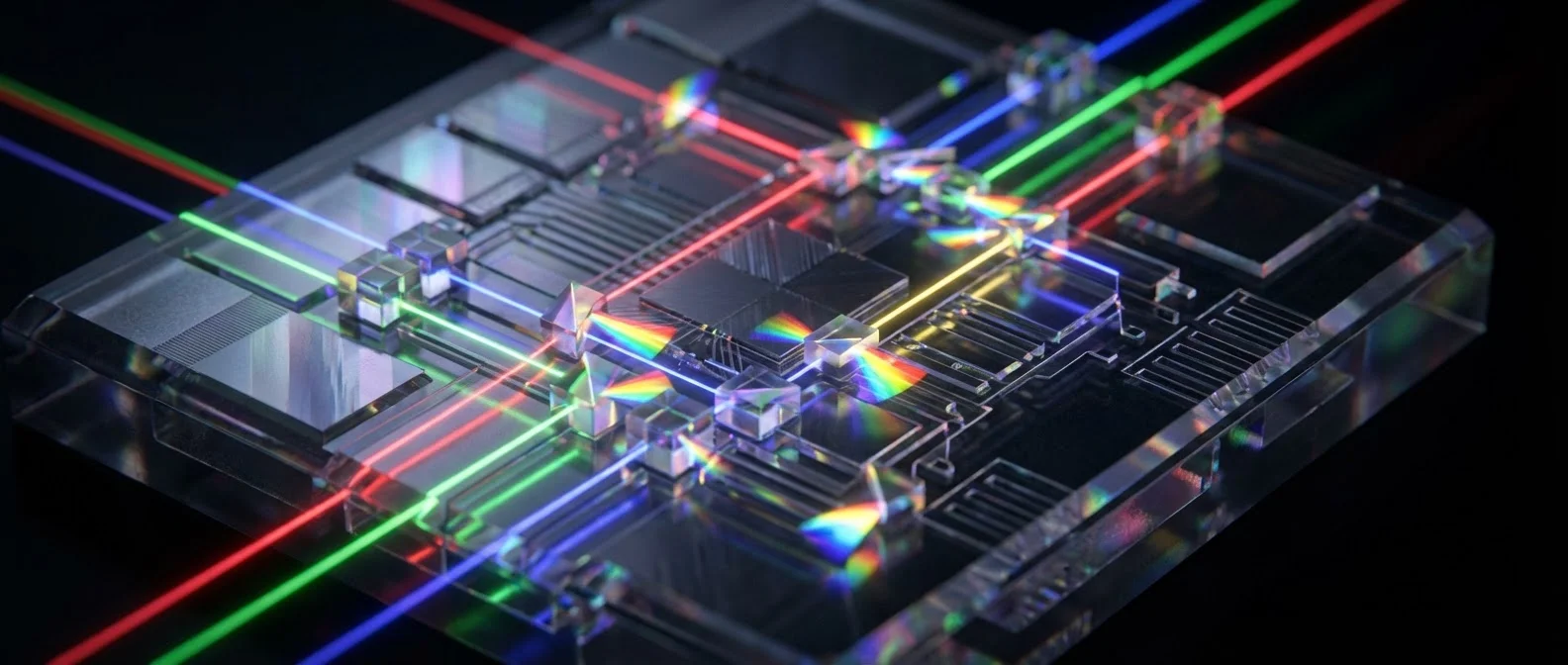
A Photonic Integrated Circuit (PIC) is a microchip containing two or more photonic components that operate as a circuit. Unlike electronic integrated circuits that use electrons, photonic circuits use photons — particles of light — to transmit, process, and detect information.
Silicon photonics combines this technology with existing semiconductor fabrication techniques. By using silicon as the optical medium, photonic components can be manufactured on the same production lines used for conventional chips. This means lower costs, faster adoption, and the ability to integrate optical and electronic components on a single chip.
🔬 How does it work?
Silicon is transparent to infrared light (above 1.1 μm wavelength) and has a very high refractive index (~3.5). This allows the creation of microscopic waveguides just a few hundred nanometers across. Data is converted into light pulses, transmitted through these waveguides, and decoded at their destination — all within a single chip.
Historical Timeline
The idea of optical computing isn't new. But the technology took decades to become commercially viable.
"Today, optics is a niche technology. Tomorrow, it's the mainstream of every chip that we build."
Applications: Where Everything Changes
Photonic chips aren't just about faster computers. They're reshaping telecommunications, medicine, autonomous vehicles, and quantum computing.
📡 Data Centers & Telecom
Photonic interconnects replace copper cables, drastically reducing energy consumption while boosting bandwidth. Intel has demonstrated 100 Gbps through a 5 mm cable — 12x faster than PCI-E.
🧠 Artificial Intelligence
Photonic processors perform matrix multiplications (tensor ops) using light, far more energy-efficiently than GPUs. Lightmatter and Lightelligence have developed AI inference chips based on Mach-Zehnder interferometers.
🏥 Healthcare & Biosensors
Photonic sensors measure temperature with sub-millikelvin precision, enabling cardiac function monitoring. Chips for optical coherence tomography (OCT) perform 3D retinal imaging in real-time.
🚗 LiDAR & Autonomous Vehicles
Photonic LiDAR circuits offer smaller size, lower cost, and higher resolution than traditional mechanical LiDAR systems. Critical for self-driving cars.
🌾 Agriculture & Food
Miniature photonic spectrometers detect fruit ripeness, soil quality, plant diseases, and CO₂ emissions — no lab required, directly in the field.
⚛️ Quantum Computing
Arrayed waveguide gratings (AWGs) in photonic chips separate optical modes — a critical function for photonic quantum computers. Companies like PsiQuantum leverage this technology.
Materials & Platforms
There's no single material that does everything. Each platform has its strengths:
📖 Read more: 15-Minute Cities: Everything Within Walking Distance
The Big Challenges
Photonic chips face four major hurdles before commercial adoption.
Nonlinearity: Computation requires nonlinear interactions — multiple signals must interact with each other. In electronics, transistors do this easily and cheaply. With photons, light-to-light interaction is much weaker and requires specialized materials.
Optoelectronic conversion: Hybrid systems (optical + electronic) waste ~30% of their energy converting photons to electrons and back. This conversion also introduces latency.
Thermal management: Computer chips run hot, but laser efficiency drops with temperature. Integrating lasers on the same chip as electronic components remains a challenge.
Space requirements: Nonlinear optical components may require larger dimensions than their electronic counterparts — running counter to the trend of miniaturization.
⚡ Why it's still worth it
Photons have no mass, produce no heat during transmission, can travel at THz frequencies, and multiple signals can be transmitted simultaneously on different wavelengths (wavelength division multiplexing). Electrons simply can't match these physics.
Global Impact
Three regions are racing to dominate photonic chips. In the Netherlands, the PhotonDelta initiative has positioned the country as Europe's photonics hub, while institutions like Eindhoven University of Technology and the University of Twente lead academic research. The European Chips Act includes photonics as a strategic technology, with projects like ELENA advancing lithium niobate PICs.
In the US, companies like Lightmatter (valued at $1.2B), Lightelligence, and PsiQuantum are attracting billions in investment. The AIM Photonics manufacturing hub, supported by the Department of Defense, is building domestic photonic chip production capability. Meanwhile, Asia's semiconductor giants — TSMC and Samsung — are integrating silicon photonics into advanced packaging for AI data center chips.
The Future: Light Everywhere
Photonic chips won't replace electronics entirely — at least not yet. Instead, hybrid systems will combine both technologies on single chips. Photonics will handle data transmission, while electronics will perform local computation.
For artificial intelligence, this evolution is particularly significant. Training large AI models requires enormous energy and bandwidth. Photonic AI processors could dramatically reduce the energy footprint, while the POMMM method — single-shot tensor computing with light — promises to handle convolutions and attention layers without GPUs.
"If we could perform massive matrix multiplication tasks with a single shot of light, it would completely change the game."
Columbia Engineering (2025) demonstrated three-dimensional photonic integration with 800 Gb/s bandwidth and 5.3 Tb/s/mm² density — proving that photonics can overcome the physical limitations of copper.
The era when optics was a “niche technology” is ending. As data centers, AI, and the digital world demand ever more, photonic chips are transforming from a research curiosity into a necessity. The question isn't whether they'll dominate — but when.