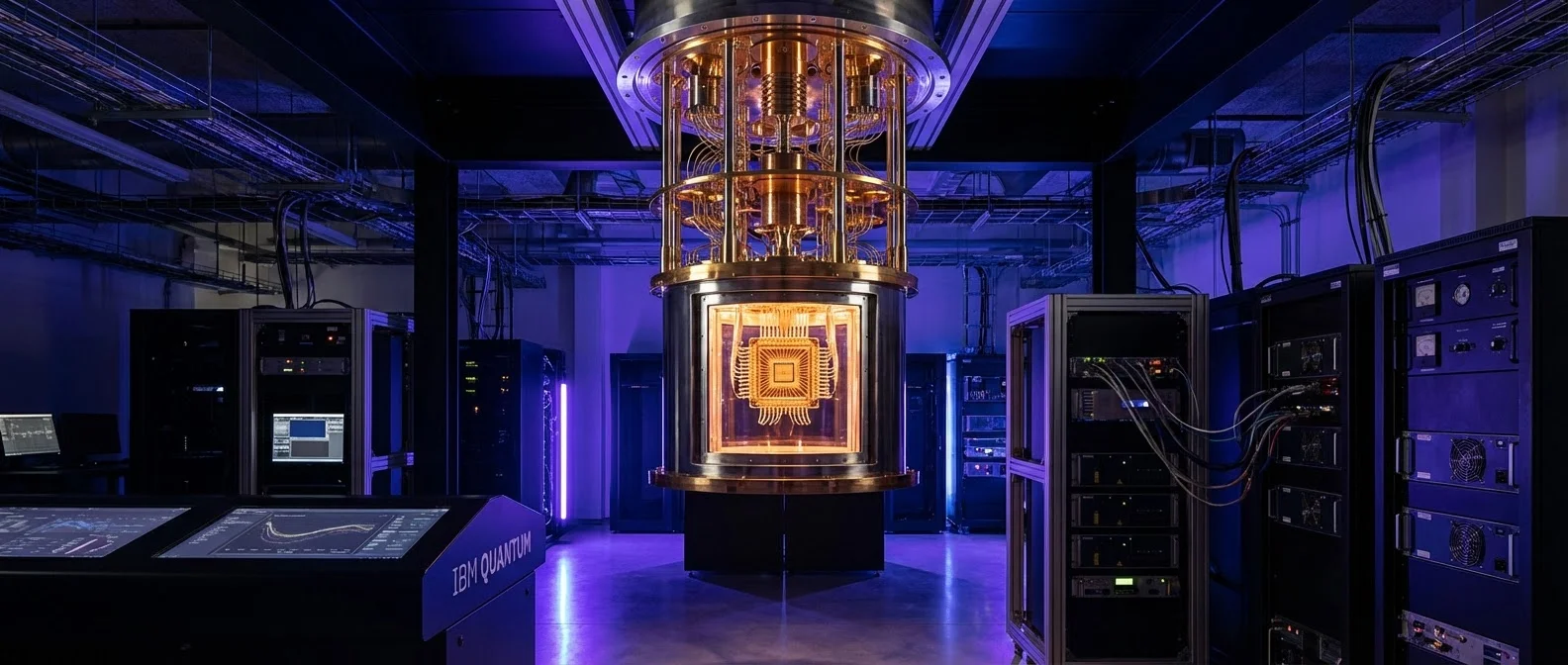
Imagine a computer that doesn't process information bit by bit, but explores millions of possibilities simultaneously. This is quantum computing. A technology advancing from laboratories to reality — one that could crack today's encryption or discover tomorrow's medications.
📖 Read more: 3D Organ Printing: Transplants in Hours
⚛️ What Is a Quantum Computer?
A quantum computer exploits phenomena from quantum mechanics — specifically superposition and entanglement — to process information in a fundamentally different way than classical computers.
While a classical bit can only exist in one of two states (0 or 1), a qubit (quantum bit) can exist in superposition — simultaneously in both states. Each additional qubit doubles the computational capacity: a 100-qubit system represents 2¹⁰⁰ states — more than the atoms in the visible universe.
⚡ Classical Bit vs Qubit
| Property | Classical Bit | Qubit |
|---|---|---|
| State | 0 or 1 | |0⟩, |1⟩ or superposition |
| Simultaneous values | 1 | Infinite (in quantum space) |
| Measurement | Deterministic | Probabilistic (Born rule) |
| Copying | Possible | Impossible (no-cloning theorem) |
| Interaction | Independent bits | Entangled qubits |
📜 Historical Milestones
🏢 Leading Companies
IBM Quantum
Leader in superconducting qubits. Condor (1,121 qubits, 2023), Quantum System One (first commercial system 2019). Goal: 100,000+ qubits by 2033.
Google Quantum AI
Sycamore processor — first quantum supremacy claim (2019, 54 qubits). Ongoing research in error correction and next-generation chipsets.
Microsoft Azure Quantum
Unique approach: topological qubits based on anyons (quasi-particles). More noise-resistant — if they work. Cloud quantum access via Azure.
IonQ
Trapped-ion technology — ions as qubits with lower error rates. Publicly traded (NYSE). Forte: 36 algorithmic qubits.
D-Wave Systems
Specializes in quantum annealing — ideal for optimization problems. 5,000+ qubits, already used by Lockheed Martin, NASA, Volkswagen.
QuEra Computing
Harvard/MIT spin-off — neutral atom qubits. Participated in the groundbreaking logical quantum circuit experiment (2023) funded by DARPA.
🌍 Applications That Will Change the World
Cryptography & Cybersecurity
Shor's algorithm can theoretically break RSA, Diffie-Hellman, and elliptic curve encryption — the foundation of nearly every online connection. “Post-quantum cryptography” is already being developed as a countermeasure.
Drug Discovery
Simulating molecular interactions at the quantum level — impossible on classical computers. The ability to design drugs “atom by atom.” Gero is already using quantum models (2023) for anti-aging medications.
Artificial Intelligence & ML
Quantum machine learning promises faster neural network training, improved pattern recognition, and new algorithms (HHL, quantum Boltzmann machines) that exceed classical limits.
Chemistry & Materials
Simulating quantum systems — the first application Feynman envisioned. Optimizing the Haber-Bosch process (fertilizers, 2% of global energy) and developing new superconductors.
Financial Services
Portfolio optimization, risk analysis, fraud detection. JPMorgan Chase, Goldman Sachs, and HSBC are already experimenting with quantum algorithms on real data.
Climate & Energy
More accurate climate models, development of more efficient batteries and solar cells, nuclear fusion simulation. Quantum computing could accelerate the clean energy transition.
⚔️ Classical vs Quantum Computers
| Parameter | Classical | Quantum |
|---|---|---|
| Information unit | Bit (0 or 1) | Qubit (superposition) |
| Parallel processing | Multi-core, serial logic | Exponential capacity via entanglement |
| Operating temperature | Room temperature | ~20 millikelvin (cryogenic cooling) |
| Error rate | ~0% (stable) | ~0.1-5% (varies) |
| Ideal problems | General computation, data | Optimization, simulation, factoring |
| Maturity | Fully commercial | NISQ era (experimental) |
| Cost | From $500 | $10-15 million+ per system |
🧩 Major Challenges
🌊 Quantum Decoherence
Qubits are extremely fragile. Any interaction with the environment — even cosmic rays — can destroy quantum superposition. That's why systems operate at 20 millikelvin, near absolute zero (-273.13°C), inside specialized dilution refrigerators. Coherence times range from nanoseconds to a few seconds.
🔧 Quantum Error Correction
Unlike classical bits, qubits cannot be copied (no-cloning theorem). Error correction requires many physical qubits for each “logical qubit.” Estimates show that at least 3 million physical qubits are needed to crack an RSA-2048 key in 5 months. Harvard/MIT's discovery (2023) with reconfigurable atom arrays is a major step, while cat qubit technology promises 100 logical qubits with just 768 physical ones, dramatically reducing requirements.
🔌 Infrastructure & Scaling
Building quantum computers requires extreme engineering: cryogenic systems, special superconducting cables (only Japan's Coax Co. manufactures them), helium-3 (a rare nuclear research byproduct). Scaling to wafer-scale integration remains a massive engineering challenge.
🌐 Global Impact: A Planetary Race
The quantum computing race has become a matter of national security. The United States, China, and the European Union are investing tens of billions, each aiming to achieve quantum advantage first. China's USTC achieved photonic quantum supremacy with Jiuzhang, while the US leads in superconducting (IBM, Google) and trapped-ion (IonQ) approaches.
The EU is investing over €1 billion in its Quantum Technologies Flagship program (2018-2028), building the European Quantum Communication Infrastructure (EuroQCI) for quantum key distribution networks protecting critical infrastructure across the continent.
🏆 Global Quantum Investment Leaders
• United States — $3.8B+ in National Quantum Initiative (2019-2028), home to IBM, Google, IonQ, Rigetti
• China — $15B+ invested, Jiuzhang quantum computer, building world's largest quantum network (Beijing-Shanghai)
• European Union — €1B+ Quantum Flagship, EuroQCI infrastructure across 27 member states
• United Kingdom — £2.5B National Quantum Strategy, strong academic research (Oxford, Cambridge)
• Japan — Major investments in quantum computing infrastructure, Coax Co. sole maker of superconducting cables
🔮 Future: When Will They Be Truly Ready?
Despite impressive progress, a Nature article (2023) was characteristically titled: “Quantum computers: For now, good for absolutely nothing.” The truth lies somewhere in between: the technology is real, but practical applications haven't yet surpassed classical computers in any real-world task.
However, the roadmap is clear:
The quantum computer won't replace your laptop. It will solve problems that no classical computer can even begin to approach — from creating new medications to breaking (and protecting) cryptographic codes. The question is no longer “if,” but "when."