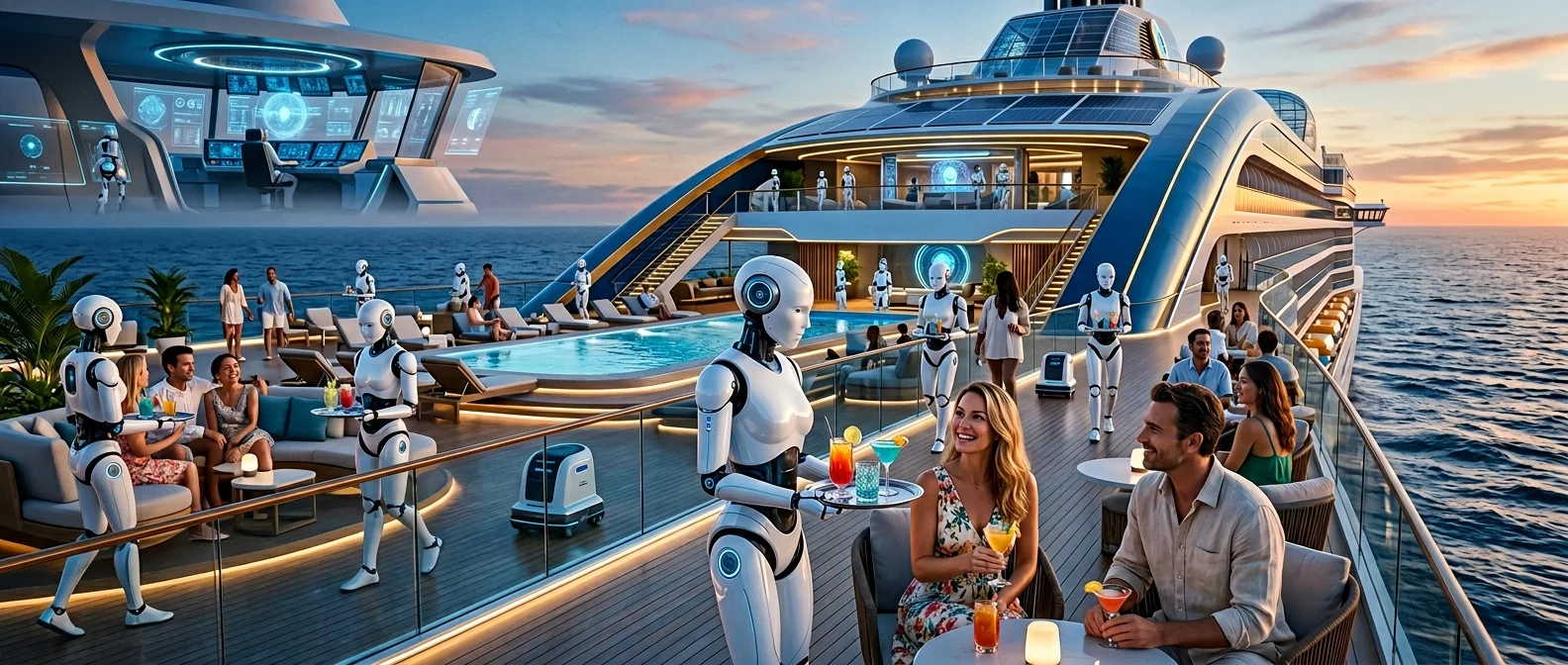
In November 2021, an 80-metre vessel sailed from Horten, Norway with no crew on the bridge. The Yara Birkeland, the world's first fully electric and autonomous container ship, entered commercial operation in spring 2022. If a cargo ship can sail itself, how far are we from a cruise ship that doesn't need a crew?
📖 Read more: Aerotropolis: Cities Built Around Airports
The Yara Birkeland: The Ship That Changed the Rules
The Yara Birkeland, built by Norwegian company Yara in partnership with Kongsberg, is a 120 TEU container ship with a 6.8 MWh battery. It carries fertiliser from Yara's plant in Porsgrunn to the port of Brevik, replacing 40,000 diesel truck journeys per year. Zero CO2 emissions, zero noise, and a gradual transition toward fully autonomous navigation.
Kongsberg provides all the sensors and integration systems for remote and autonomous operations, along with electric propulsion and control systems. The technology exists — the question is when it will scale.
The IMO Is Writing Rules for Crewless Ships
The International Maritime Organization (IMO) isn't merely watching developments — it's building the regulatory framework for Maritime Autonomous Surface Ships (MASS). Following an extensive regulatory scoping exercise completed in 2021, three committees (MSC, Legal, Facilitation) are collaborating to create a MASS Code.
The IMO's timeline is specific: May 2026 — finalise non-mandatory Code. December 2026 — framework for an experience-building phase. 2028 — begin developing the mandatory Code. And the critical milestone: by 1 July 2030, adopt the mandatory Code, entering into force on 1 January 2032.
Four degrees of autonomy per IMO: Degree 1 — automation with crew on the bridge. Degree 2 — remote control with standby crew. Degree 3 — remote control with no crew on board. Degree 4 — fully autonomous ship, the system makes all decisions itself.
From Cargo to Passengers: The Cruise Ship of 2040
The Yara Birkeland is a freighter. No passengers, no pools, no kitchen for 1,000 people. The transition to autonomous cruise ships is far more complex — but it's already underway. The path won't be from full crew to zero crew in one step, but gradual.
Robots at the Bar: Already Reality
Royal Caribbean installed robotic bartender arms at its Bionic Bar back in 2014. MSC Cruises uses the AI assistant Zoe in cabins. Carnival has deployed the Ocean Medallion, a wearable device that unlocks doors, orders food, and personalises the experience with AI. The crew isn't vanishing yet — but its role is transforming.
Autonomous Navigation: The Next Step
Autonomous navigation for cruise ships will follow the car industry's logic: gradual removal of the human factor. In the first phase, bridge operations will be supervised from shore (Degree 2 per IMO). In the second, navigation will be fully automated, with humans only for emergencies. Ultimately, Degree 4: a fully autonomous vessel with no one on the bridge.
What the 2040 Cruise Ship Will Look Like
The cruise ship of 2040 won't have zero crew — it will have a different crew. Instead of 2,000 people staffing a modern mega-ship, the scenario includes:
- Small safety team: 50-100 people for emergencies, medical care, and systems oversight.
- AI concierge: A digital assistant in every cabin, available 24/7, in any language.
- Robotic room service: Autonomous delivery robots (Starship-style) on every deck.
- Automated kitchens: Robotic arms preparing food, from sushi to pizza.
- Shore-based navigation: The bridge controlled from an operations centre on land, with AI handling daily navigation.
📖 Read more: AI Companionship: Human-Robot Relationships 2035
The Economics: Why Companies Want This
Crew is the biggest operational cost for any cruise ship. A modern mega-ship like Royal Caribbean's Icon of the Seas carries roughly 2,350 crew for 5,600+ passengers. Every crew member means accommodation, meals, wages, insurance, training.
Reducing crew by 70% would transform the industry's economics. Crew cabins — which typically occupy 3-4 lower decks — could be converted to passenger or entertainment spaces. The savings could either lower ticket prices or increase profit margins — most likely both.
The Obstacles: Safety, Regulation, Trust
A crewless cargo ship is acceptable — if it sinks, containers are lost. A crewless cruise ship is governed by entirely different rules — 4,000+ people in the middle of the ocean.
The IMO has identified critical issues that must be resolved: what does “master” mean on an autonomous ship? Who is liable in an accident? How do you conduct search and rescue without a crew? How is firefighting ensured without human intervention?
And beyond the regulations, there's the psychological barrier. Would you board a cruise ship knowing there's no captain on the bridge? Public acceptance is perhaps the biggest obstacle — and it can't be solved with regulations or algorithms.
Cyber Security: The Achilles Heel
The IMO states explicitly: “appropriate steps should be taken to ensure sufficient cyber risk management” on autonomous ships. A vessel controlled entirely digitally is vulnerable to hacking, GPS spoofing, and ransomware. The consequences on a cruise ship carrying thousands of passengers would be catastrophic.
The solution lies in multiple layers of protection: encrypted communications with the shore base, secure navigation systems with multiple redundancies, and isolated networks for critical systems. In any case, cybersecurity isn't optional — it's a prerequisite.
And Greek Shipping?
Greece owns the world's largest merchant fleet. Greek shipowners control roughly 20% of global tanker and cargo capacity. The transition to autonomous ships will profoundly affect the industry — and thousands of seafarer jobs.
The question isn't whether robots will come to ships. It's whether we'll be ready to trust them with our lives in the middle of the ocean. With the IMO's MASS Code becoming mandatory in 2032, answers need to come sooner than we think.