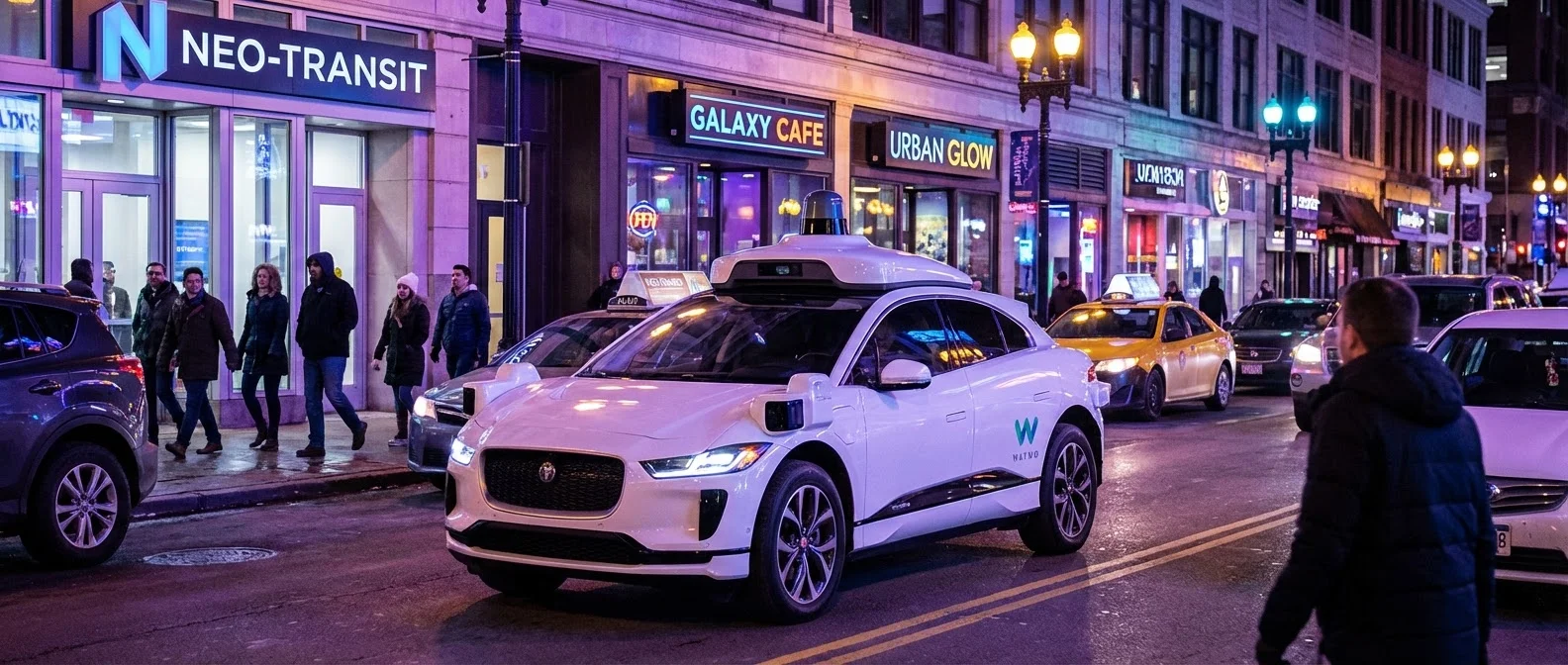
On June 22, 2025, Tesla launched its first commercial Robotaxi service in Austin, Texas, at a flat fare of $4.20 per ride. Waymo already operates across 5+ US cities and announced expansion to 24 more, plus London in 2026. Baidu Apollo Go in China has surpassed 7 million rides with 400 fully driverless vehicles in Wuhan alone. Robotaxis are no longer science fiction — they're reshaping how we move.
📖 Read more: Photonic AI Chip: 100x Faster Than NVIDIA
What Are Robotaxis?
A robotaxi is a SAE Level 4 or Level 5 autonomous vehicle operating as a ride-hailing service — with no human driver. Passengers summon the vehicle via app, get in, ride to their destination, and pay automatically. The vehicle “sees” through LiDAR, cameras, and radar sensors, makes decisions with AI, and reacts in real time.
Studies suggest robotaxis could reduce traffic congestion, cut emissions (most are electric), and make transportation far more affordable — potentially 10 times cheaper than car ownership by 2030 according to RethinkX estimates. Kearney researchers warn the opposite: cheaper rides could flood streets with more trips.
The Major Players
🚗 Waymo (Alphabet/Google)
The US pioneer. Operating in Phoenix, San Francisco Bay Area, Los Angeles, Austin, and Atlanta. Announced expansion to 24+ cities. London from 2026 — first international market. 2024 study: 85% fewer injuries per mile driven.
🇨🇳 Baidu Apollo Go
China's dominant player. 400+ fully driverless robotaxis in Wuhan 24/7. 100+ million km without a major accident. 6th-gen vehicle under $30,000. Base fare 4 yuan ($0.55) vs 18 yuan for regular taxis.
⚡ Tesla Robotaxi
Launched June 2025 in Austin. Cybercab (2-seater) and Robovan (20 passengers). Flat fare $4.20. Tesla employee still in passenger seat for safety. Vision-only approach (no LiDAR).
📦 Zoox (Amazon)
Purpose-built robotaxi designed from scratch. Passengers in Foster City (2023) and San Francisco (2025). Bidirectional design — no front or back. Fully electric.
📖 Read more: Swarm Robotics: 1,000 Robots on One Mission
Historical Milestones
Technology & Cost
| Company | Sensors | Cost/Vehicle | SAE Level |
|---|---|---|---|
| Waymo | LiDAR + cameras + radar | ~$180,000 | Level 4 |
| Baidu (6th gen) | LiDAR + cameras + radar | <$30,000 | Level 4 |
| Tesla | Cameras only (Vision) | <$25,000 (target) | Level 4 (target) |
| Zoox | LiDAR + cameras + radar | Undisclosed | Level 4 |
| Early (2020) | Multiple sensors | ~$400,000 | Level 3-4 |
Operating costs currently stand at $7-9 per mile (2025), compared to $1 for a private car. McKinsey estimates this will drop below $2/mile by 2035 — the tipping point for mass adoption.
Safety: The Great Debate
Safety results are mixed. Waymo presents impressive data: 85% fewer injuries per mile driven compared to human drivers (2024 study). Baidu reports over 100 million kilometers without a major accident.
On the other hand, Tesla's data shows a crash rate 3 times worse than humans, even with supervision (Electrek, January 2026). Cruise recalled 950 vehicles after the October 2023 incident. Public trust remains low — only 13% of Americans trust autonomous vehicles (AAA, 2025).
📖 Read more: DNA Storage: All Knowledge in a Single Drop
China vs USA: The Global Competition
China leads in scale: Baidu, Pony.ai, WeRide, DiDi, and AutoX each operate in 10-25 cities, with fleets of hundreds of robotaxis. In Wuhan, robotaxis cost $0.55 per ride — 5 times cheaper than regular taxis — sparking concerns about gig economy jobs.
The US leads in sensor technology (Waymo), but regulatory complexity (each state with its own rules) slows expansion. China's central government finalized regulations in December 2023 with a 3:1 ratio of robotaxis to remote supervisors.
Global Regulatory Landscape
Robotaxis operate only within geofenced zones — specific urban areas approved by authorities. They cannot (yet) drive anywhere. Key regulations:
• Arizona (2018): First US state to permit commercial robotaxi operations (Waymo)
• California (2022-2023): CPUC issues permits to Waymo & Cruise. Cruise permit revoked after incident. Waymo expands throughout Bay Area + Sacramento
• China (2022-2023): First driverless permits for Baidu & Pony.ai (Beijing). National regulations December 2023
📖 Read more: Holograms: From Sci-Fi to Reality
• Texas (2025): Tesla Robotaxi launch
• UK (2026): Waymo's first international expansion to London
Social Impact
Jobs: The biggest concern. Millions of taxi, Uber/Lyft, and truck drivers face disruption. In Wuhan, the spread of $0.55 robotaxi fares sent shockwaves through the gig economy workforce.
Car ownership: Analysts predict robotaxis will make car ownership unnecessary in urban areas — especially if costs drop to $2/mile. Fewer cars mean less need for parking, less congestion.
Accessibility: The elderly, disabled, and minors gain new mobility options. This is perhaps the most positive social consequence.
Horizon 2030-2035
McKinsey and The Economist predict that by 2035: robotaxis will reach costs below $2/mile, hundreds of cities will have services, China will lead in scale while the US leads in technology, and urban car ownership will decline significantly. Europe will follow with a 3-5 year delay, with London (Waymo 2026) as the first stop.
The question is no longer “if” but “how fast.” And the answer, based on what we're already seeing in Wuhan, San Francisco, and Austin, is: much faster than we imagine.