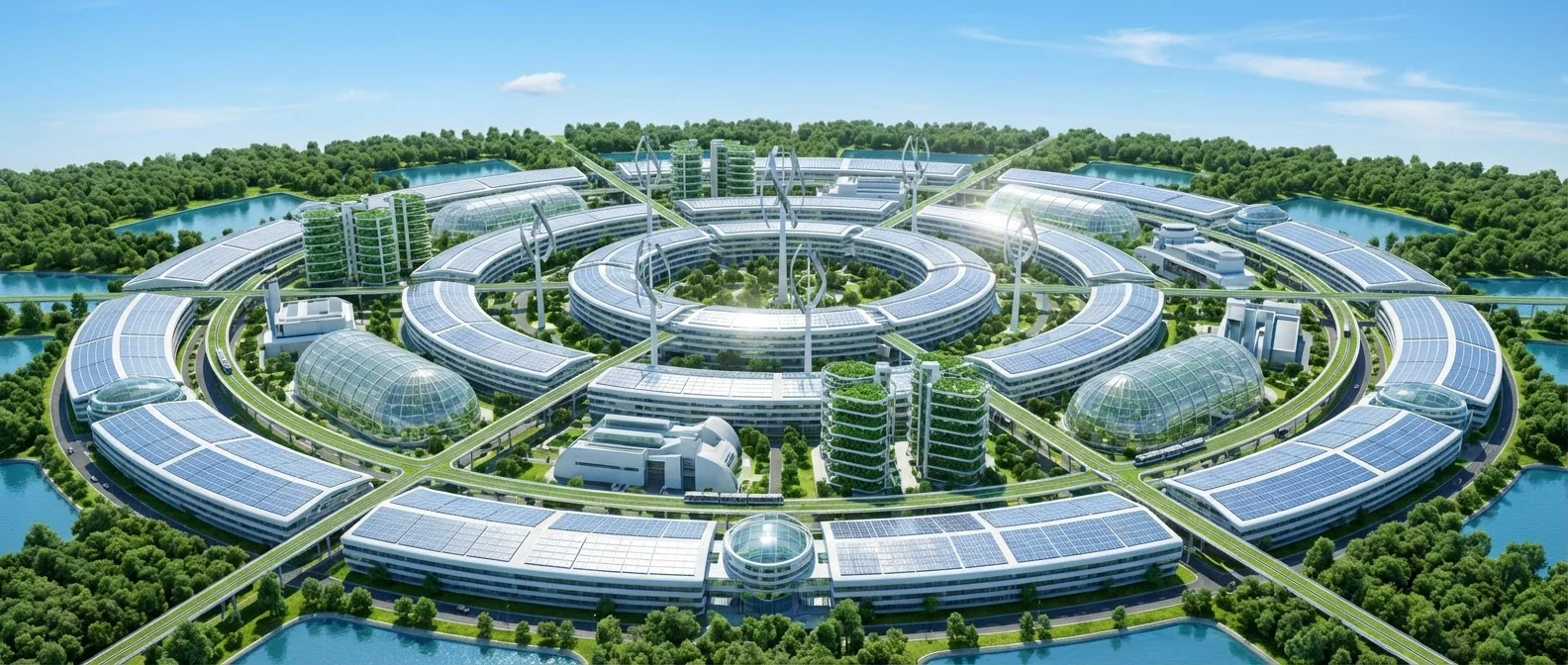
Imagine a city that generates all the electricity it consumes, feeds its residents with locally grown produce, transforms every piece of “waste” into raw material, and breathes through thousands of trees instead of car exhaust. This isn't utopia — it's the declared goal of hundreds of metropolises worldwide, from Copenhagen to Adelaide, racing to hit zero waste and 100% renewable energy by 2050.
Why Self-Sufficiency Is Necessary
Cities occupy just 3% of Earth's land surface, yet consume 60-80% of global energy and are responsible for over 70% of carbon dioxide emissions. According to the UN Environment Programme (UNEP), most cities today face environmental degradation, traffic congestion, and inadequate basic services — water supply, sanitation, waste management.
United Nations Sustainable Development Goal 11 (SDG 11) explicitly defines a sustainable city as one that promotes inclusive, green, and economically healthy development. The European Investment Bank (EIB) has already invested over €150 billion over the past eight years in city improvement projects — transportation, energy efficiency, sustainable housing, education, and healthcare.
Self-sufficiency doesn't mean isolation. It means a city can meet its basic needs — energy, food, water, materials management — without depleting non-renewable resources. This requires a radical rethinking of how we design, build, and operate urban environments.
Zero Waste: From Landfills to Circular Economy
The “zero waste” philosophy isn't simply about recycling. According to the Zero Waste International Alliance (ZWIA), zero waste means "complete resource recovery with no discharges to land, water, or air that threaten the environment or human health." It's about a total reorganization of how materials flow through society.
The World Bank estimated in 2012 that urban populations produced 1.3 billion tons of municipal waste annually, a figure expected to reach 2.2 billion by 2025. Only 9% of global plastic is recycled. The rest ends up in landfills, oceans, and incinerators.
🔄 Cradle-to-Cradle vs Cradle-to-Grave
The linear model of “extraction → manufacturing → landfill” (cradle-to-grave) is gradually being replaced by the circular “cradle-to-cradle” logic: every material is designed from the start to return to the industrial or biological cycle. William McDonough articulated this philosophy: one organism's “waste” becomes nutrients for another — exactly as in nature.
Bea Johnson's 5Rs — Refuse, Reduce, Reuse, Recycle, Rot — form the foundation for individual and collective action. Johnson herself reduced her four-person family's annual trash to a single glass jar.
Pioneer Cities Around the World
From Copenhagen's bike highways to Kamikatsu's zero-waste sorting, cities worldwide are ditching theory for results.
🇩🇰 Copenhagen, Denmark
Copenhagen's 2025 Climate Plan aims to become the world's first net-zero carbon major city. Over 50% of residents already commute by bicycle thanks to hundreds of kilometers of segregated bike lanes, while the Cycle Super Highways ensure fast, car-free commuting.
🇦🇺 Adelaide, Australia
South Australia went from zero wind power in 2002 to 26% of electricity generation by 2011. Meanwhile, its Zero Waste strategy achieved a recycling rate of nearly 80%, diverting 4.3 million tons of materials from landfills. Since 2009, non-reusable plastic bags have been banned — preventing 400 million plastic bags annually from entering the waste stream.
🇦🇪 Masdar City, UAE
Masdar City in Abu Dhabi was designed to be fully self-sufficient: 100% solar energy, zero emissions, zero waste. A Group Rapid Transit network replaces cars, while pedestrian walkways and plazas are integrated into every neighborhood following New Urbanism principles.
🇰🇷 Songdo IBD, South Korea
Songdo in Incheon features a central park irrigated with seawater, a subway line, bicycle lanes, rainwater catchment systems, and a pneumatic waste collection system. 75% of the city's construction waste was recycled.
🇯🇵 Kamikatsu, Japan
The small town of Kamikatsu recycles 80% of its waste at the Zero Waste Center — a building made from recycled materials. Residents sort their garbage into 45 different categories.
Energy: 100% Renewable or Nothing
A self-sufficient city cannot depend on fossil fuels. Rooftop solar panels, urban wind farms, biomass from sewage, and Zero-Energy Buildings form the main pillars. Denmark conducted two comprehensive studies (IDA Climate Plan 2050 and Danish Commission on Climate Change Policy 2011) demonstrating the feasibility of running the entire country on 100% renewable energy by 2050.
Freiburg in Germany — the “green capital” — houses the Vauban district, where every building meets low energy consumption standards and the entire neighborhood was designed car-free. In neighboring Rieselfeld, homes generate more energy than they consume.
Biomass proves particularly effective in Eco-Industrial Parks. Unlike solar and wind energy which depend on weather conditions, biomass offers steady output — converting urban sewage and organic waste into energy.
Zero-Emission Transportation
The transport sector accounts for approximately 24% of global CO₂ emissions. The self-sufficient city of the future rewrites mobility rules in three key ways: better urban planning, modal shift, and more efficient existing technologies.
🏙️ The 15-Minute City
Paris is experimenting with the idea that every basic need — work, shopping, schools, healthcare, entertainment — is within a 15-minute walk or bike ride. Melbourne implements the “20-minute neighbourhood.” This design eliminates the need for cars while simultaneously reducing emissions and commute times.
Barcelona's Superblocks transform nine-block areas into unified pedestrian neighborhoods, targeting a 20% reduction in traffic and freeing 60% of road space for parks, farmers' markets, and bike lanes. Madrid banned all non-resident vehicles from its downtown in 2018, while Oslo reduced traffic by 4-7% by introducing congestion charges.
"Smart mobility" (Mobility as a Service — MaaS) uses algorithms to route public transit in real time based on demand. Israel is already experimenting with a public-private partnership that gives citizens flexible transport choices through a mobile app.
Urban Agriculture and Food Autonomy
A city that feeds its residents dramatically reduces “food miles” — the distance food travels from field to fork. Urban farming integrates into the urban ecosystem: it uses urban workers, converts organic waste into compost, and directly supplies local consumers.
"Tiny forests" — a new concept in urban vegetation — grow 10 times faster and 30 times denser than conventional forests, with 100 times greater biodiversity, on very small patches of land. Fully organic, they're planned with precision: the ratio of shrub layer, sub-tree layer, tree layer, and canopy is determined before planting.
"Street and residential trees can reduce near-ground air temperatures by as much as 12°C — with the strongest cooling effects observed in hot, dry climates."
Adelaide launched a program in 2003 to plant 3 million native trees across 300 sites, aiming to reduce CO₂ emissions by 600,000 tons annually — while simultaneously improving air quality, water quality, and biodiversity.
Green Architecture and Regenerative Design
Buildings account for approximately 40% of global CO₂ emissions, 14% of water consumption, and 60% of waste production. LEED (Leadership in Energy and Environmental Design) certification recognizes holistic sustainable design across key areas: sustainable sites, water efficiency, energy and atmosphere, materials and resources, and indoor environmental quality.
Regenerative architecture goes one step further: it doesn't settle for reducing harm but aims to restore ecosystems. These buildings self-sustain — generating their own energy, managing their water, composting their waste, and creating opportunities for rooftop urban farming. A prime example: converting abandoned industrial spaces into green parks, like New York's High Line.
Green roofs (eco roofs) improve air quality, regulate temperature, and reduce stormwater runoff. Combined with passive radiative cooling, natural ventilation, and water features, they combat the “heat island effect” that makes urban centers up to 6°C warmer than surrounding rural areas.
Social Justice: Sustainability for All
A self-sufficient city cannot leave anyone behind. Historically, landfills and polluting facilities are disproportionately placed near low-income and non-white populations. Studies show that surface temperatures in these neighborhoods are significantly higher — a legacy of discriminatory housing policies.
For this reason, SDG 11 emphasizes “inclusive” sustainability. The United Cities and Local Governments (UCLG) organization has identified 13 global challenges — from demographic change and poverty to urbanization and climate change. Citizen participation in urban planning isn't a luxury — it's a prerequisite.
Obstacles and Criticism
The path toward zero waste isn't easy. Many companies and cities adopt “zero waste” slogans without substantive changes — simply increasing recycling without redesigning product life cycles. The principle of Extended Producer Responsibility (EPR) demands that manufacturers — not consumers — bear the cost of packaging and disposal.
Moreover, ambitious projects like Saudi Arabia's NEOM (a 26,500 sq km city featuring “The Line” — a 170 km linear smart city) face criticism for greenwashing, authoritarian implementation, and questionable feasibility. Shanghai's Dongtan Eco-City — which was supposed to house 50,000 residents by 2010 — was abandoned, while China's Huangbaiyu ended up with most of its “green” homes unoccupied.
"Sustainability isn't just about reducing harm. It's about regenerative design — systems that give back to the environment more than they take."
The Self-Sufficient City of 2050
Concretely, what will a fully self-sufficient city look like by mid-century? Experts sketch a picture combining the best elements of pioneering cities:
Energy: Solar panels on every roof, small wind turbines on buildings, community battery storage. Biomass from organic waste powers district heating. Zero or positive energy buildings throughout.
Food: Vertical farms in every neighborhood, community gardens in parks, weekly farmers' markets. Organic scraps are composted and feed back into the farms — a closed loop.
Transport: Electric mass transit, extensive bike lanes, autonomous on-demand mini-buses, cars only at peripheral hubs. Everything within a 15-minute walk.
Materials: Pneumatic waste collection systems (like Songdo), automated sorting into 40+ categories (like Kamikatsu), industrial symbiosis in Eco-Industrial Parks where one company's waste becomes another's raw material — following the Kalundborg model in Denmark.
Nature: At least 20% green space, urban forests, green roofs, water features. The city “breathes” instead of overheating.
What We Can Do Today
The sustainable city isn't built by governments alone. Bea Johnson started from her kitchen. The ZWIA was founded in 2002 by a handful of activists. Taiwan changed its policy because public opinion pressured businesses to transform their material usage patterns. Change starts locally — with every act of “refuse, reduce, reuse” multiplying outward.
Self-sufficient cities aren't utopia. They are a mathematical necessity on a planet with finite resources and 10 billion inhabitants by 2050. The technology exists, the models work, the pioneer cities show the way. All that's missing is political will — and our collective determination.