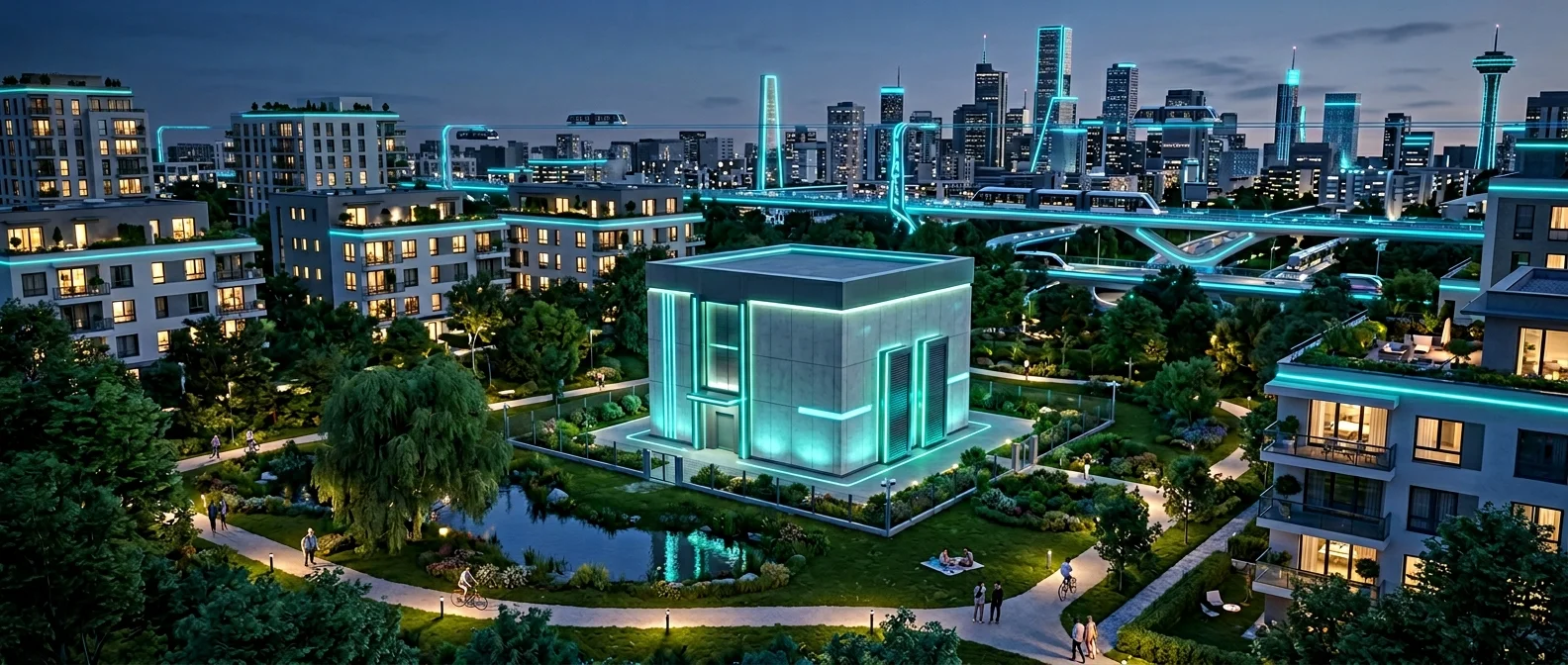
Picture a nuclear reactor the size of a classroom. Built entirely inside a factory, shipped by truck, capable of powering 100,000 homes. This isn't science fiction — it's SMR technology (Small Modular Reactors), and units are already under construction on three continents.
📖 Read more: Thorium: The Reactors Changing Everything
What Are SMRs — and Why Talk About Them Now
SMR stands for Small Modular Reactor. According to the International Atomic Energy Agency (IAEA), an SMR produces up to 300 MW(e) per unit — roughly one-third the output of a conventional nuclear plant. The fundamental difference: instead of being built on-site over 10-15 years, an SMR is manufactured in a factory setting and shipped ready for installation.
Right now, the IAEA catalogues more than 80 SMR designs at various stages of development worldwide. Four reactors are in advanced construction: in Argentina (CAREM-25), China (ACP100 and HTR-PM), and Russia (KLT-40S aboard the floating plant Akademik Lomonosov, already operational). Construction is accelerating.
Factory Construction: The Big Shift
Conventional nuclear plants are built on-site. That means runaway delays, ballooning costs, and decades before the first watt flows. Final costs for modern projects like Hinkley Point C in Britain exceed £35 billion. SMRs flip this equation.
Each modular unit is manufactured in a controlled factory environment with industrial precision and strict quality control. It's then shipped to the installation site — even to remote areas, industrial zones, or islands. Construction time drops dramatically: 3-4 years instead of 10-15.
Scale on demand: A plant can start with a single SMR module and add units as electricity demand grows. This modular approach cuts upfront investment risk.
Safety: Passive Systems Without Human Intervention
After Fukushima, every nuclear conversation starts — rightly — with safety. SMRs work differently. Most designs incorporate passive safety mechanisms: systems that function without electricity, without pumps, without human commands.
In an anomaly scenario, the reactor shuts down automatically using natural laws — gravity, natural coolant circulation, thermal inertia. The IAEA notes that the “enhanced and inherent safety features” of SMRs make them suitable even for sites near populated areas.
The smaller core size matters too: less nuclear fuel means a smaller thermal load in extreme scenarios, faster cooling, and easier crisis management.
Who's Building SMRs — The Players of 2026
NuScale Power (USA)
NuScale Power holds the first SMR to receive full Design Certification from the U.S. Nuclear Regulatory Commission (NRC). Each NuScale module produces 77 MW(e), while a full plant can house up to 12 modules. The company had planned a pilot project at Idaho National Laboratory in partnership with UAMPS, though recent cost revisions created uncertainty in the timeline.
Rolls-Royce SMR (UK)
Rolls-Royce is developing a 470 MW(e) design tailored specifically for Britain's needs. The UK government actively supports the programme, and the company targets operation by the early 2030s. Each plant would occupy just 10 hectares — less than two football pitches.
BWRX-300 (GE Hitachi)
The BWRX-300 is a 300 MW(e) boiling water reactor promising construction costs 50% lower than today's nuclear stations. Canada has already approved the design, while Poland and Sweden are actively evaluating it.
📖 Read more: AI Gondolas: Autonomous Boats on Water
Coolants: Beyond Water
Traditional reactors use light water as coolant. Several SMR designs explore alternative coolants, opening new possibilities:
- Molten Salt: Operates at lower pressure, reducing explosion risk. Companies like Terrestrial Energy and Kairos Power are developing such designs.
- Liquid Metal: Lead or sodium as coolant, enabling higher operating temperatures — ideal for industrial heating.
- Gas (Helium): Gas cooling with no risk of radioactive water leaks. China's HTR-PM uses helium and is already operating commercially.
The U.S. Department of Energy funds both water and alternative coolant designs, betting that different applications need different solutions.
Applications Beyond Kilowatts
SMRs do more than generate electricity. Small reactors can serve:
- Desalination: Producing drinking water in arid regions using reactor heat.
- District heating: Supplying heat to urban networks, replacing natural gas boilers.
- Hydrogen production: Water electrolysis powered by nuclear energy — green hydrogen without wind turbines.
- Remote communities: Powering mines, islands, or Arctic bases currently dependent entirely on diesel.
The Challenges: Cost, Waste, and Public Perception
The economics tell a different story. In November 2023, NuScale cancelled its pilot project in Idaho after costs rose from $5.3 to $9.2 billion — a sign that even small modules face the same economic hurdles as large reactors.
Nuclear waste remains an issue. While SMRs produce smaller quantities per unit, no design eliminates radioactive residues entirely. Final storage of spent fuel — for thousands of years — remains an open technical and social problem.
Public opinion complicates the picture. In Europe, the word “nuclear” triggers reactions. Germany shut down its last reactors in 2023. In seismically active countries, proximity to densely populated areas adds further complexity to an already charged debate.
The Road Ahead: 2026-2035
The sector keeps advancing. Rolls-Royce is proceeding in Britain. Canada backs GE Hitachi's BWRX-300. China already operates the HTR-PM. France is planning the Nuward. South Korea is developing the SMART.
The DOE estimates first commercial units will enter operation in the late 2020s or early 2030s. Licensing processes are becoming more flexible: the IAEA's SMR Regulators' Forum encourages international harmonisation of standards, cutting through red tape.
The race is on: can SMRs cut costs fast enough to beat solar panels and wind turbines? Factory construction could make nuclear competitive again — without the decade-long construction sites and budget blowouts.