📖 Read more: Smart Highways That Charge EVs While Driving
Why Sodium Instead of Lithium?
The idea isn't new. The first sodium batteries were developed in the 1970s and 1980s, but lithium's commercial success in the 1990s pushed them to the sidelines. The revival came in the early 2010s, when lithium prices skyrocketed and the search for alternatives became urgent. Patent filings surpassed academic publications around 2020 — a clear signal that the technology was maturing toward commercial use.
Sodium's core advantage is abundance. It's the sixth most common element on Earth and exists in enormous quantities in seawater. Lithium, by contrast, concentrates in just a few regions — primarily Chile, Australia, and China — and its extraction damages ecosystems. Additionally, many sodium battery types don't require cobalt, nickel, or copper, metals with problematic supply chains and high costs.
How Do They Work?
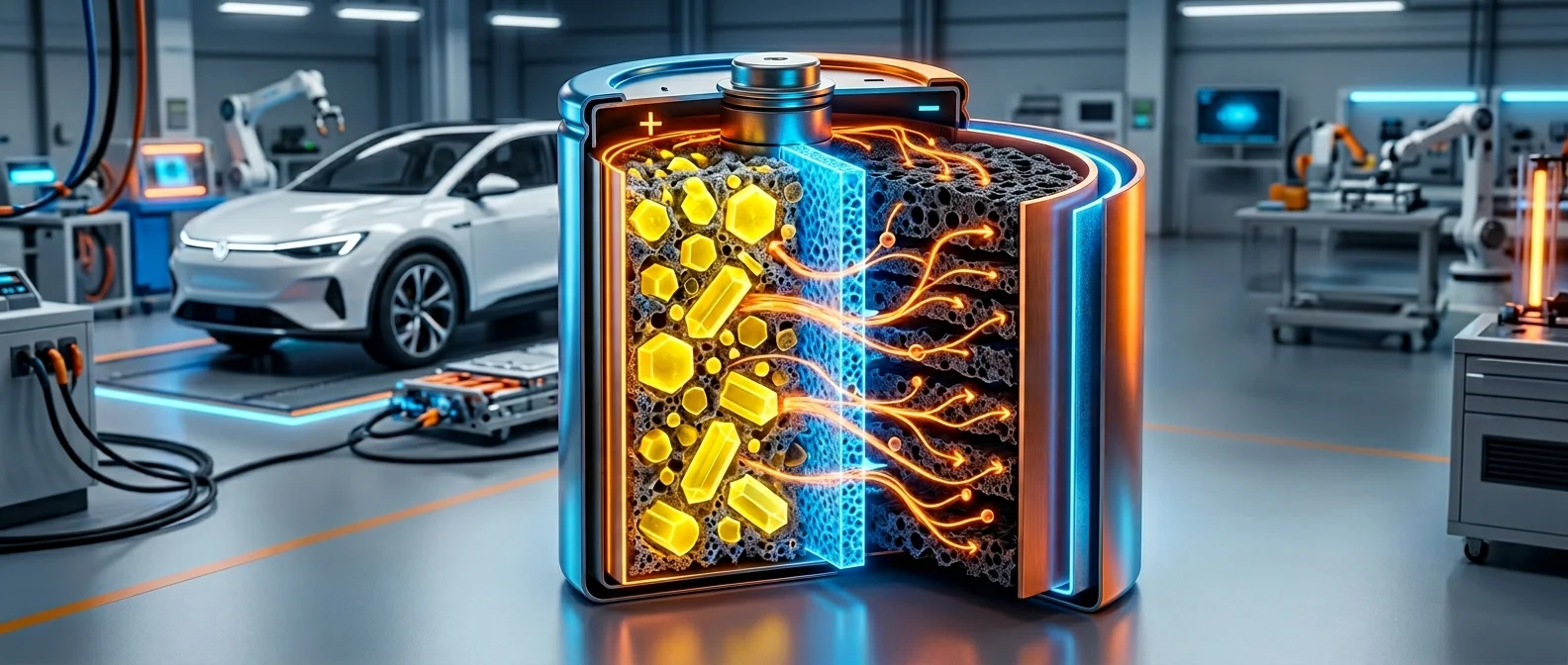
The operating principle closely resembles lithium-ion batteries. During charging, sodium ions move from the cathode to the anode through an electrolyte while electrons flow through the external circuit. During discharge, the reverse occurs. The key difference: the sodium ion (116 pm) is notably larger than the lithium ion (90 pm). This means slower intercalation kinetics, but also a significant advantage — there's no cation mixing in the cathode lattice, which allows the use of cheap materials like iron and manganese instead of expensive nickel and cobalt.
The anode typically uses hard carbon, a porous material capable of storing sodium at approximately 300 mAh/g — comparable to graphite in lithium batteries. The cathode can be based on transition metal oxides, polyanionic compounds, or Prussian blue analogues, each offering different performance characteristics and costs.
The Big Comparison: Na-ion vs Li-ion
Let's talk numbers. Sodium battery energy density currently ranges from 75-175 Wh/kg, while lithium NMC reaches 120-260 Wh/kg and LFP hits 175-200 Wh/kg. At first glance, lithium appears superior — but the picture is changing rapidly.
Cost per kWh (2025): Sodium batteries target a theoretical cost of $40-77/kWh, while LFP sits at $81/kWh and NMC at $128/kWh. A 2025 IRENA report estimates Na-ion cell costs could drop to $40/kWh.
Cycle life: CATL reports over 10,000 charge-discharge cycles for its Naxtra batteries — enough for up to 5.8 million kilometers in an electric vehicle.
Temperature: Na-ion batteries operate from -20°C to 60°C, with CATL demonstrating discharge even at -40°C, retaining 93% capacity at -30°C.
Round-trip efficiency reaches 92% — comparable to or slightly below lithium-ion. Another advantage: sodium batteries can be transported in a fully discharged state (0V), eliminating transport risks — something impossible with lithium batteries.
CATL: The Giant Enters the Game
The world's largest battery manufacturer, China's CATL, announced its first-generation sodium battery in 2021, claiming an energy density of 160 Wh/kg with mass production promised by 2023. Chery Automobile became their first customer.
In October 2024, CATL unveiled Freevoy, a hybrid battery pack combining sodium and lithium cells. Offering over 400 kilometers of range, 4C fast charging, and operation at -40°C, it targeted hybrid vehicles. By 2025, around 30 different vehicle models were expected to incorporate this pack.
CATL is already partnering with Li Auto to integrate sodium batteries into EVs, while a collaboration with Changan Automobile plans a sodium-ion EV launch in mid-2026 — a milestone that could reshape the market.
📖 Read more: AI Legal Rights: Should Robots Have Them?
China: Full-Speed Ahead
China dominates sodium batteries just as it dominates lithium. BYD invested $1.4 billion in a sodium battery plant in Xuzhou, with 30 GWh annual production capacity. HiNa Battery Technology, a Chinese Academy of Sciences spin-off, placed the first sodium batteries in an electric test car in February 2023 — the Sehol E10X.
Farasis Energy built the first serial-production A00-class EV with a sodium battery — the JMEV EV3, achieving 251 kilometers of range. And JAC Group delivered the first Na-ion EVs in early 2024, equipped with a 23.2 kWh pack and 230 kilometers of range.
In August 2023, the first grid-scale sodium battery entered commercial operation in China: a 5 MW/10 MWh system, the first commercial proof that grid storage could operate without lithium.
Europe, India, and the Rest of the World
Europe is scrambling to keep up, with mixed results. Sweden's Northvolt announced a sodium battery exceeding 160 Wh/kg, designed for energy storage stations. However, the company filed for bankruptcy in November 2024, leaving a gap in the European market. France's TIAMAT, a CNRS spin-off, develops cylindrical 18650 cells with 100-120 Wh/kg and over 5,000 cycle life, and in October 2023 commercialized the first consumer product using a sodium battery — an electric screwdriver.
Altris AB, a spin-off from Uppsala University, is developing a Prussian blue cathode with non-flammable electrolyte. Germany's BASF and Mercedes-Benz invested €1.3 million in a joint program, while Australia's Altech is building a 120 MWh facility in Germany. Estonia's Freen launched a 10 kWh residential sodium battery for solar and wind integration.
In India, KPIT Technologies unveiled the country's first Na-ion technology in December 2023, promising a 25-30% cost reduction compared to lithium batteries, with 3,000-6,000 cycle life. Faradion, a subsidiary of Reliance Industries, develops pouch cells achieving 160 Wh/kg.
The Remaining Obstacles
It's not all rosy. By 2025, sodium battery packs remained 30% more expensive than LFP due to lack of production scale. Energy density, while improving rapidly, remains lower — meaning heavier batteries or shorter range. Natron Energy in the US, which had opened a $40 million facility in Michigan in April 2024, ceased all operations in September 2025 due to funding challenges.
Safety concerns also exist: certain sodium battery types with carbon electrodes show thermal runaway risks above 50% state of charge. Aqueous electrolytes solve this problem but dramatically reduce voltage and energy density.
The Future: What's the Realistic Picture?
Sodium batteries won't fully replace lithium — at least not in the immediately foreseeable future. Premium long-range EVs will stick with lithium's superior energy density. But sodium targets a different market: grid storage, city cars, two-wheelers, and home batteries where cost trumps weight.
In January 2025, BYD unveiled electric motorbikes with sodium batteries. In February 2026, CATL and Changan announced the first EV with a pure sodium-ion battery. If prices truly drop to around $40/kWh, it will pave the way for electric cars under $20,000 — a massive shift for EV affordability.
Research progress is striking. In July 2024, researchers at the University of Chicago and UC San Diego developed an anode-free solid-state sodium battery — cheap, safe, and fast-charging. In India, researchers created a Na-ion battery that charges to 80% in just 6 minutes with 3,000+ cycle life. And organic cathode technology TAQ achieved 606 Wh/kg energy density at the electrode level — a number suggesting enormous room for improvement.
The battle between sodium and lithium isn't zero-sum. It's about expanding the pie — more options, less dependence on scarce materials, and ultimately cheaper energy for everyone. The coming decade will determine whether sodium batteries remain a niche technology or become the backbone of our energy future.
Reuters — China's CATL launches new sodium-ion battery brand (April 2025)
Electrek — The world's first sodium-ion battery EV (February 2026)
Energy Storage News — World-first grid-scale sodium-ion battery project (August 2023)